Measured acoustic performance
NRC absorption coefficient: how to really read a panel's performance.
When a manufacturer announces an NRC of 0.85, what are you actually buying? A single number here sums up all of a material's absorbing power, across the frequencies that truly count, those of the voice. To compare two panels without getting it wrong, you need to know where this number comes from, how it is measured and how it differs from the European alpha w. ACOUSTELIO gives you the reading grid, figures and standards in hand.
The definition
The NRC, a single number to sum up absorption.
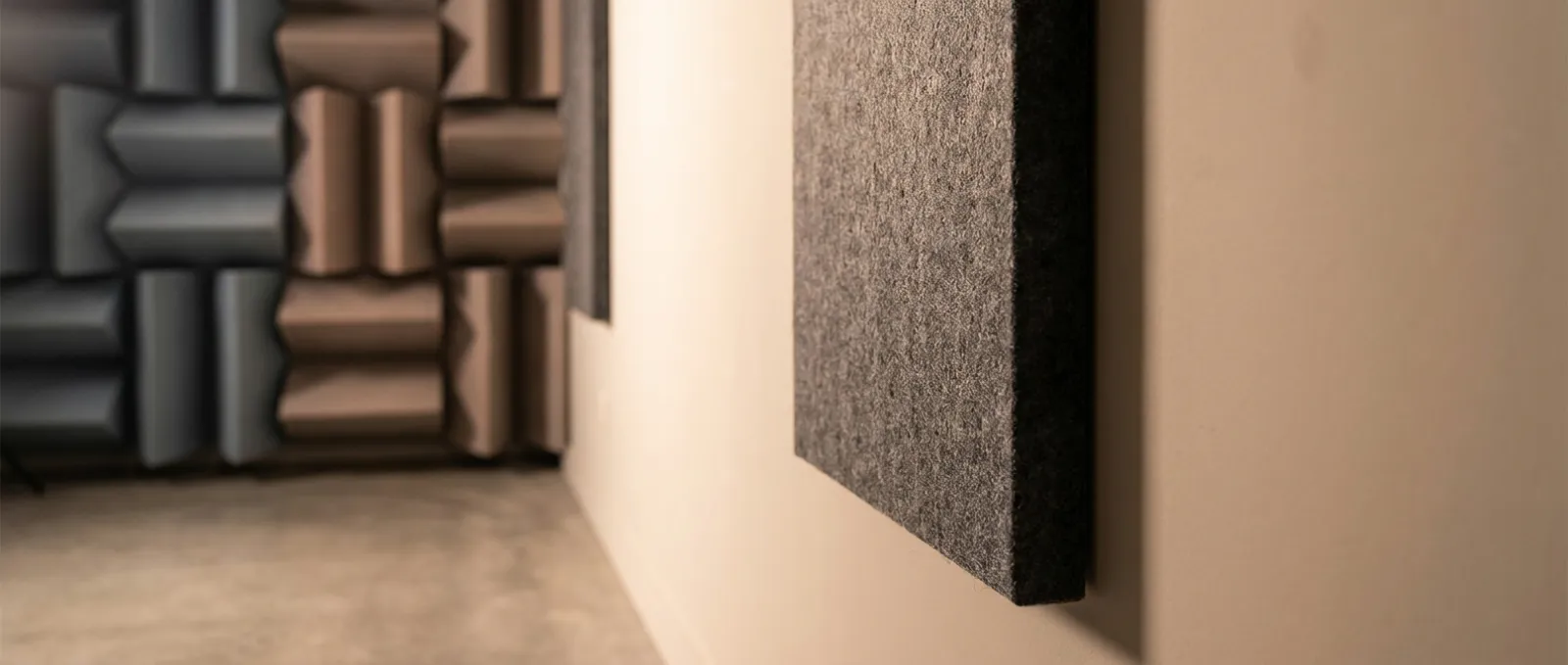
NRC stands for Noise Reduction Coefficient. It is a single index, designed to quickly compare the absorbing power of different materials without having to comb through an entire curve. You get it by averaging the absorption coefficients measured at four precise frequencies: 250, 500, 1000 and 2000 Hz. The result is rounded in steps of 0.05.
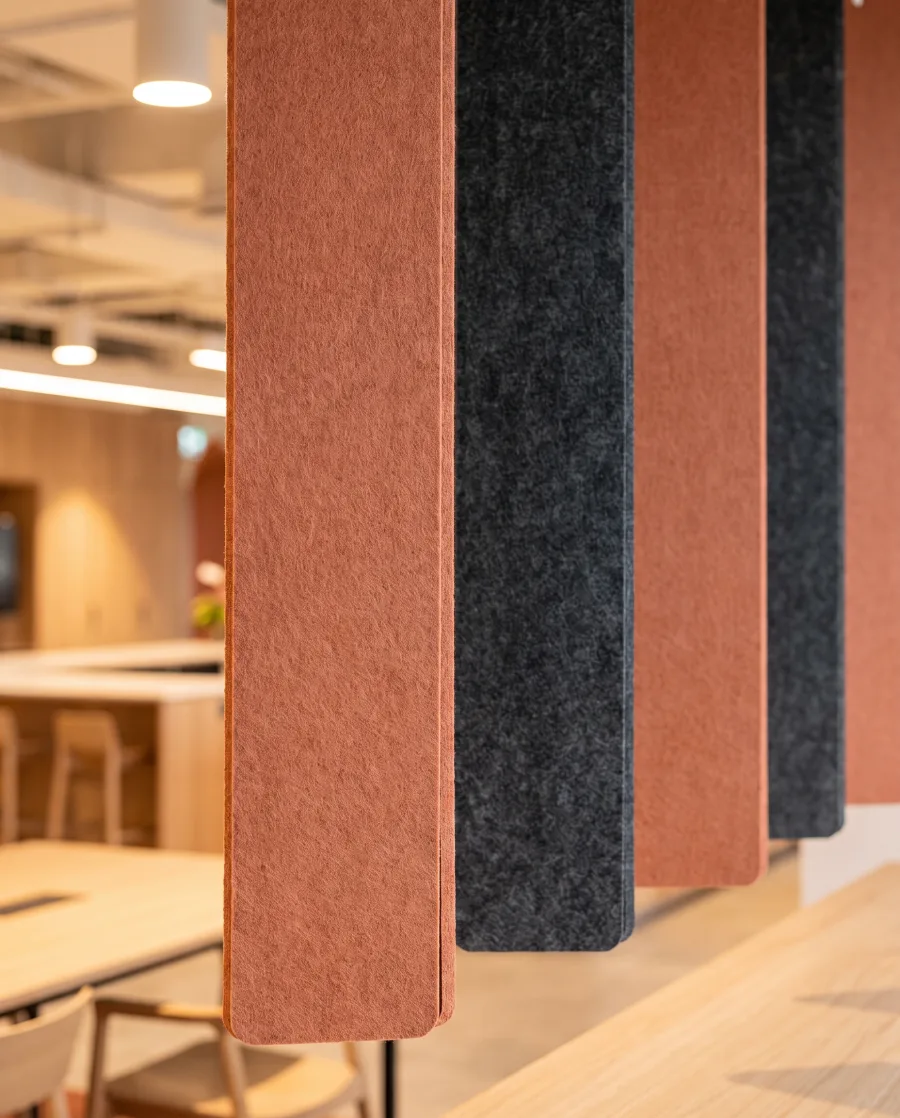
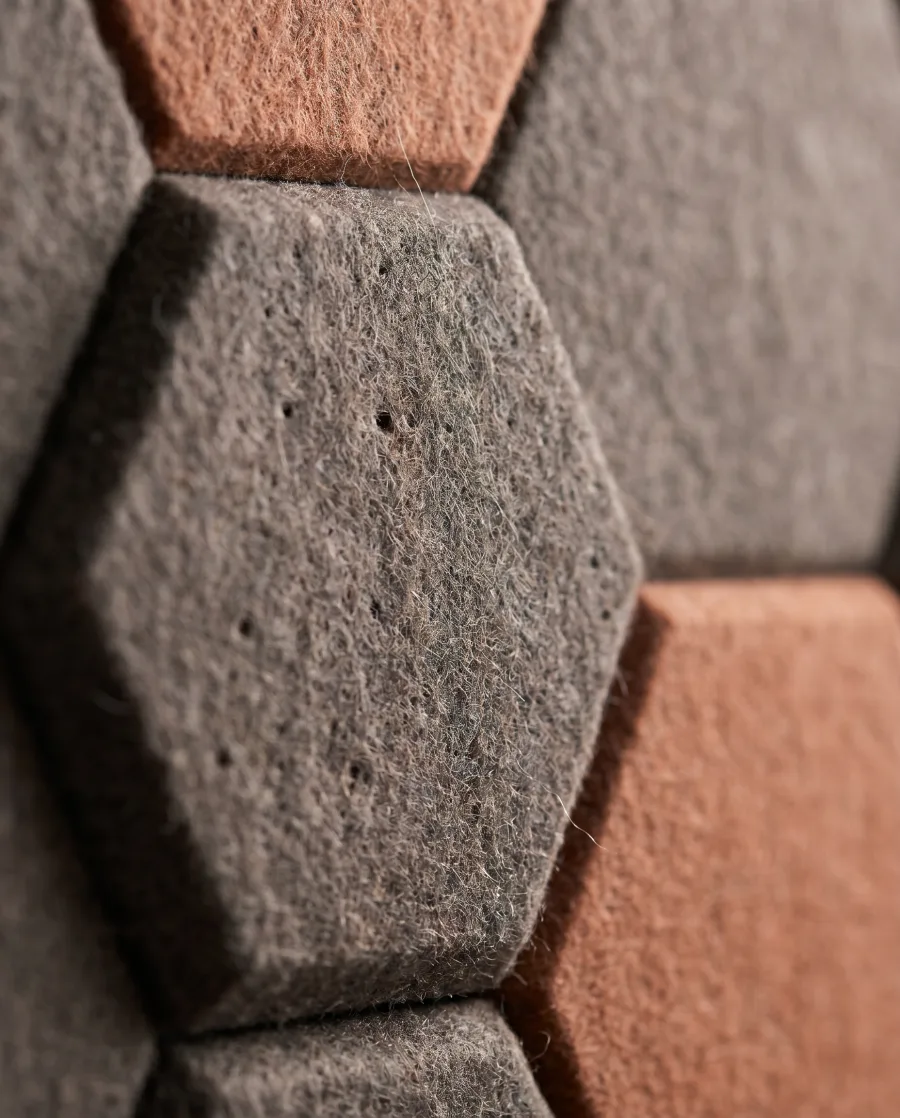
The scale runs from 0 to 1, and it reads like a percentage of sound energy absorbed. An NRC of 0 describes a perfectly reflective wall: all the sound bounces back, nothing is absorbed. Think of glass, tile, smooth concrete. An NRC close to 1 describes a material that swallows almost all the sound that hits it. Our PET felt panels show an NRC of 0.85, or about 85% of the incident sound absorbed across this range.
An honest technical detail: you sometimes read coefficients that exceed 1 in laboratory tests, because of edge effects from the sample. The NRC, though, is capped at 1 by convention, precisely to remain a simple, comparable benchmark.
The benchmark
The 0 to 1 scale, from glass to felt.
Four levels to place any surface, from the sound mirror to the high-performing absorber.
0 to 0.15
Hard, reflective surfaces: glass, concrete, tile. Sound bounces back almost entirely and the room echoes.
0.30 to 0.50
Partial absorption: thick carpet, heavy curtains, certain tiles. A real but limited effect on reverberation.
0.55 to 0.75
Common good absorbers: standard acoustic ceiling tiles, foams. Enough in many cases.
0.80 to 1
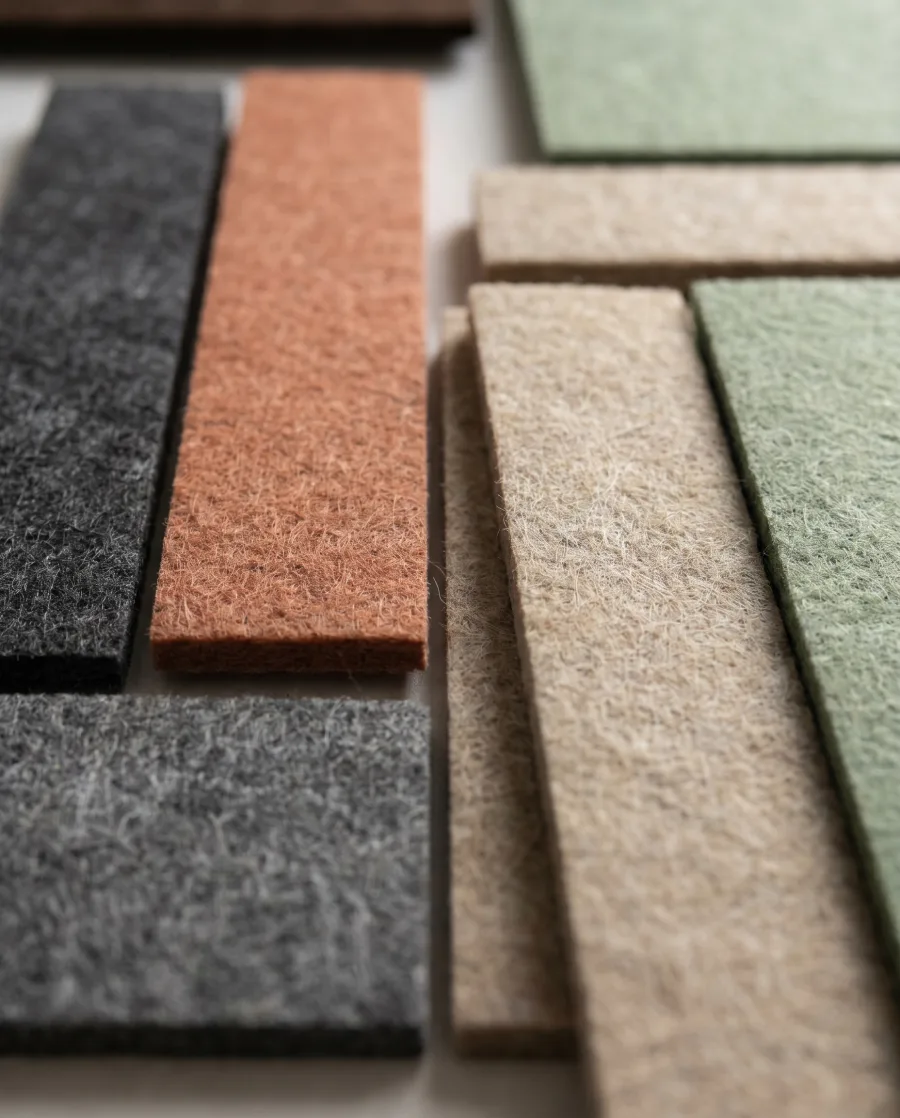
High-performing absorbers. Our PET felt at NRC 0.85 sits here, where the effect becomes clearly noticeable.
NRC versus alpha w
Two indices, two conventions, close values.
On technical datasheets, you come across two numbers for the same quality: the NRC and the alpha w (αw). Nothing to get lost in once the logic is clear. The NRC is North American in origin. It is a raw arithmetic mean of the coefficients at 250, 500, 1000 and 2000 Hz. Simple, direct, widely used on the international market.
The alpha w comes from the European standard ISO 11654. Its method is finer: instead of averaging, you overlay the measured absorption curve on a stepped reference curve, then deduce a single value, rounded in steps of 0.05. The alpha w often comes with an absorption class from A to E, where A is the best. It is the index favoured by specifiers and engineering firms in Europe.
In practice, both give consistent orders of magnitude for the same product. A good absorber rated NRC 0.85 lands at the top of the alpha w scale. Knowing both simply avoids comparing an American apple to a European pear on two datasheets.
Comparison
NRC or alpha w: which says what?
The two indices both describe absorption, but they are not calculated the same way. Here is how to read them.
Need a quantified acoustic target?
We start from your volume and use to aim for a precise reverberation time, then size the absorbing surface.
Request my free quoteThe measurement
Reverberation chamber, ISO 354 and Sabine's legacy.
Where does an absorption coefficient really come from? From a standardised test in a reverberation chamber, framed by the ISO 354 standard. The principle goes back to Wallace Sabine, the physicist who founded room acoustics at the end of the nineteenth century by linking a room's reverberation to the amount of absorbing material it contains.
The method is elegant. You first measure the reverberation time of the empty chamber, its walls deliberately very reflective. You then place a known surface of the material to test inside, and measure again. With the sample having absorbed part of the energy, the sound decays faster. From this gap in reverberation time, Sabine's formula lets you work back to the absorption coefficient, frequency by frequency.
The result is a complete curve. The NRC extracts an average over four frequencies from it, the alpha w derives a weighted value. But both rest on the same laboratory measurement, comparable from one manufacturer to another. That is what separates a proven figure from a marketing claim.
The physical common sense
Why target voice frequencies?
Here is the point that makes the NRC relevant for an office or a restaurant. The human voice and speech intelligibility sit roughly between 250 and 4000 Hz. It is this band that disturbs: the hubbub, the conversation next door you understand despite yourself, the speaker you can no longer follow in a room that echoes.
And the four NRC frequencies, 250, 500, 1000 and 2000 Hz, fall right in the middle of it. It is no accident: the index was designed to judge absorption where it counts for speech comfort. A material that performs at these frequencies treats exactly the noise that steals attention. PET felt excels at these mids and highs, which explains the clear effect on concentration you feel once the panels are in place.
Conversely, deep low frequencies demand much more thickness of material. For an open-plan office or a meeting room, that is not the priority: you first treat the voice, where the perceived comfort tips. So the NRC is an excellent indicator for these commercial spaces.
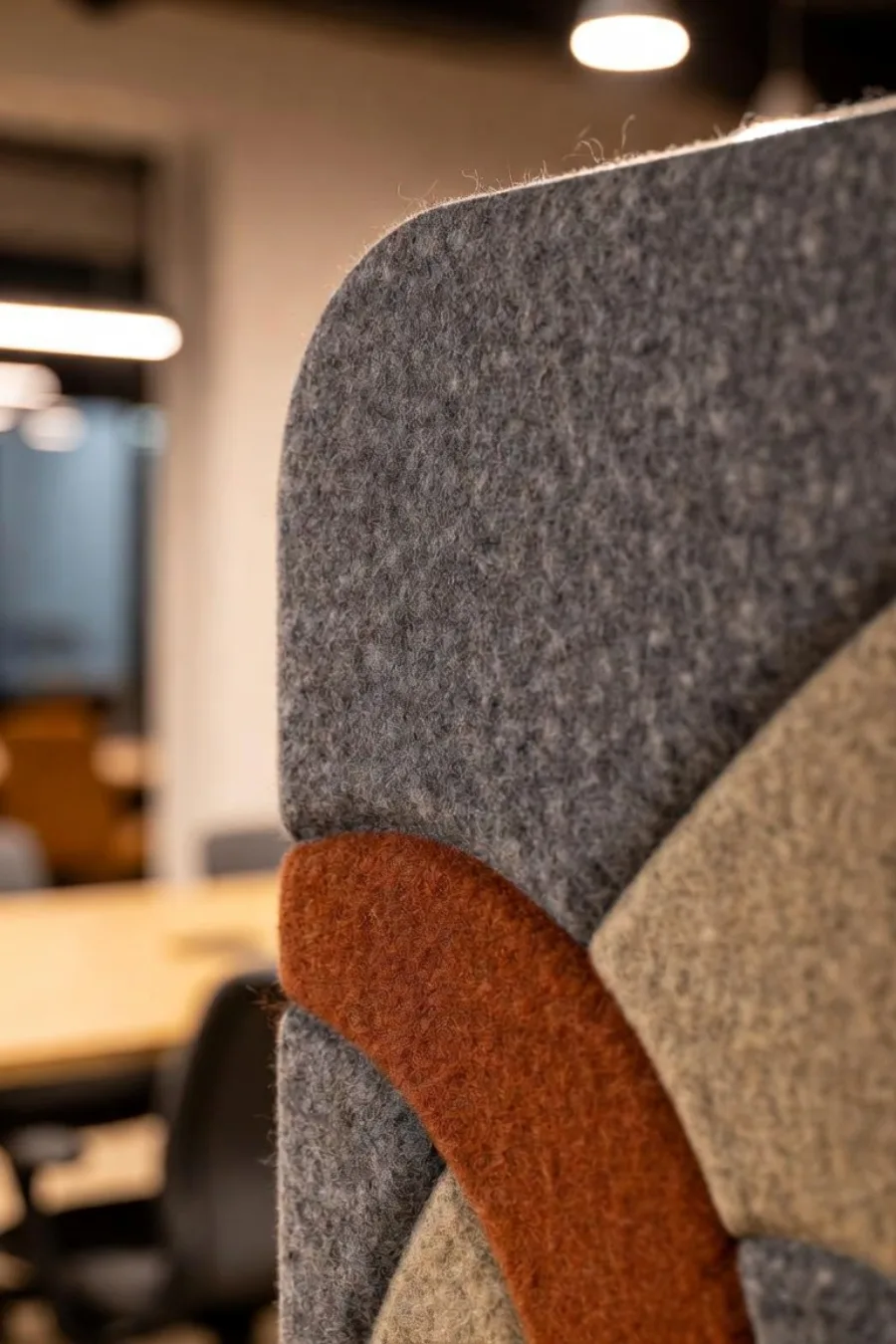
The levers
Thickness and air gap: two decisive settings.
A panel's absorption coefficient does not depend only on its material. Two layout parameters shift it, and you need to know them so you neither overpay nor undertreat a space.
Thickness. The thicker a panel, the better it absorbs low frequencies, because the wave needs to pass through a certain thickness of porous fibre to lose its energy. Across the mids and highs of the voice, a few centimetres are already enough to reach a good NRC. So we match the thickness to what you want to treat.
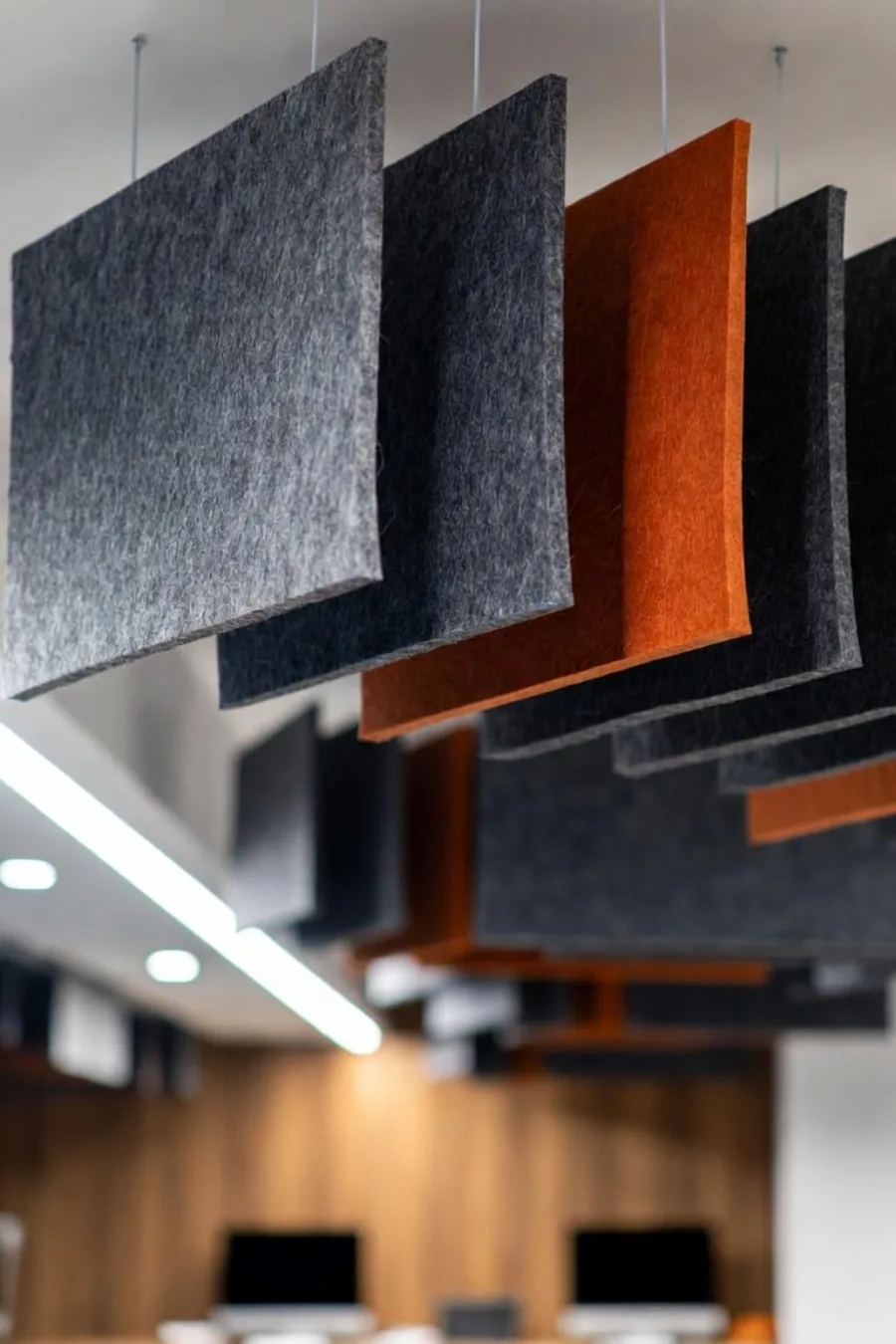
The air gap. By pulling the panel off the wall, or hanging it away from the ceiling, you create an air void behind it. This standoff improves the absorption of lower frequencies, as if you had thickened the panel without adding material. A suspended baffle naturally benefits from this effect on both its faces.
The consequence. The same product does not deliver the same result depending on its installation. This is why we reason in terms of layout, not a simple catalogue: we choose thickness and standoff according to the frequencies to tame in your volume, to aim for the right reverberation time.
The right reflex. Never compare two panels on the NRC alone without looking at the thickness tested and the mounting used in the test. The same material can show different values depending on its installation method in the reverberation chamber.
Frequently asked questions
Absorption coefficient: your questions.
What is the NRC of an acoustic panel?
What is the difference between NRC and alpha w?
How is absorption measured?
What is an NRC of 0.85 worth in practice?
Why do we talk about voice frequencies?
Do thickness and the air gap change absorption?
Certified measurements
The exact figures, measured in the lab.
Absorption measured by SGS in a reverberation room (ISO 354, type E mounting with a 200 mm air cavity). Test reports are supplied with every quote.
| Frequency | 9 mm panel | 12 mm panel |
|---|---|---|
| 125 Hz | 0,39 | 0,41 |
| 250 Hz | 0,69 | 0,77 |
| 500 Hz | 0,95 | 0,92 |
| 1000 Hz | 0,66 | 0,72 |
| 2000 Hz | 0,84 | 0,92 |
| 4000 Hz | 0,93 | 0,99 |
| NRC (overall rating) | 0,80 | 0,85 |
| Surface weight | 1,83 kg/m² | 2,09 kg/m² |
Alpha-s absorption coefficient per octave band. NRC = average at 250, 500, 1000 and 2000 Hz (SGS reports CZIN2502000039CM01 and CZIN2502000038CM01).
A good panel is not judged by eye or by promise. It is judged on a figure measured in a laboratory, across the frequencies of the voice, where discomfort is born.
The benchmark we apply to size every project, from the studio to the whole floor.
An absorption figure can be verified. Make the most of it.
Give us your volume and your use: we aim for a target reverberation time and price the layout, quote within 48 h.
Request my free quote