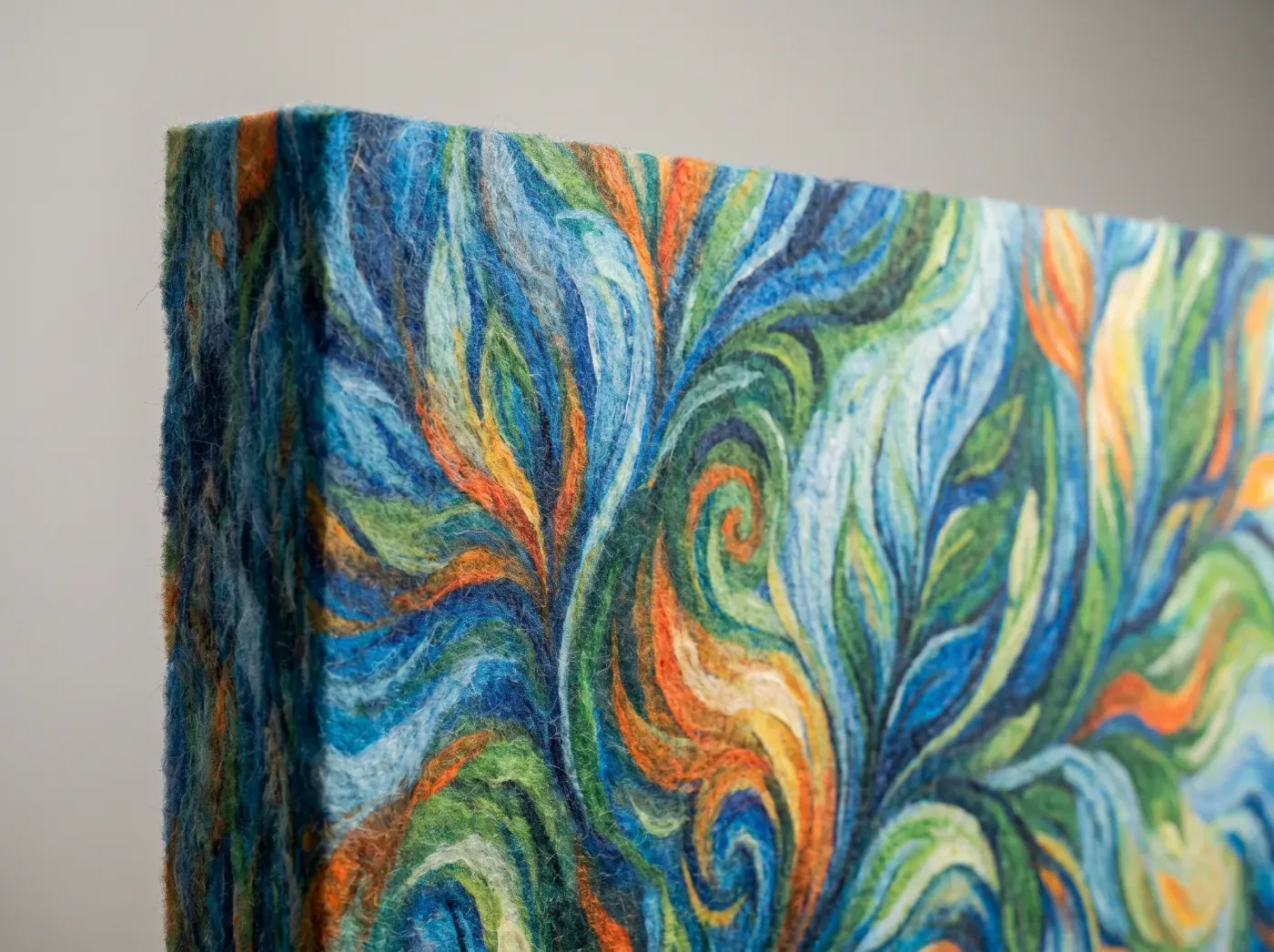
Printing in your colours
Pattern, photo, mural or discreet logo: the wall becomes a visual medium.
See made-to-measure →Product · Wall panels
The PET felt wall panel is the simplest way to bring a room's echo down. Absorbent and decorative at once, it prints in your colours and installs in a few hours. ACOUSTELIO makes them to measure, fire-certified for public buildings.
The principle
A wall panel is not there to soundproof two rooms: it treats sound inside a single space. PET felt is porous: sound waves penetrate it and their energy dissipates instead of bouncing off the hard walls. The result: reverberation drops, voices carry less, the room becomes calmer and more intelligible. The same product goes by other names, acoustic board or wall tile: whatever the label, it is an absorber, not a soundproofing barrier.
Concretely, a wave that hits a bare wall (glass, concrete, painted plasterboard) bounces back almost intact and strikes the wall opposite. It rebounds several times before dying out: it is this chain of reflections that lengthens the sound tail and blurs speech. By inserting an absorbent surface in the wave's path, you break these back-and-forths. The sound is captured at first contact instead of feeding the echo.
This is exactly the answer to the din of offices and restaurants. To understand the difference with soundproofing, see acoustic treatment vs soundproofing.

Performance
PET felt performs particularly well on mid and high frequencies, roughly 600 to 5000 Hz, the band of human speech. That is what makes it ideal against overlapping conversations. Our panels reach an absorption coefficient of NRC 0,85: up to 85 % of the incident noise absorbed.
Why target this frequency band? Because the discomfort of a noisy room rarely comes from the lows: it comes from voices that linger and get understood despite yourself. By capturing the energy between 600 and 5000 Hz, the panel shortens the sound tail where the ear is most sensitive. You keep a living room, without the muffled, dull feel of a badly tuned treatment. Absorption stays measurable: the NRC coefficient is set out on the absorption coefficient data sheet.
A material made partly from recycled PET, light, free of irritating fibres, and fire-certified B-s1,d0. All the evidence in the technical data sheet supplied.
Where to fit them
The wall panel makes the difference where the sound bounces and where people speak.
Small volume, big table, a screen wall: sound bounces and video calls become painful. A few panels at the reflection points make speech crisp on both sides of the camera.
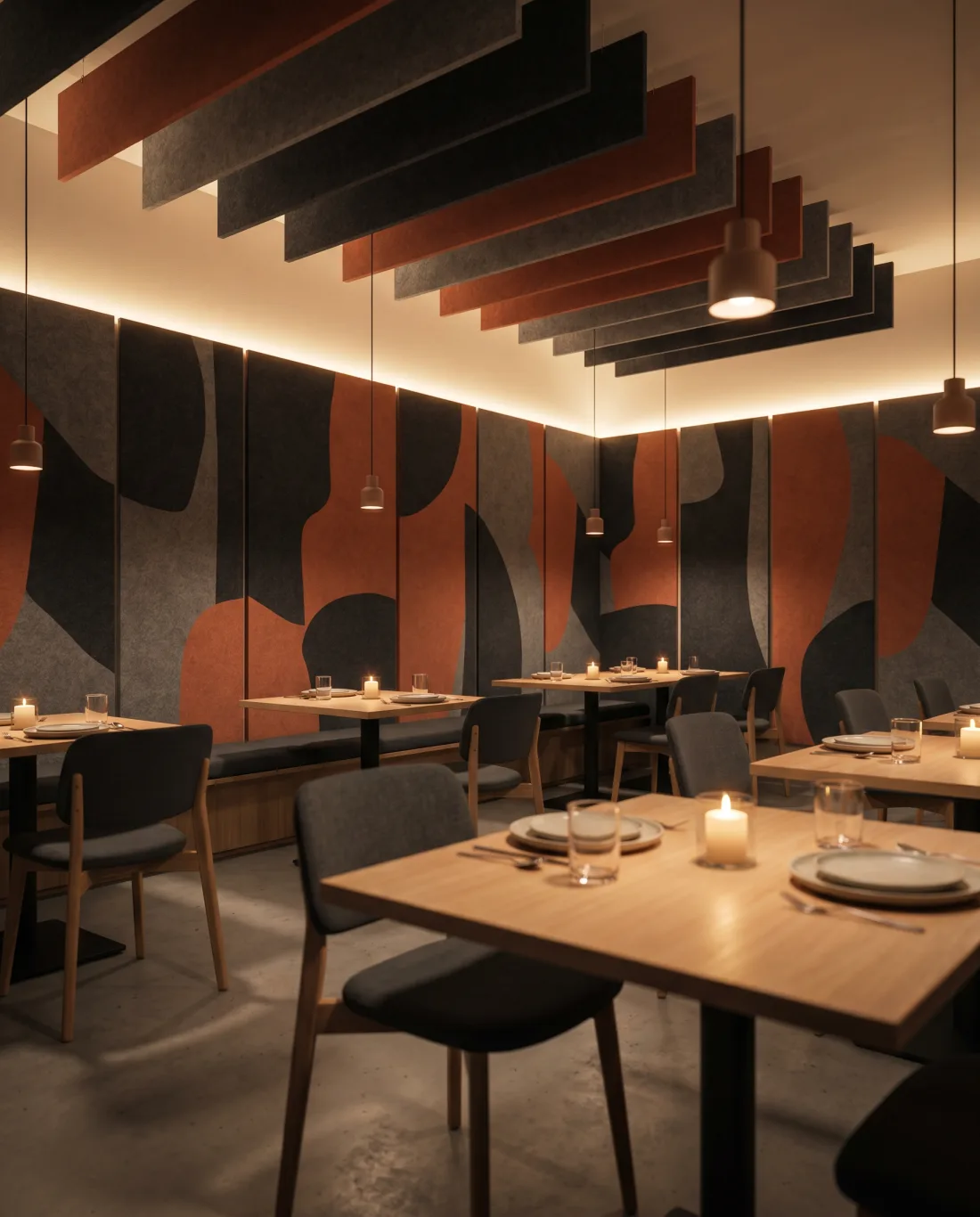
Hard walls and closely packed guests drive up the din. Panels on the large spans bring the sound level down and diners stop raising their voices.
Alongside the ceiling, a few wall surfaces on the large glazing or concrete spans break the lateral reflections between rows of desks.
Large volume, plenty of hard surface, a strong first impression. A printed signature wall sets the tone from the entrance while calming the echo of busy spaces.
How much surface
The question comes up on every project, and the answer holds in one principle: placing well matters more than covering a lot. In practice, treating 15 to 30 % of the walls in absorbent surface already clearly changes how an office or a restaurant feels. No need to line an entire room: the first well-positioned square metres bring most of the gain.
The spots that pay off the most are the walls that face each other (they sustain the back-and-forth of the sound) and the first-reflection points, where the wave bounces before reaching the ear. We spot these zones from your plan and the position of the desks or tables, then concentrate the panels there. The rest of the walls can stay bare with no noticeable loss of comfort.
We start from your dimensions (surface, ceiling height, wall type) to estimate the useful quantity and propose a costed layout, without oversizing. You know what you are buying and the expected effect, not a number of panels pulled from a catalogue. The quote details everything, free and within 48 h.
Formats & finishes
You choose the shape, the size, the colour and the print.
Pattern, photo, mural or discreet logo: the wall becomes a visual medium.
See made-to-measure →
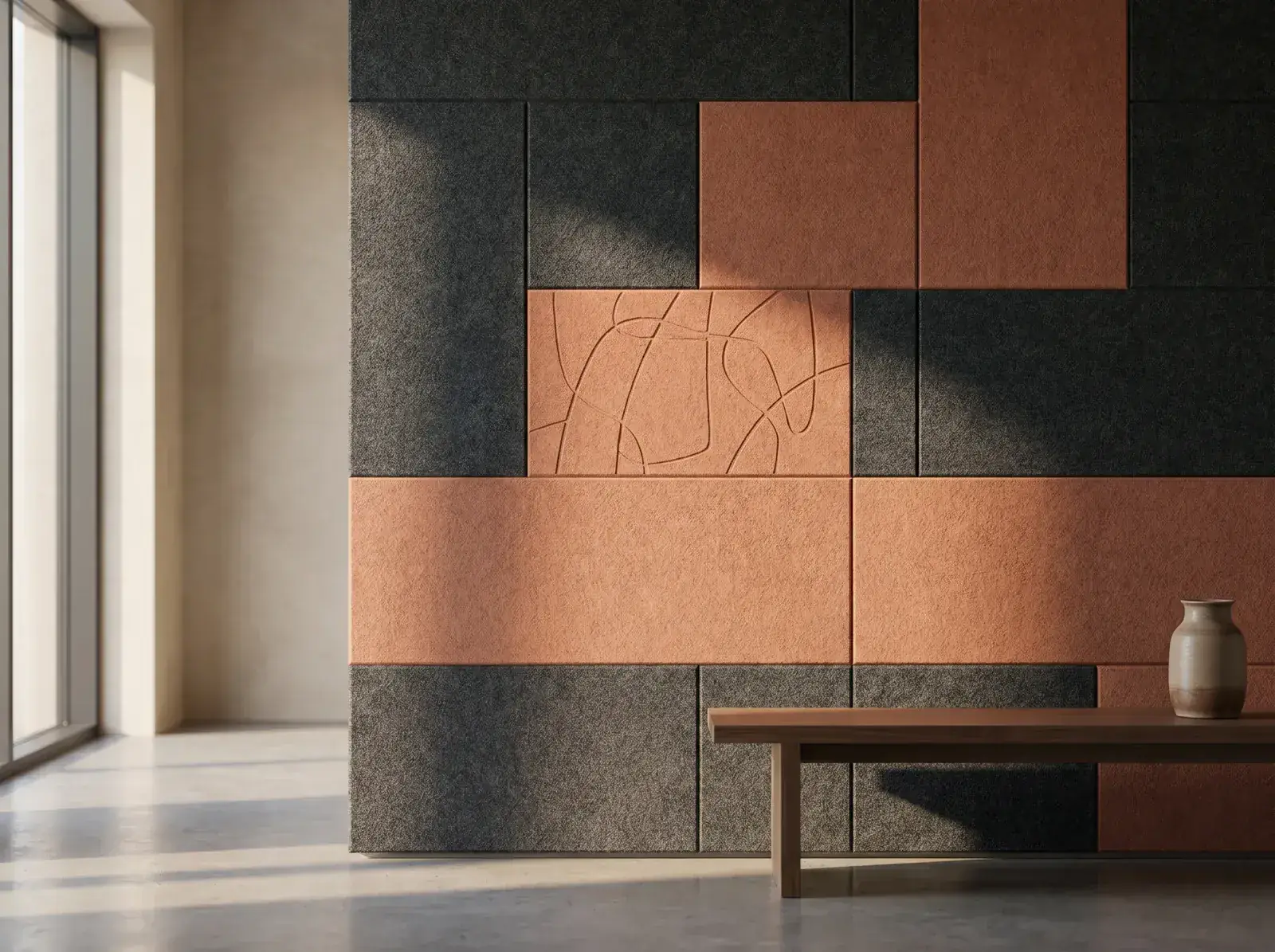
Rectangles, hexagons, free forms, to the exact dimensions of your wall.
Office acoustics →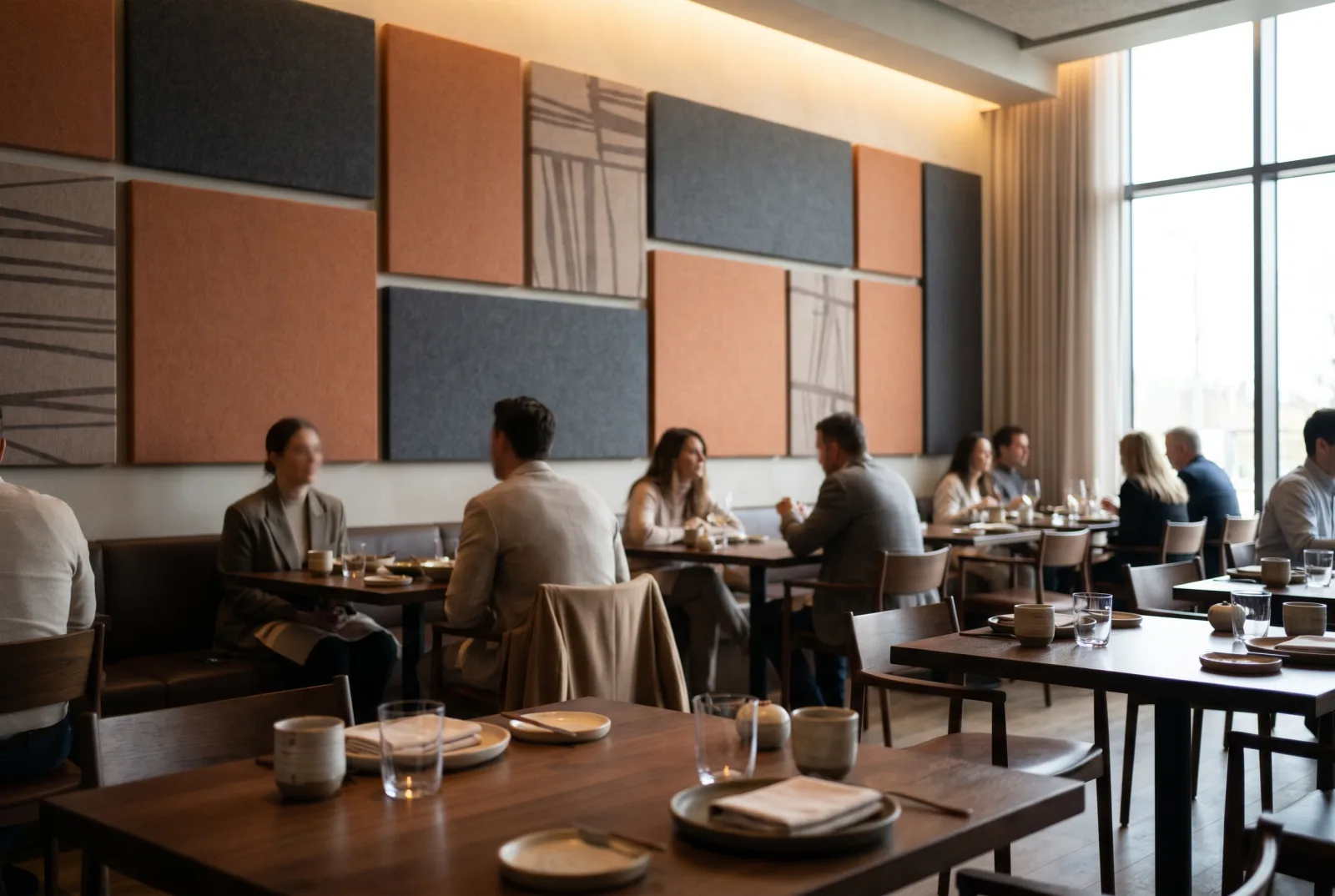
Light: bonding or screws, in a few hours, with no major building work.
Restaurant acoustics →Formats, thicknesses, finishes
Our wall panels are generally 9 to 12 mm thick. That is the right compromise: enough material to capture the voice effectively, thin enough to stay discreet and not eat into the space. This thickness is enough for the vast majority of offices, restaurants and meeting rooms, where the problem comes from mid and high frequencies.
On shapes, everything starts from your wall. Two standard formats, 100 × 100 cm and 120 × 60 cm, answer simple, urgent projects; for the rest, each acoustic board is cut to the exact dimensions of your wall. Rectangles and squares for a crisp look, hexagons or discs for a graphic scatter, free cuts to hug a constraint or draw a pattern. You can compose a mural from several butted modules or a set of spaced shapes that lets the wall breathe. Shades are chosen from several dozen colours, from warm neutrals to bold tones.
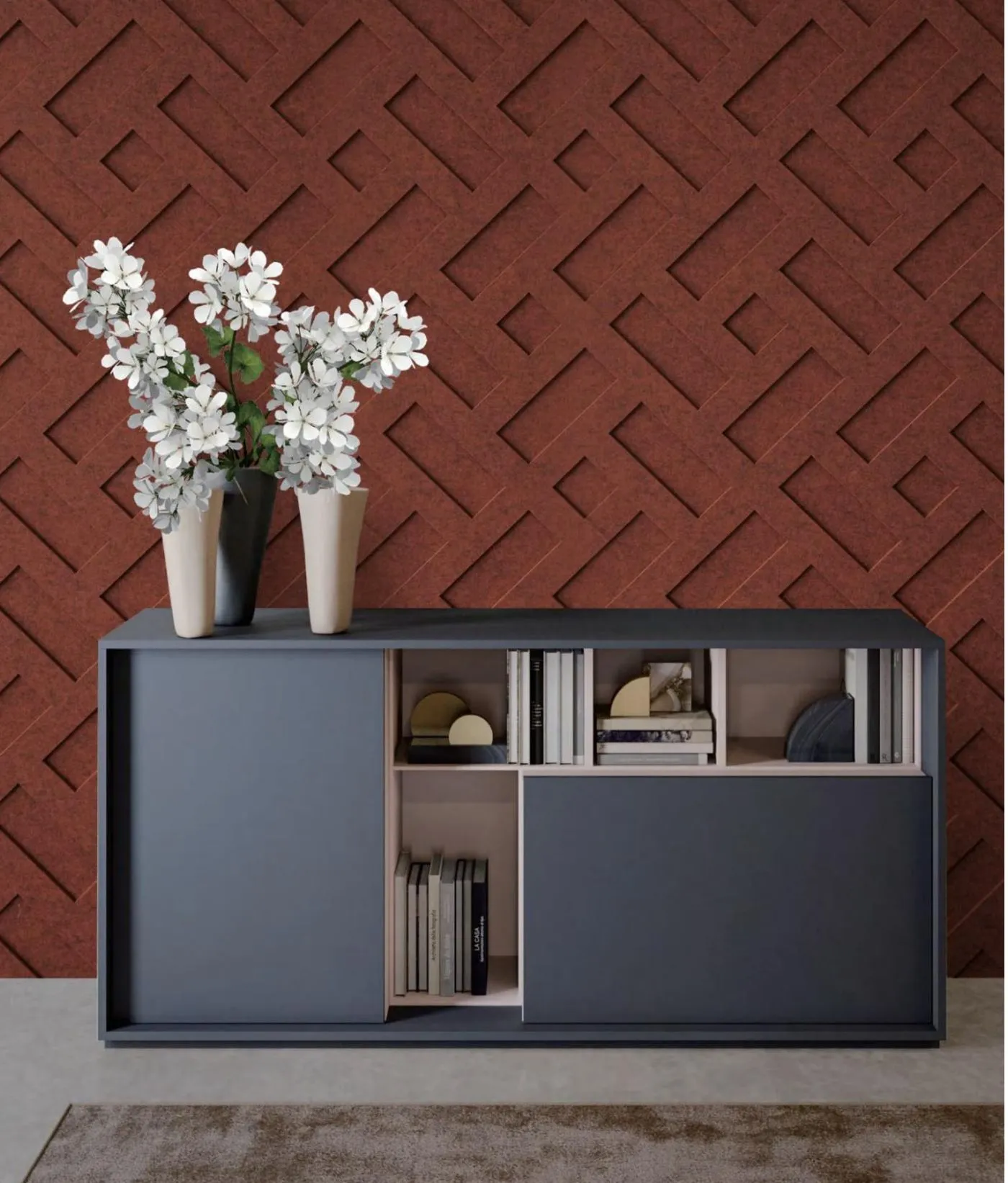
On the final look, two schools coexist: the panel fitted flat, sober and flush, or the panel offset by a few millimetres that creates a cast shadow and relief. By mixing several thicknesses and a scatter of shapes, hexagons, discs, vertical blades, you push to a real 3D effect: light catches the edges and the wall becomes a relief decor. We steer the choice by the intended mood and the style of the space. For projects that want to go further in customisation, everything is decided on the printed made-to-measure side.
Which absorber to choose
Three materials often compared to dress a wall. Here is where each one really stands.
The ACOUSTELIO difference
Too many acoustic panels look like technical tiles. Ours print and cut to your image: you gain sound comfort without sacrificing the decor. Performance and aesthetics in the same product, approved on a proof before production.
Need to treat the ceiling too? See the ceiling baffles.
The install
PET felt panels are light, so the install stays simple and free of major building work. Two methods cover almost every case. Bonding, with double-sided mounting tape, suits flat, clean surfaces: painted plasterboard, smooth concrete, glass. It is the fastest and most invisible solution, ideal when you want a flush panel.
The screw fixing, with spacers, is the way to go on irregular walls, fragile partitions, or when you want to offset the panel. The spacers create a 20 to 40 mm air gap behind the panel: this small space extends absorption towards lower frequencies, useful in a meeting room or a music space. It is also what gives the relief and cast shadow of an offset mounting.
No special skill is required: most teams install themselves in half a day. We provide fitting recommendations suited to your surface (plasterboard, concrete, glass, wood) and the layout plan. For a large or high-level job, we can point you to an installer.
How it works
Dimensions, hard surfaces, target sound ambience.
Layout, approved printed visual, quote within 48 h.
Made-to-measure cutting and printing, fire-certified.
Delivered DDP, ready to fit, within 10 to 15 days.
Send your dimensions or a few photos, quote within 48 h.
Request my free quoteMaintenance & lifespan
PET felt needs little attention day to day. A pass with a soft-brush vacuum removes dust, and a damp cloth with a little neutral soap is enough for a stain, without rubbing hard. Unlike acoustic foam, the material does not yellow in the sun and does not crumble over time: it keeps its look for several years, even in a busy spot.
This low maintenance weighs in the choice for a restaurant, a lobby or a reception, where stretched fabrics get dirty and are hard to repair. The panel stays a clean investment over time. The detail of the material and its recycled share is set out on the PET felt data sheet.
Compliance
As soon as a space receives the public (restaurant, shop, reception office, gym), the fire reaction of wall coverings is regulated. Our panels are classified EN 13501-1 B-s1,d0, the level expected in public-access buildings: low contribution to fire, very little smoke, no flaming droplets. It is a criterion regularly checked by the safety commission, so it is better to settle it up front.
The classification report and the absorption data sheet come with every order, ready for the commission or the inspection body. Compliance is part of the quote, it is not an option to tick at the end of the process. The detail is available on the EN 13501 fire classification side.
Certified measurements
Absorption measured by SGS in a reverberation room (ISO 354, type E mounting with a 200 mm air cavity). Test reports are supplied with every quote.
| Frequency | 9 mm panel | 12 mm panel |
|---|---|---|
| 125 Hz | 0,39 | 0,41 |
| 250 Hz | 0,69 | 0,77 |
| 500 Hz | 0,95 | 0,92 |
| 1000 Hz | 0,66 | 0,72 |
| 2000 Hz | 0,84 | 0,92 |
| 4000 Hz | 0,93 | 0,99 |
| NRC (overall rating) | 0,80 | 0,85 |
| Surface weight | 1,83 kg/m² | 2,09 kg/m² |
Alpha-s absorption coefficient per octave band. NRC = average at 250, 500, 1000 and 2000 Hz (SGS reports CZIN2502000039CM01 and CZIN2502000038CM01).
EN 13501-1:2018 (SBI EN 13823 + EN ISO 11925-2 tests): low contribution to fire, s1 smoke, no flaming droplets. Valid for walls, ceilings and free-standing partitions.
ASTM E84-2024: flame spread index 5 (Class A is 0 to 25), smoke developed index 300. The level required for interior walls and ceilings.
VOC emissions tested to ISO 16000: formaldehyde and TVOC not detected on day 7. French A+ label (decree 2011-321), certificate valid until 04/2029.
Felt made from recycled PET bottles, spun then heat-pressed. Production audited to FSC and GRS (Global Recycled Standard), tested by SGS, Intertek and TÜV.
The collections
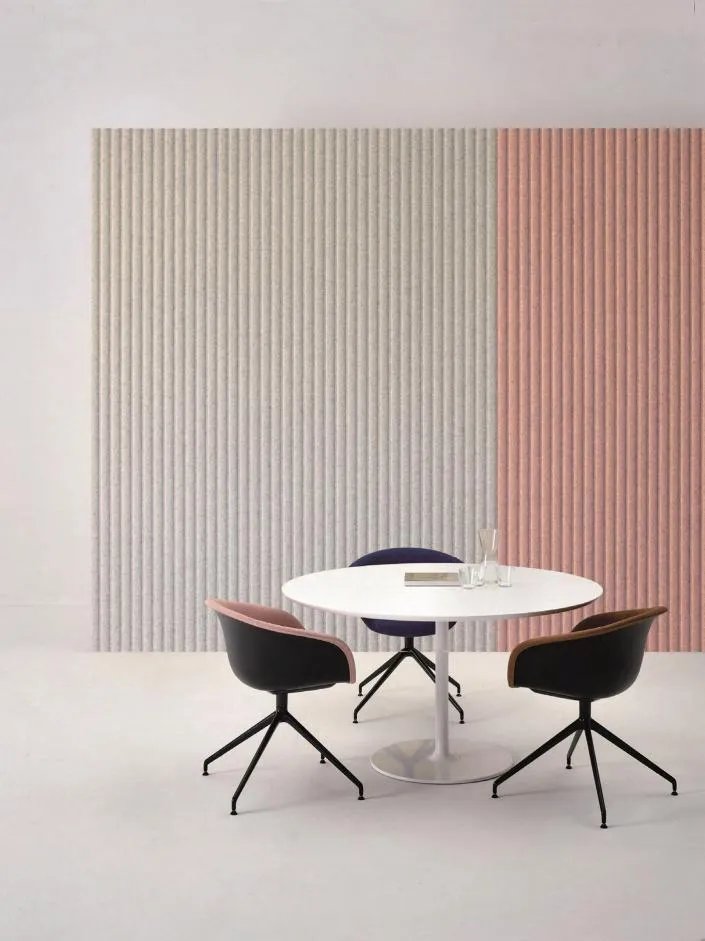
Every photo shows a real product from our collections. Everything comes in 55 felt colours, 9 or 12 mm thick, and can be printed with your artwork.
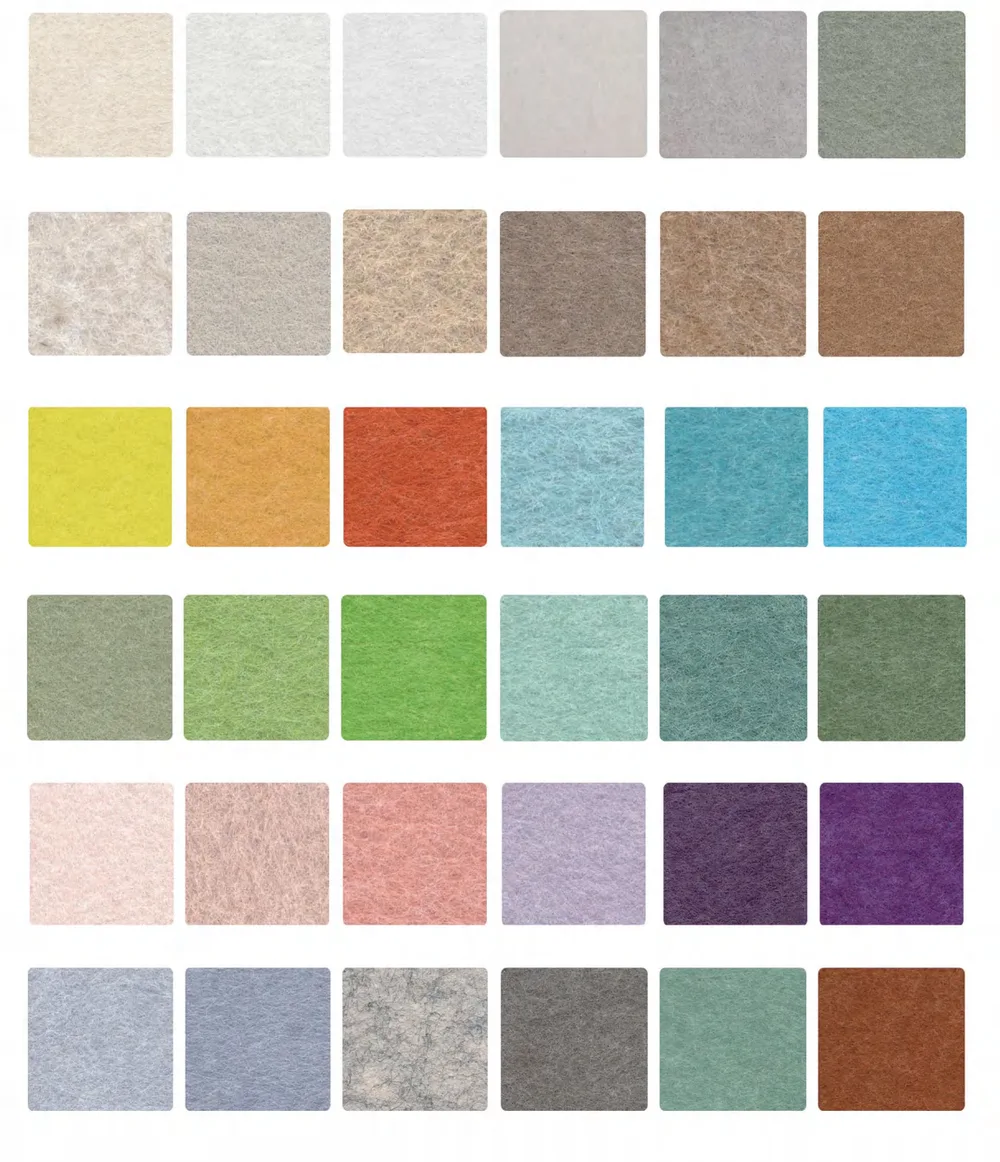
55 colours · 9 / 12 mm
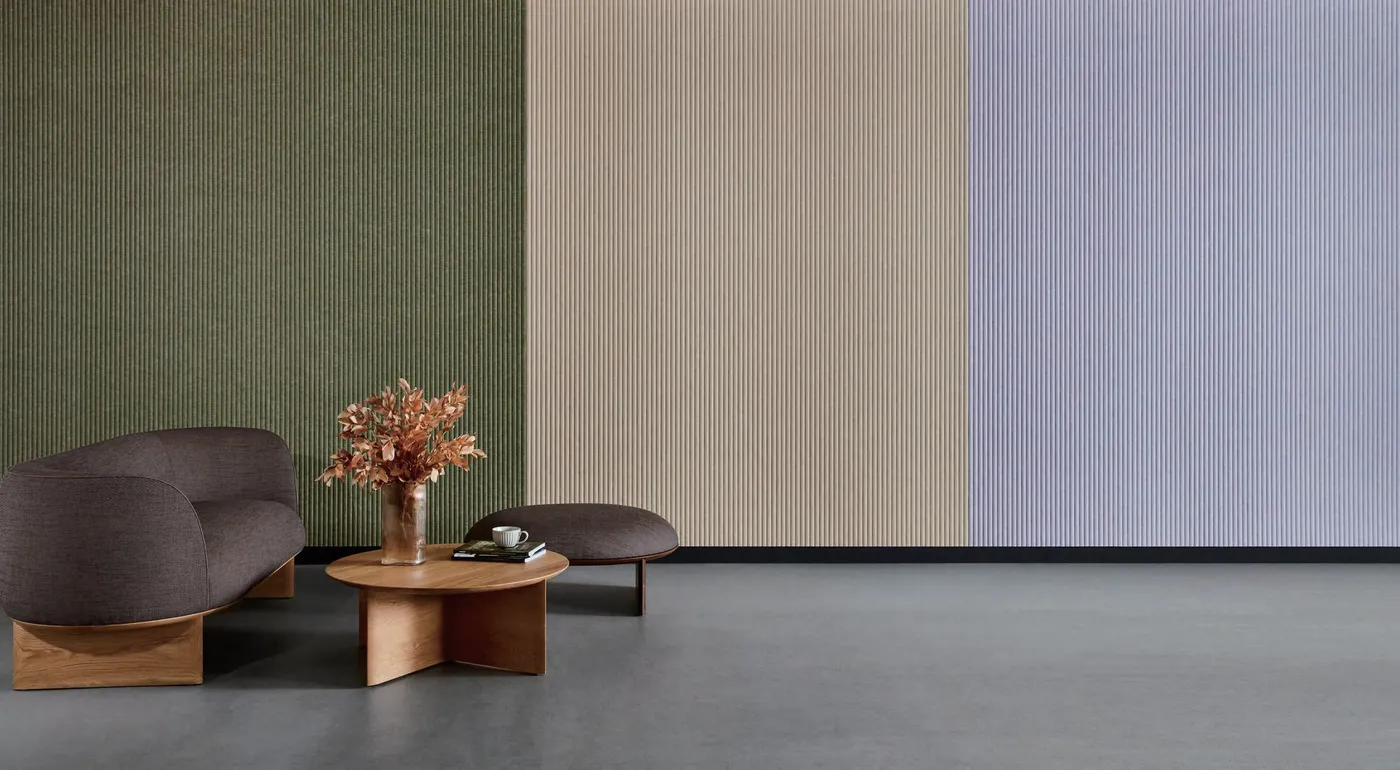
55 PET felt colours on the swatch card, from mineral neutrals to bold tones, in 9 or 12 mm.
Explore the collection →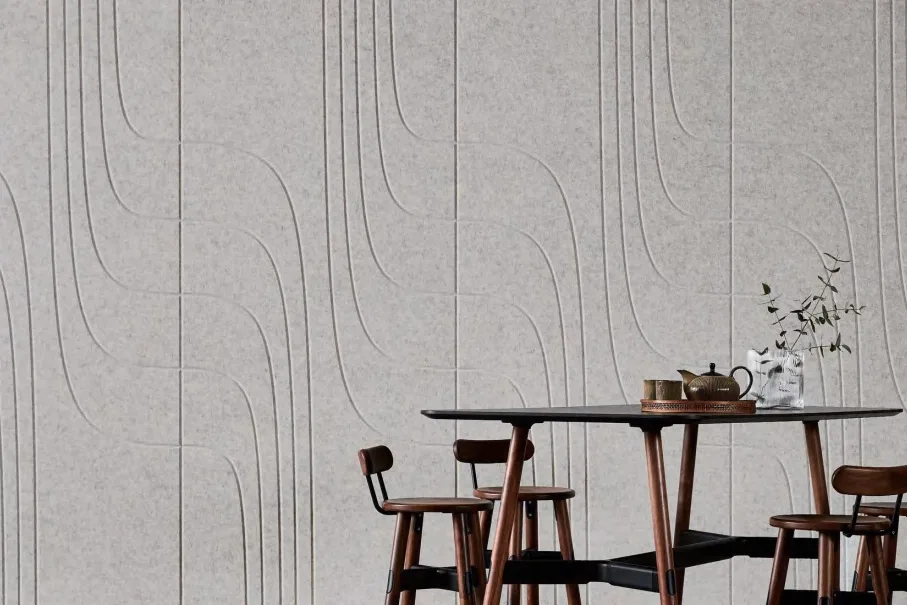
15+ patterns · 1200 × 2800 mm
Carved wall panels: lines, chevrons, arches and weaves, in large 1200 × 2800 mm formats.
Explore the collection →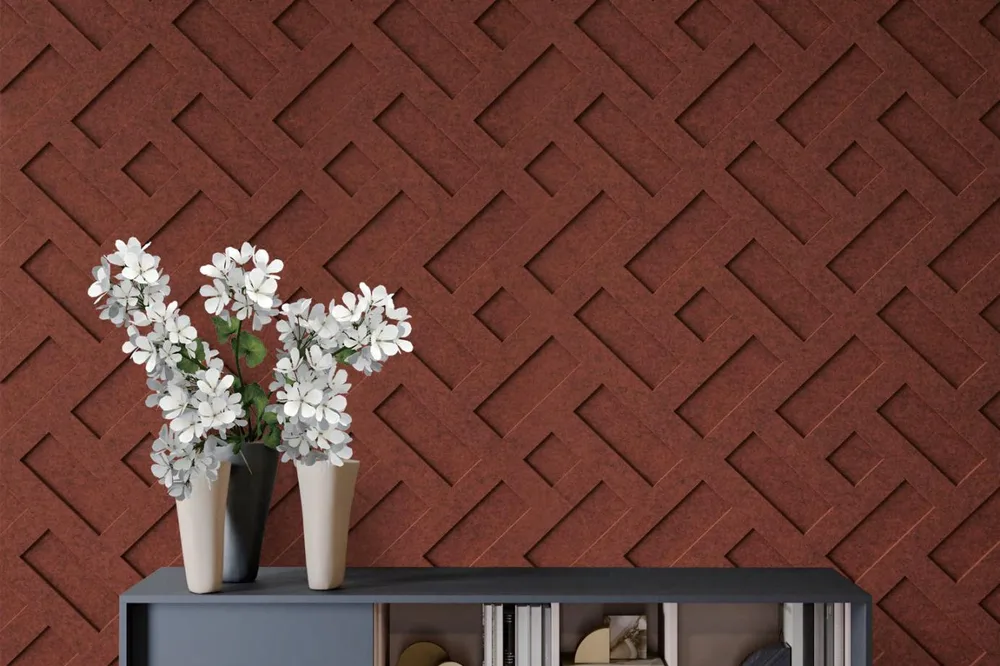
9 textures · ref. EM-001 to EM-009
Nine embossed textures (scales, waves, weave) that catch the light and give the wall real depth.
Explore the collection →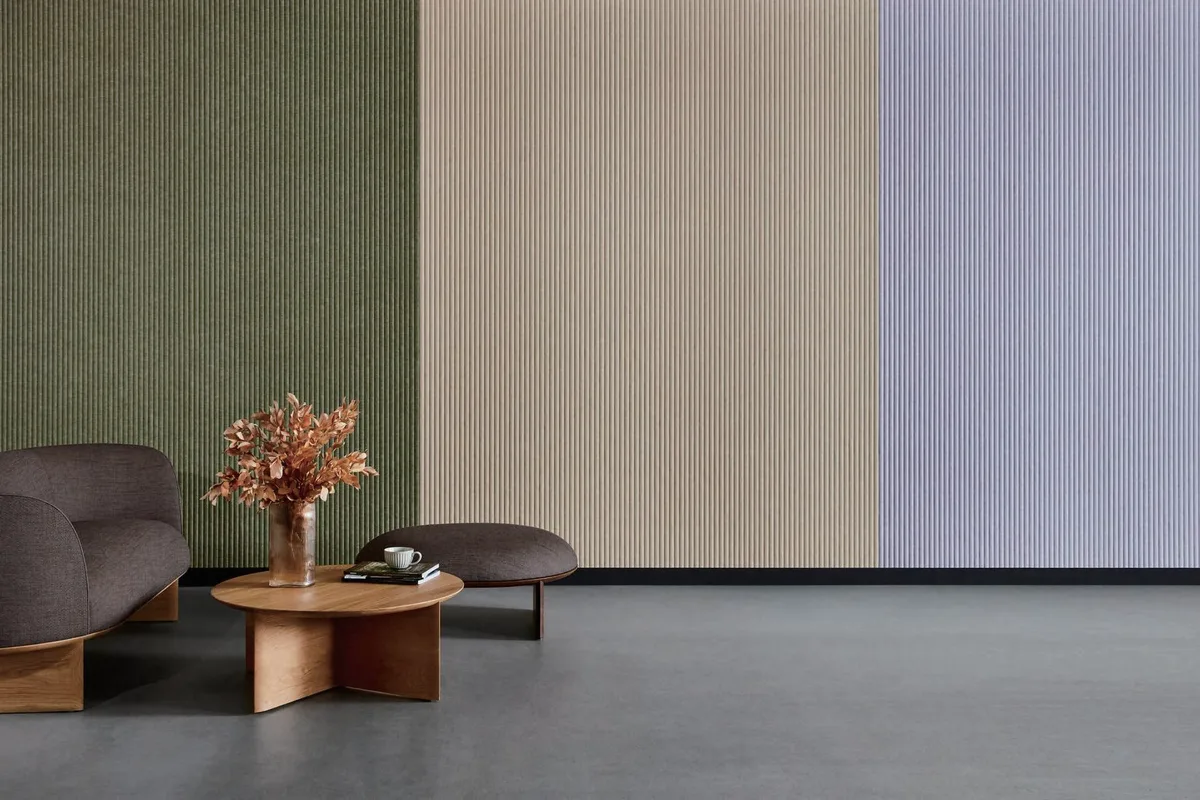
8 profiles · 1200 × 2400 mm
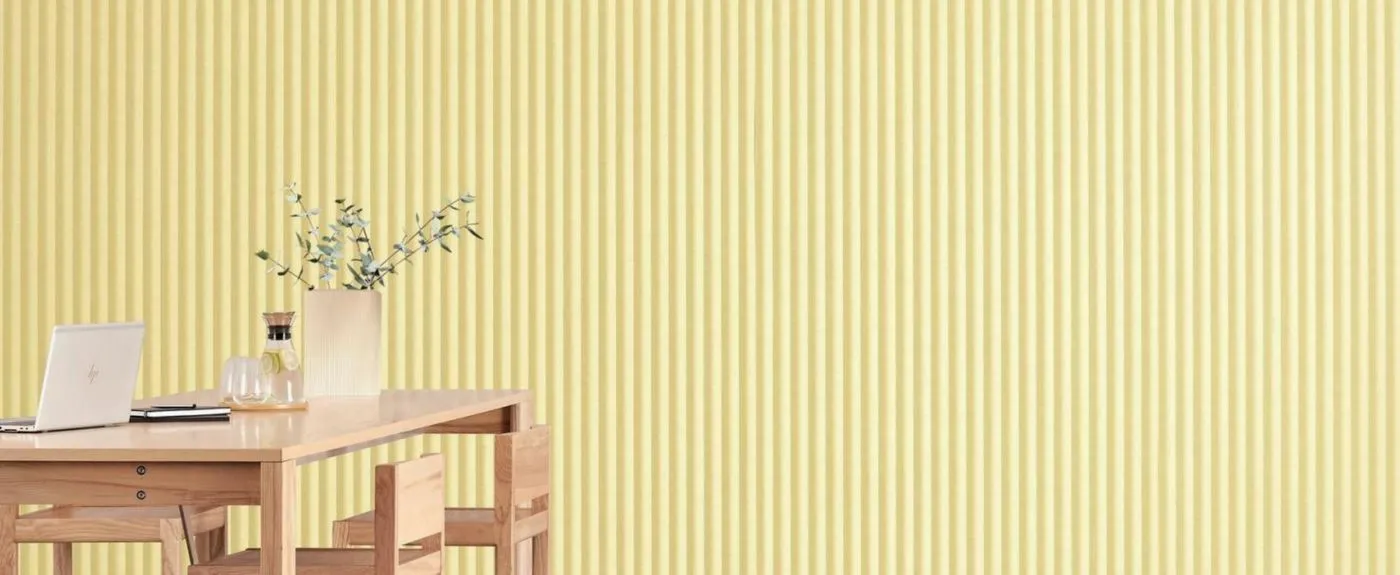
Wave and flute profiles (BW and BL ranges): a ribbed fabric look, in wall strips 2400 mm high.
Explore the collection →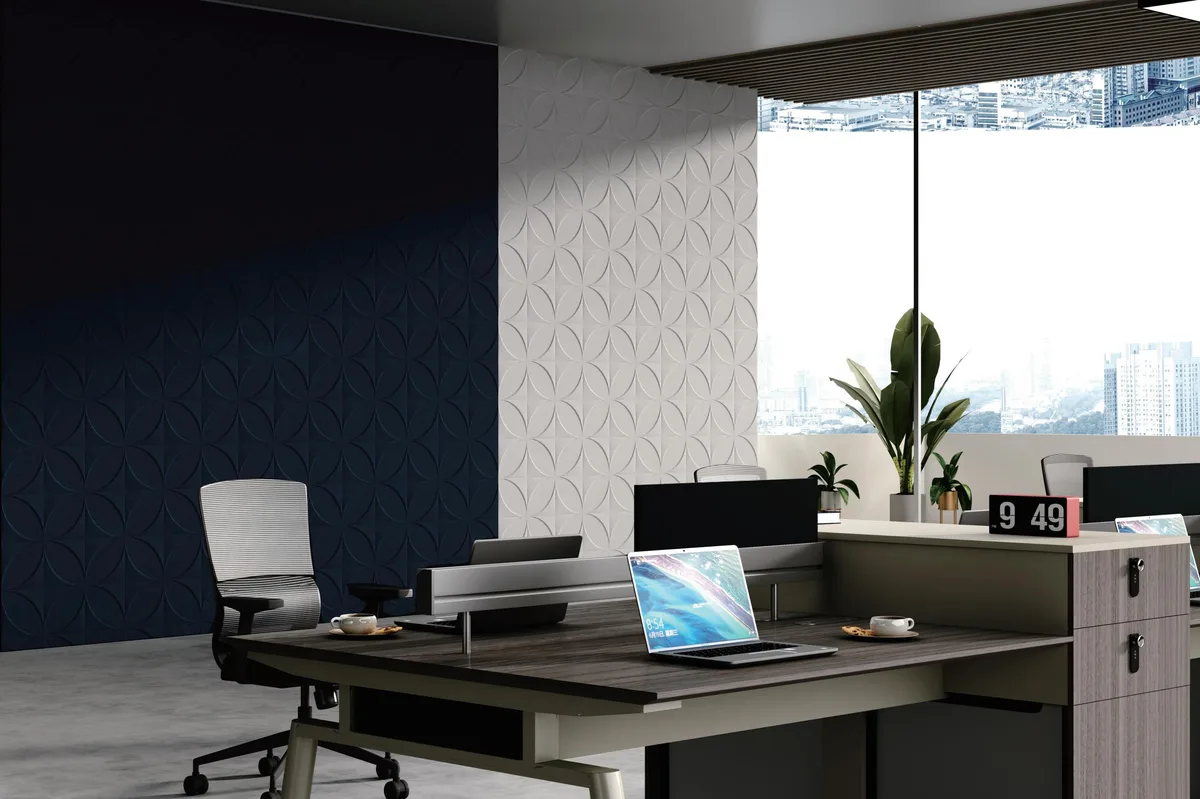
42 modules · ref. FC-3D001 to 042
Sculpted volume modules (waves, petals, pyramids) that turn a whole wall into an acoustic feature.
Explore the collection →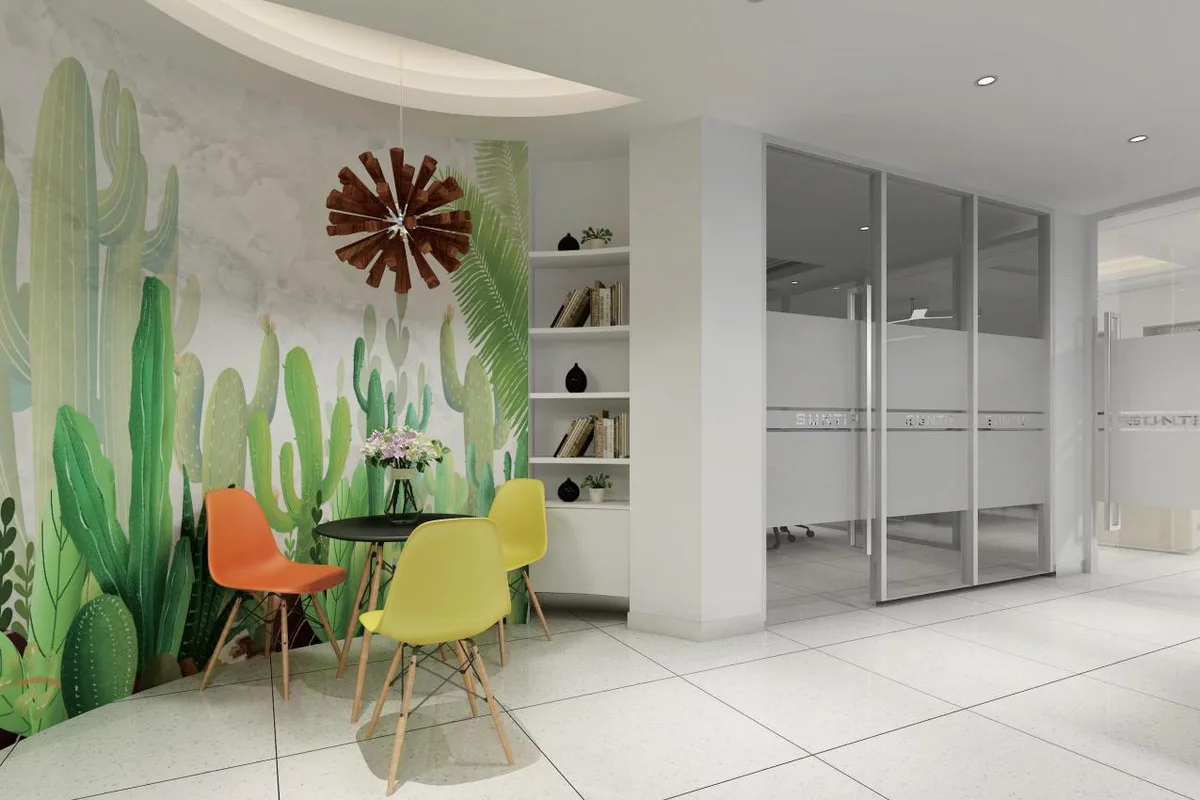
HD printing · any artwork
Our speciality: your artwork (mural, photo, pattern, logo) printed in high definition on the felt.
Explore the collection →Frequently asked questions
A bare wall sends back almost all the sound it receives. A wall dressed with PET felt captures the voice at first contact and brings the echo down.
The principle we apply to every room, from the meeting office to the restaurant floor.
Felt colour chart · 55
Every reference in this collection comes in the 55 colours of the PET felt chart, with free mixing between modules.
FC 100Neutrals & sands
FC 200Suns & greens
FC 300Powders & purples
FC 400Greys & blues
FC 500Deeps & reds
On-screen shades are indicative: felt is a melange material, physical samples prevail (sent with your quote on request).
2026 catalogue
36-colour chart, pattern boards, dimensioned ceiling systems, desk screens and certified performance data: everything you need to specify or price your project.
Send us your dimensions or a few photos, and we come back with a layout and a quote within 48 h.
Request my free quote