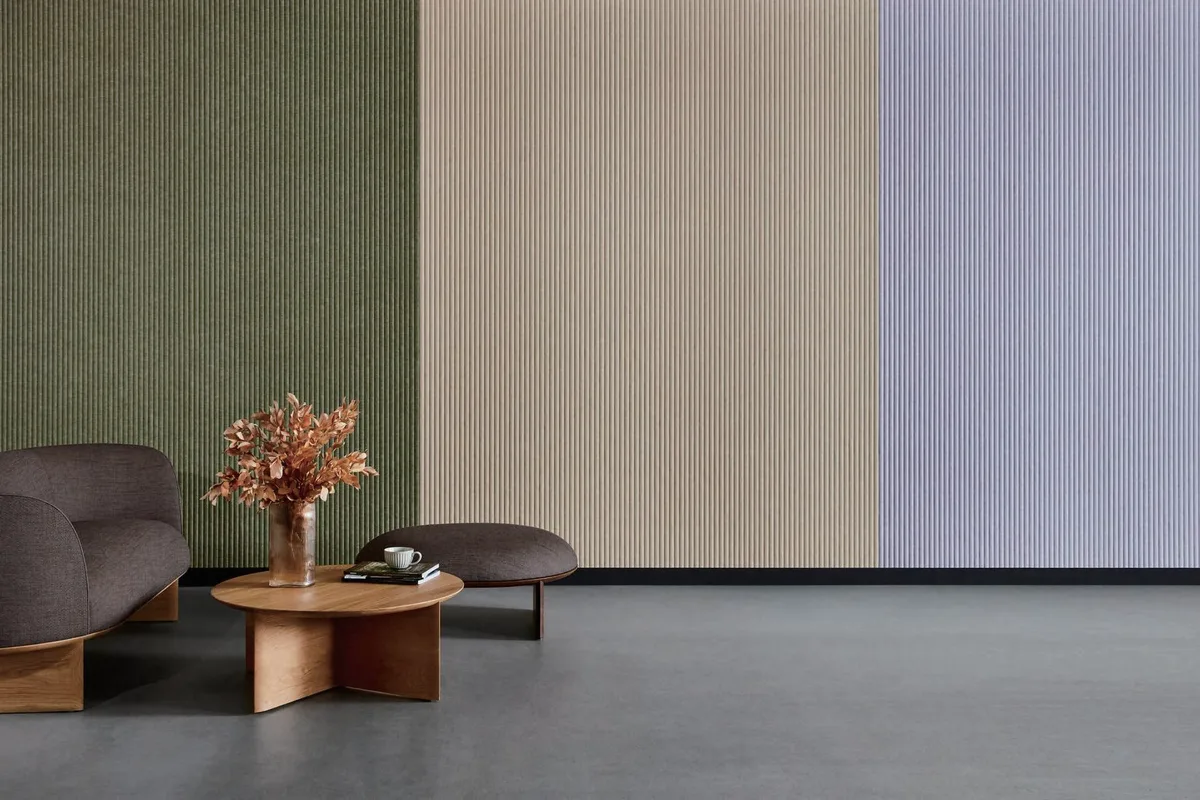
Fluted waves
8 profiles · 1200 × 2400 mm
Wave and flute profiles (BW and BL ranges): a ribbed fabric look, in wall strips 2400 mm high.
Explore the collection →Product · Ceiling & baffles
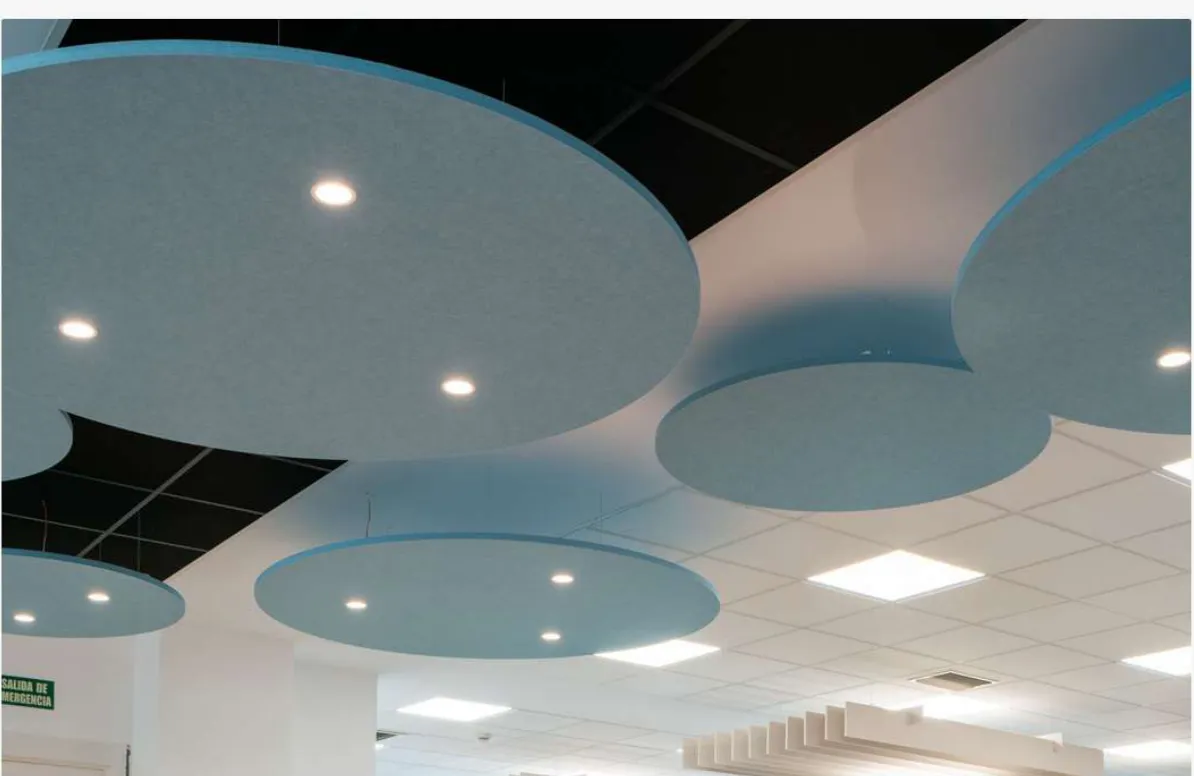
When the ceiling is high and the volume large, suspended baffles are the most effective solution: they capture sound on both faces and treat a large absorbent surface up high, where the floor and walls are already taken. ACOUSTELIO makes them to measure in PET felt, printable in your colours and fire-certified for public buildings.
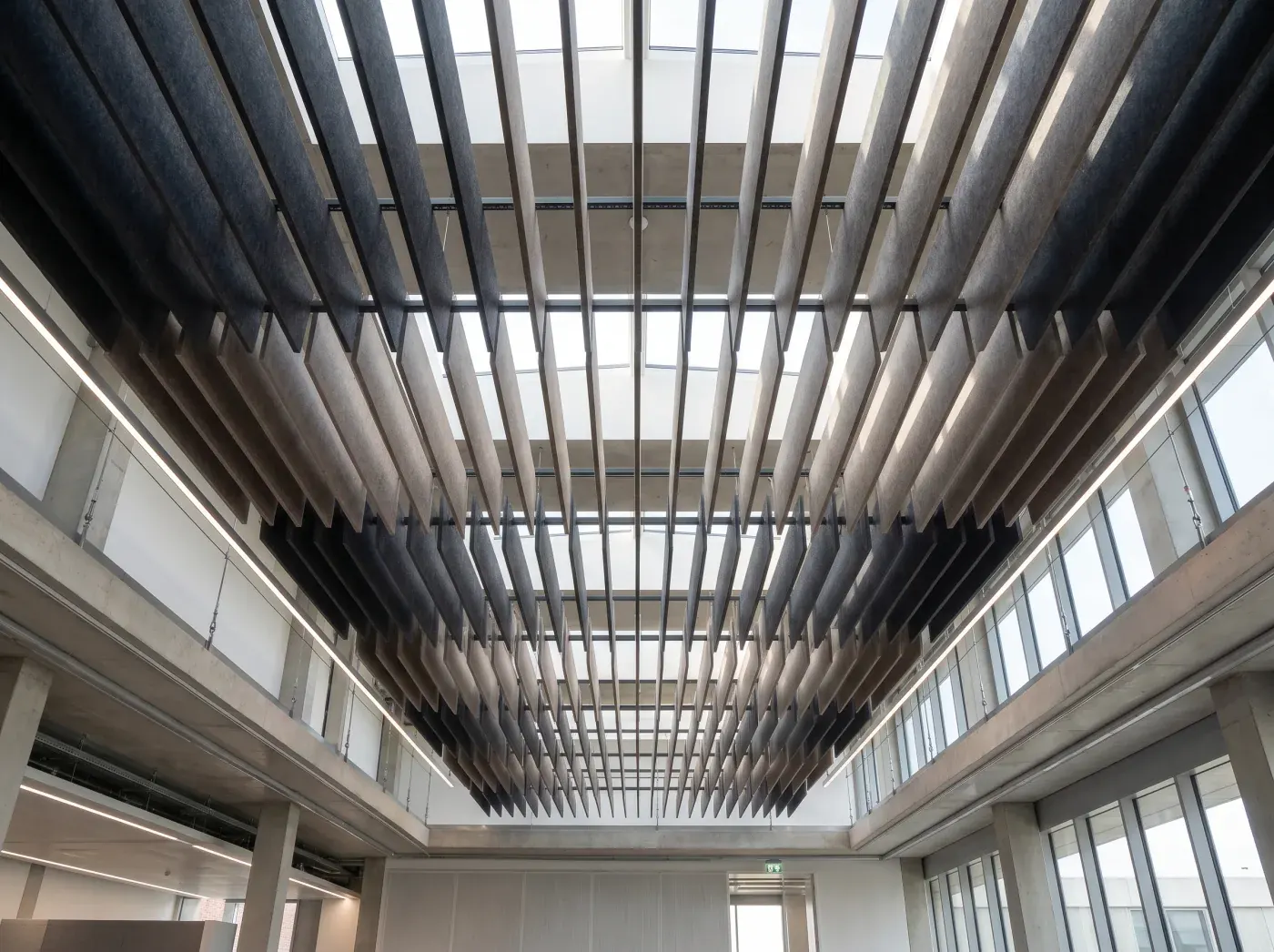
SYS-01 → SYS-09
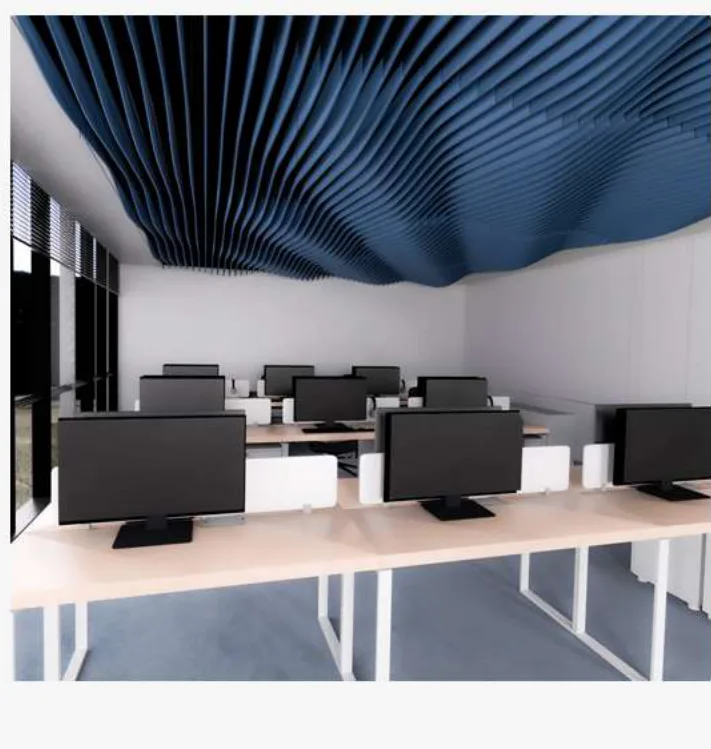
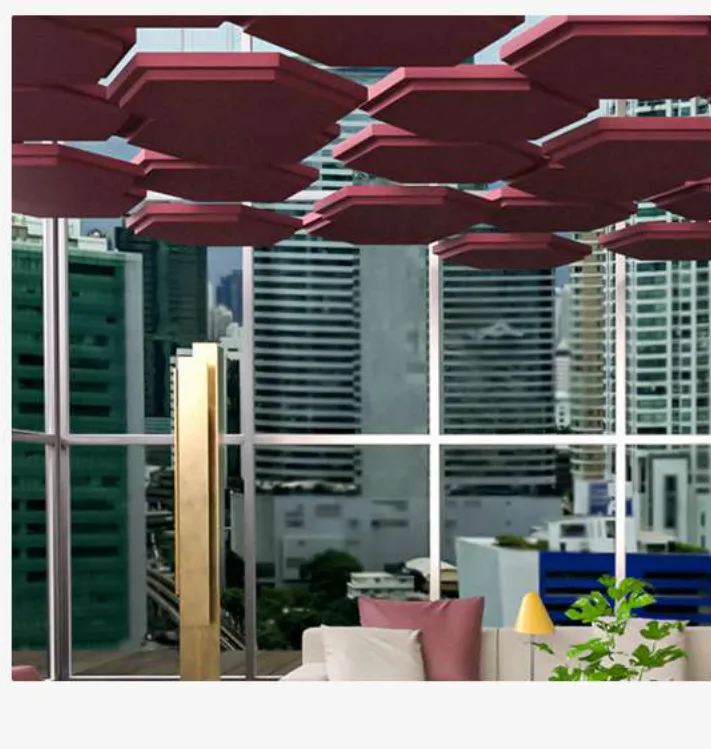
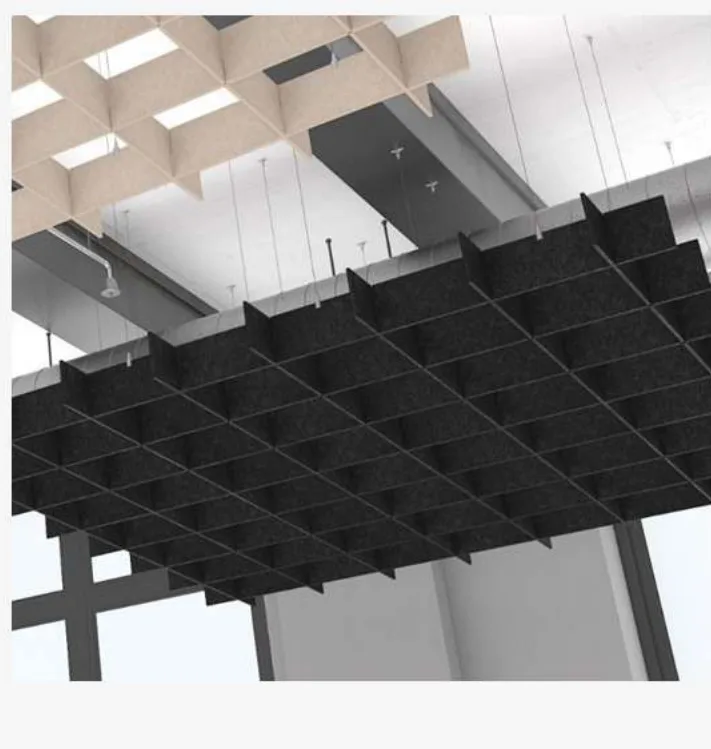
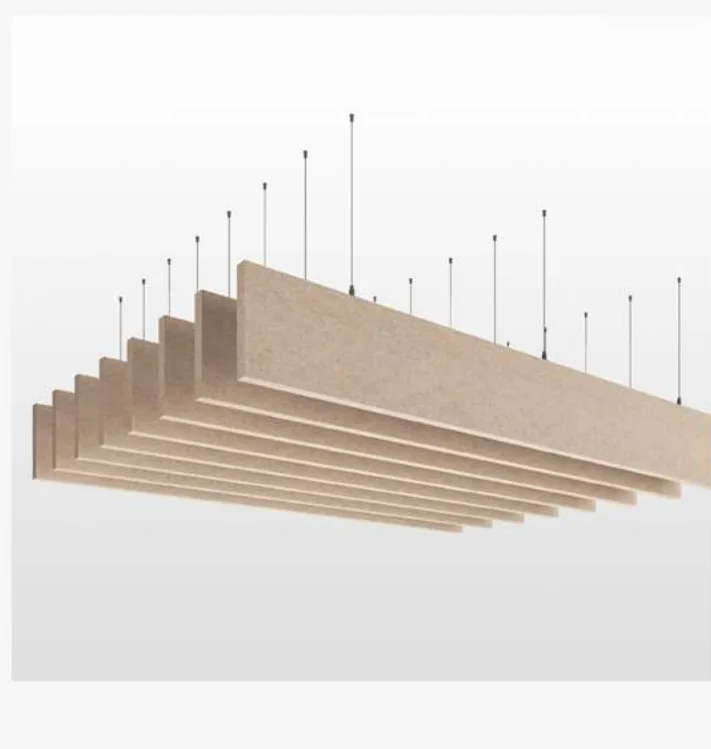
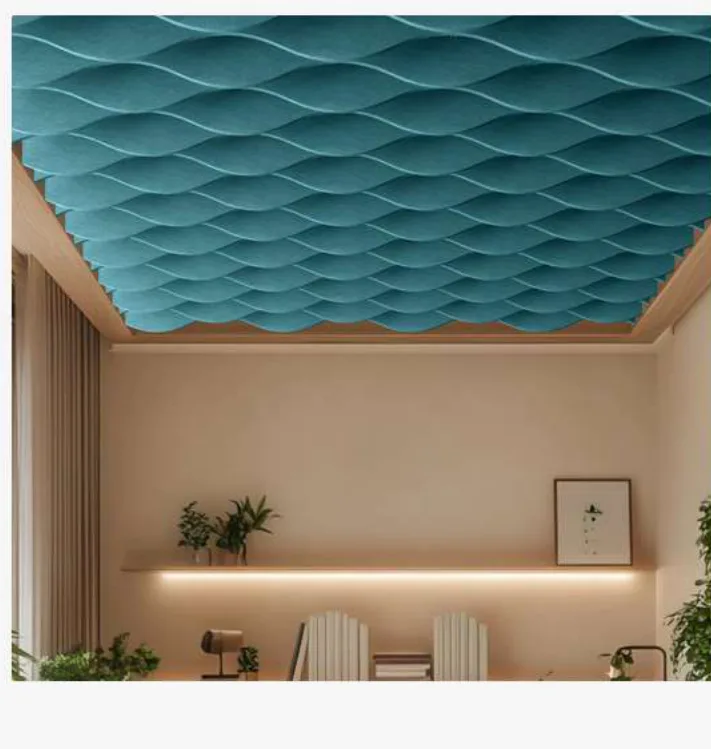
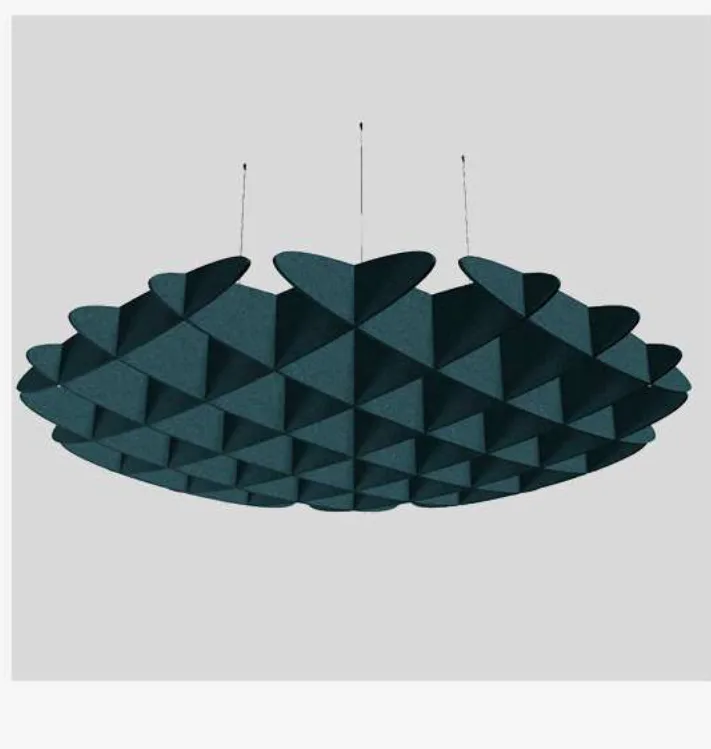
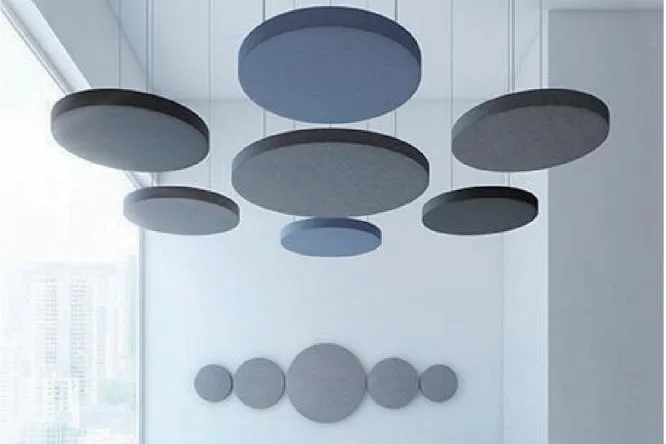
Baffles, discs, waves, grids and clouds suspended on adjustable cables. Standard dimensions below, felt chart colours, layout from your plan.
The principle
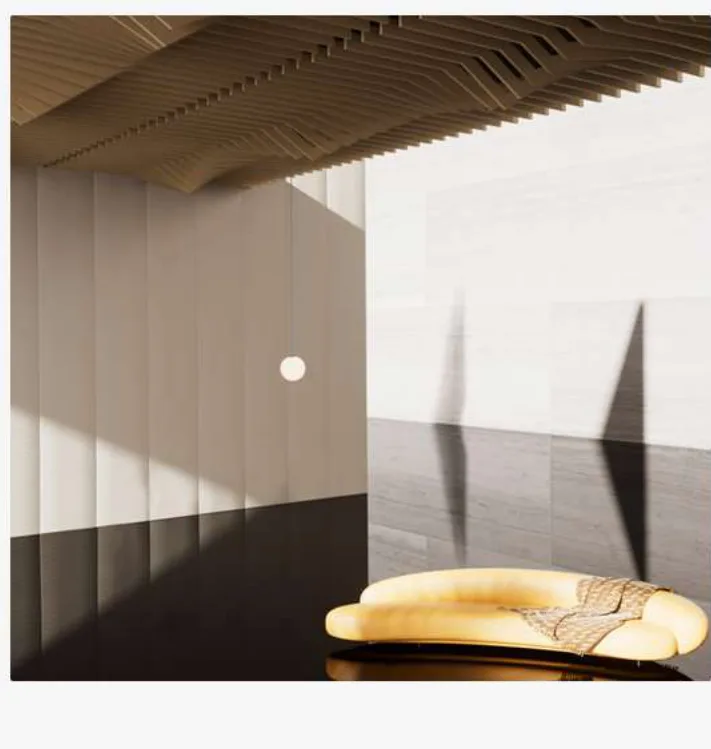
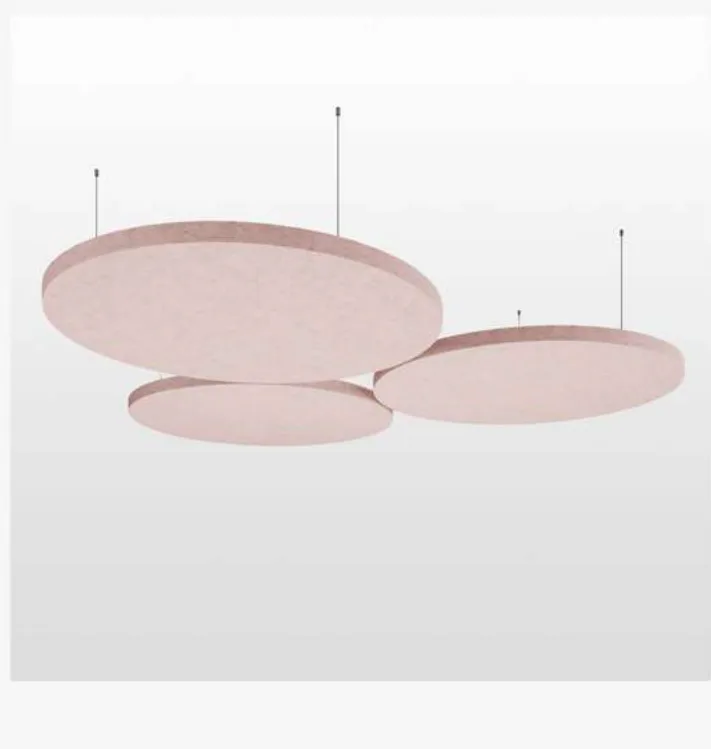
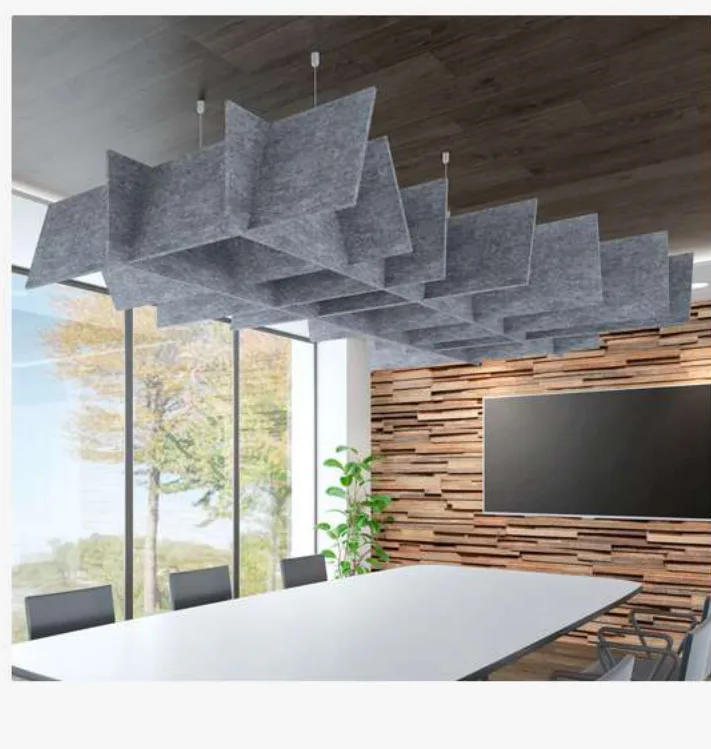
A baffle is suspended vertically below the ceiling, most often by cables. Because it exposes its two faces to the sound, it absorbs the waves that rise and those that come back down after striking the underside. For an equal surface of material, it therefore captures far more than a simple panel pressed against the ceiling, which works on one side only. It is this double exposure that explains its yield in large volumes.
The install is done in parallel lines, in a chequerboard or a comb, at the chosen height. We orient the baffles perpendicular to the dominant sound flow to maximise the surface offered to the waves. The light weight of PET felt allows thin cables and a minimal load on the structure, with no heavy frame to build.
It is the ideal tool for high ceilings, where the walls are glazed or inaccessible. To clearly tell this treatment apart from soundproofing, which answers a completely different need, see acoustic treatment vs soundproofing.
Why the ceiling
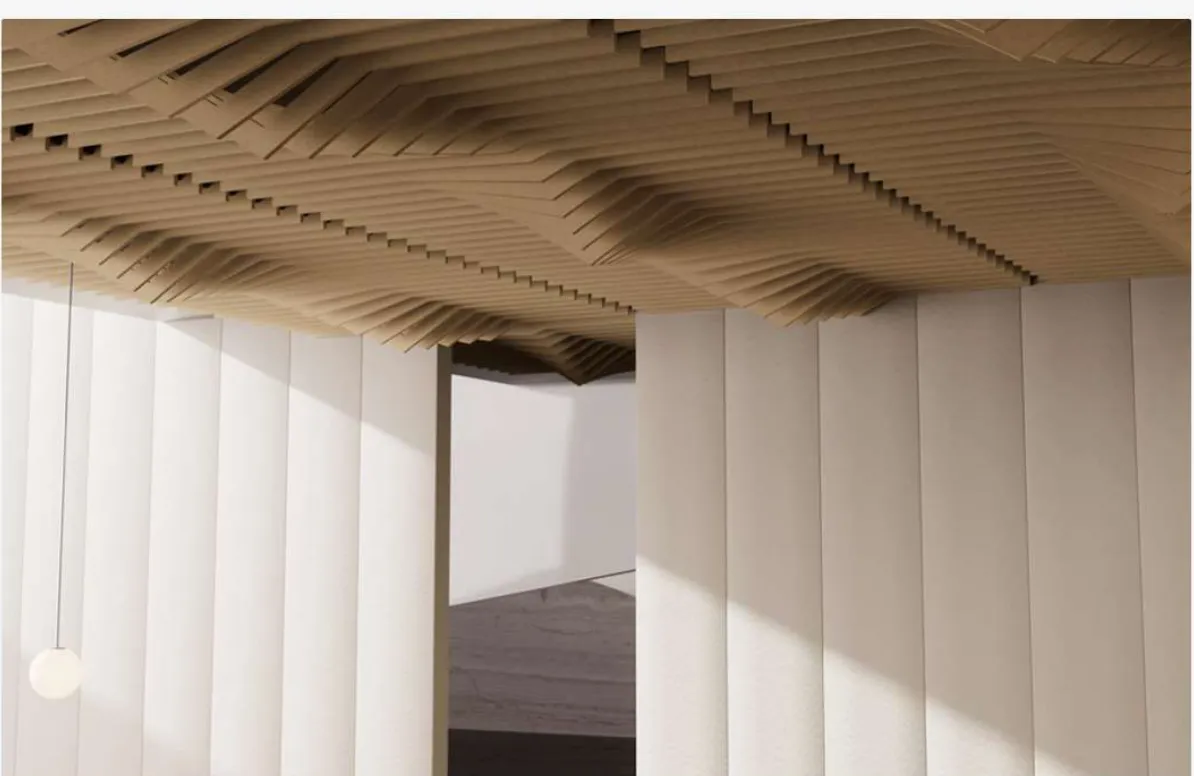
Look at a workshop, a lobby or a sizeable restaurant. The floor is taken up by machines, tables or furniture. The walls are often glazed, covered with shelving, punched with doors and bays. That leaves the ceiling: the biggest hard, flat and empty surface of the space. It sends back the largest share of the sound towards the ears, and it is precisely there that you can place the most absorption in a single move.
Treating the ceiling first therefore gives the best acoustic yield per euro spent. You act on the overall reverberation, that diffuse din that stagnates in the volume, before even dealing with the local reflections. In a large space, this mass of absorption up high changes how it feels for everyone, not just those placed near a treated wall.
Another decisive advantage: you don't touch the structure or the existing services. No dismantling, no false ceiling to open. Baffles hang below what is already there, which makes them easy to fit in an occupied building and entirely reversible on the day of a move.
Performance
Suspended with an air gap between the baffle and the ceiling, our baffles can reach an absorption coefficient close to NRC 1,00: almost all the incident sound energy is absorbed, and next to nothing is sent back. This figure is not a marketing promise, it is a value measured in the laboratory on this type of suspended mounting.
The role of the air gap deserves an explanation, as it is the most underrated lever. By leaving a space of several centimetres between the top of the baffle and the underside, you give the sound wave room to dissipate on both sides of the material. This space clearly improves the absorption of low and mid sounds, those that carry the voice and the din. A baffle suspended with an air gap does better, at equal thickness, than a panel bonded to the ceiling. We therefore set three parameters together: the felt thickness, the spacing between baffles and the height of this air gap, according to your volume and the target reverberation time.
PET felt with a share of recycled material, light, stable over time and fire-certified B-s1,d0. It works mainly on the human voice band, where comfort is decided. Evidence and absorption data sheet in the guarantees.
Where to fit baffles
Six spaces where a high ceiling makes baffles the first lever.
Metal structures, hard floors, resonating machines. The ceiling stays the only large free surface to place absorption.
Atriums and receptions with high ceilings, often heavily glazed. Baffles treat the echo without touching the walls or the light.
Rooms where the din climbs fast at service. Suspended above the tables, baffles bring the level down without hampering movement.
A mass of absorption up high, where the floor is already taken by desks. The most powerful lever on a large floor plate.
Huge volumes, unusable walls. Suspended out of reach of the balls, baffles break an often extreme reverberation.
The sound peak of lunch, concentrated in one hour. A ceiling treated with baffles makes meals far more bearable.
Certified measurements
Absorption measured by SGS in a reverberation room (ISO 354, type E mounting with a 200 mm air cavity). Test reports are supplied with every quote.
| Frequency | 9 mm panel | 12 mm panel |
|---|---|---|
| 125 Hz | 0,39 | 0,41 |
| 250 Hz | 0,69 | 0,77 |
| 500 Hz | 0,95 | 0,92 |
| 1000 Hz | 0,66 | 0,72 |
| 2000 Hz | 0,84 | 0,92 |
| 4000 Hz | 0,93 | 0,99 |
| NRC (overall rating) | 0,80 | 0,85 |
| Surface weight | 1,83 kg/m² | 2,09 kg/m² |
Alpha-s absorption coefficient per octave band. NRC = average at 250, 500, 1000 and 2000 Hz (SGS reports CZIN2502000039CM01 and CZIN2502000038CM01).
EN 13501-1:2018 (SBI EN 13823 + EN ISO 11925-2 tests): low contribution to fire, s1 smoke, no flaming droplets. Valid for walls, ceilings and free-standing partitions.
ASTM E84-2024: flame spread index 5 (Class A is 0 to 25), smoke developed index 300. The level required for interior walls and ceilings.
VOC emissions tested to ISO 16000: formaldehyde and TVOC not detected on day 7. French A+ label (decree 2011-321), certificate valid until 04/2029.
Felt made from recycled PET bottles, spun then heat-pressed. Production audited to FSC and GRS (Global Recycled Standard), tested by SGS, Intertek and TÜV.
The collections
Every photo shows a real product from our collections. Everything comes in 55 felt colours, 9 or 12 mm thick, and can be printed with your artwork.
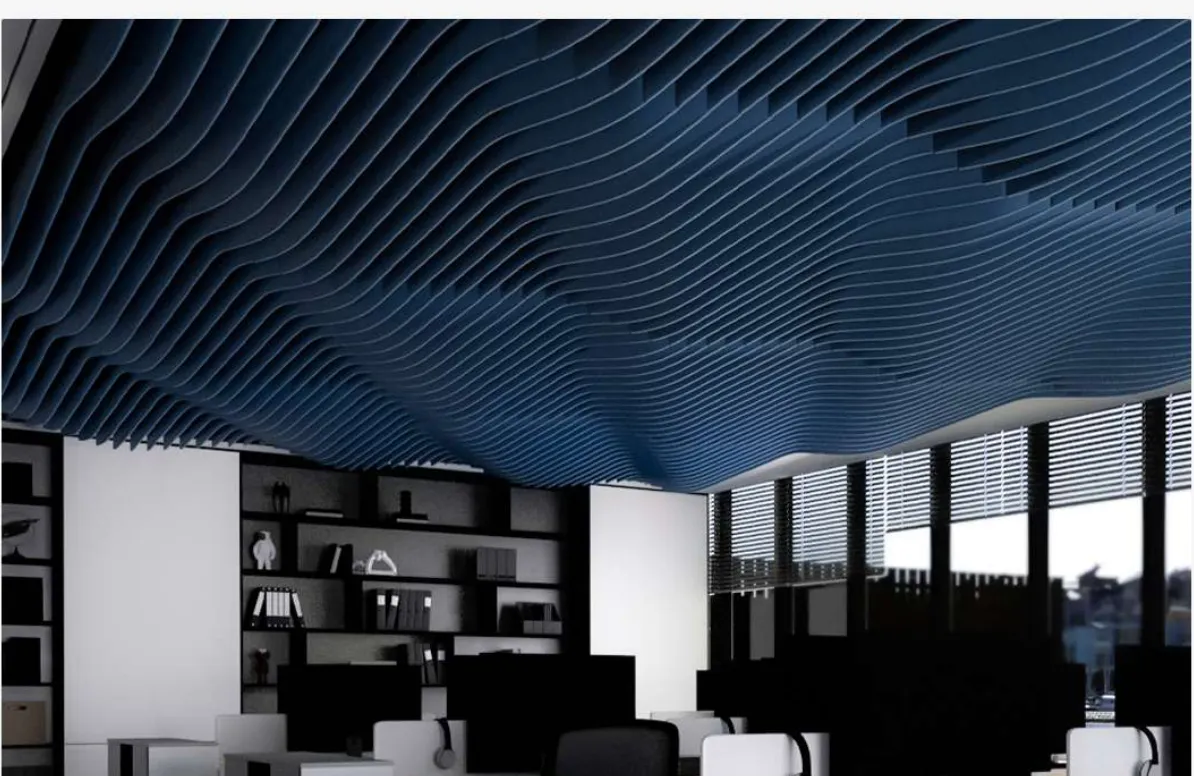
8 profiles · 1200 × 2400 mm
Wave and flute profiles (BW and BL ranges): a ribbed fabric look, in wall strips 2400 mm high.
Explore the collection →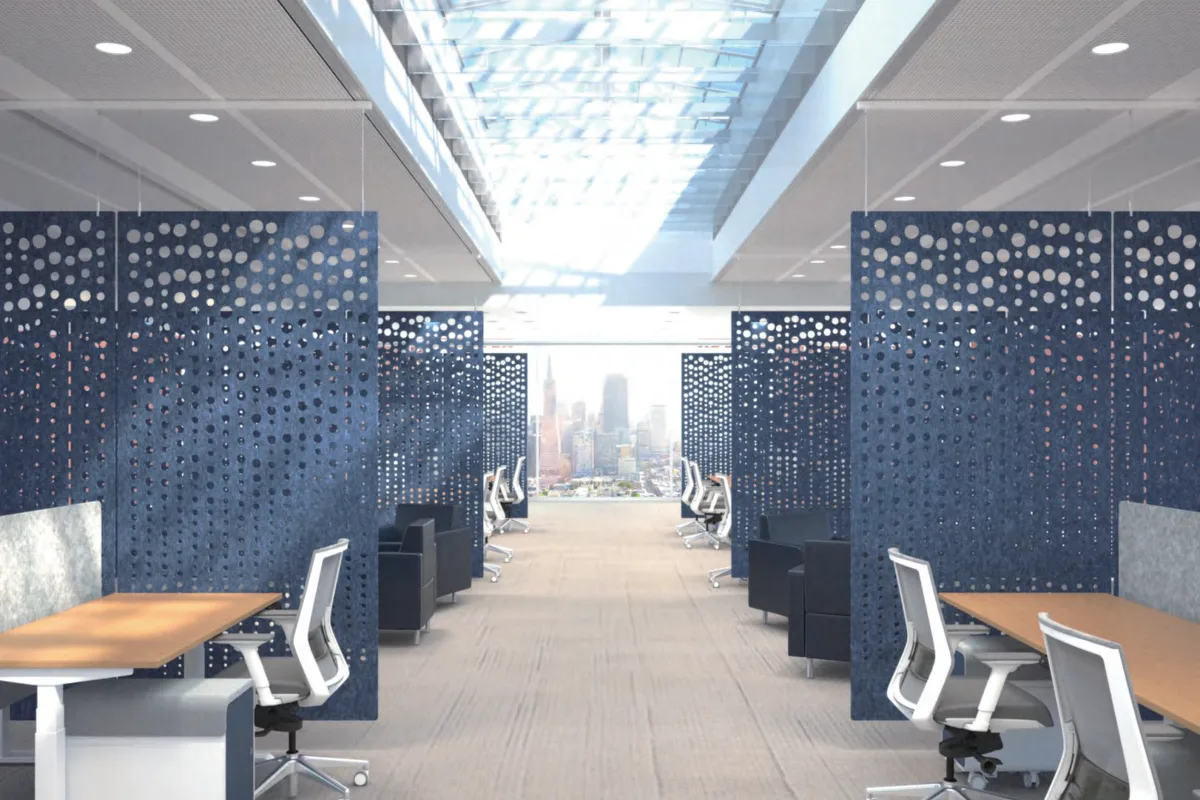
20+ cut-out patterns · suspended
Openwork cut screens (foliage, geometric patterns) hung from the ceiling to zone a space without closing it.
Explore the collection →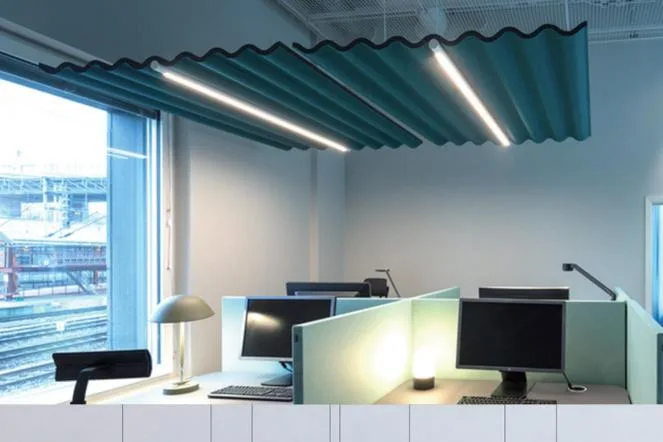
Baffles, grids, islands · ref. CE
Vertical baffles, grids, waves and suspended rafts (CE-001 to CE-014) to treat the ceiling.
Explore the collection →In real spaces
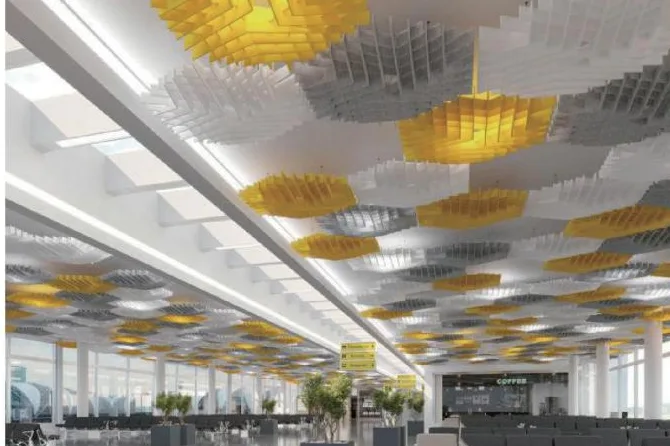
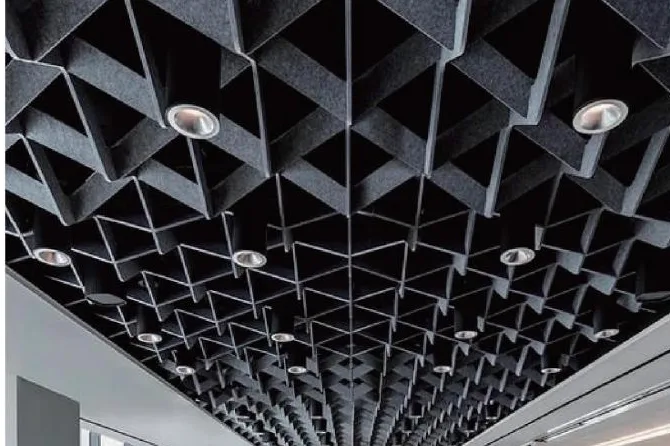
Layout & density
The number of baffles is not a magic figure. It follows from the volume to treat, the ceiling height, the materials in place and the starting reverberation time. In an open space, you generally aim for 30 to 40 % of the ceiling surface covered in absorption. In a more partitioned room, where the walls already play a part, 20 to 30 % is often enough. As a guide, one baffle treats on the order of 2,5 to 3 m² of room, but this ratio shifts with height and initial echo.
The layout is the fitting plan: how many lines, what spacing, what orientation. The spacing counts as much as the number. Too tight, and the baffles cast acoustic shadow on each other and the yield plateaus. Too far apart, and zones of the volume stay reverberant. We therefore look for a regular distribution that exposes a maximum of faces to the sound, taking into account the lighting, the sprinklers, the ventilation and the beams to work around.
Rather than applying a catalogue recipe, we start from your plan with surface, height and materials, we estimate the useful absorbent surface to reach the target reverberation time, then we draw the layout. You know exactly how many baffles you are buying and the expected effect, without the oversizing that inflates the bill without improving anything.
Baffles or a suspended ceiling?
On a large volume you want to keep open, suspended baffles almost always win.
Where to fit them
Where the ceiling is high and the surface large.
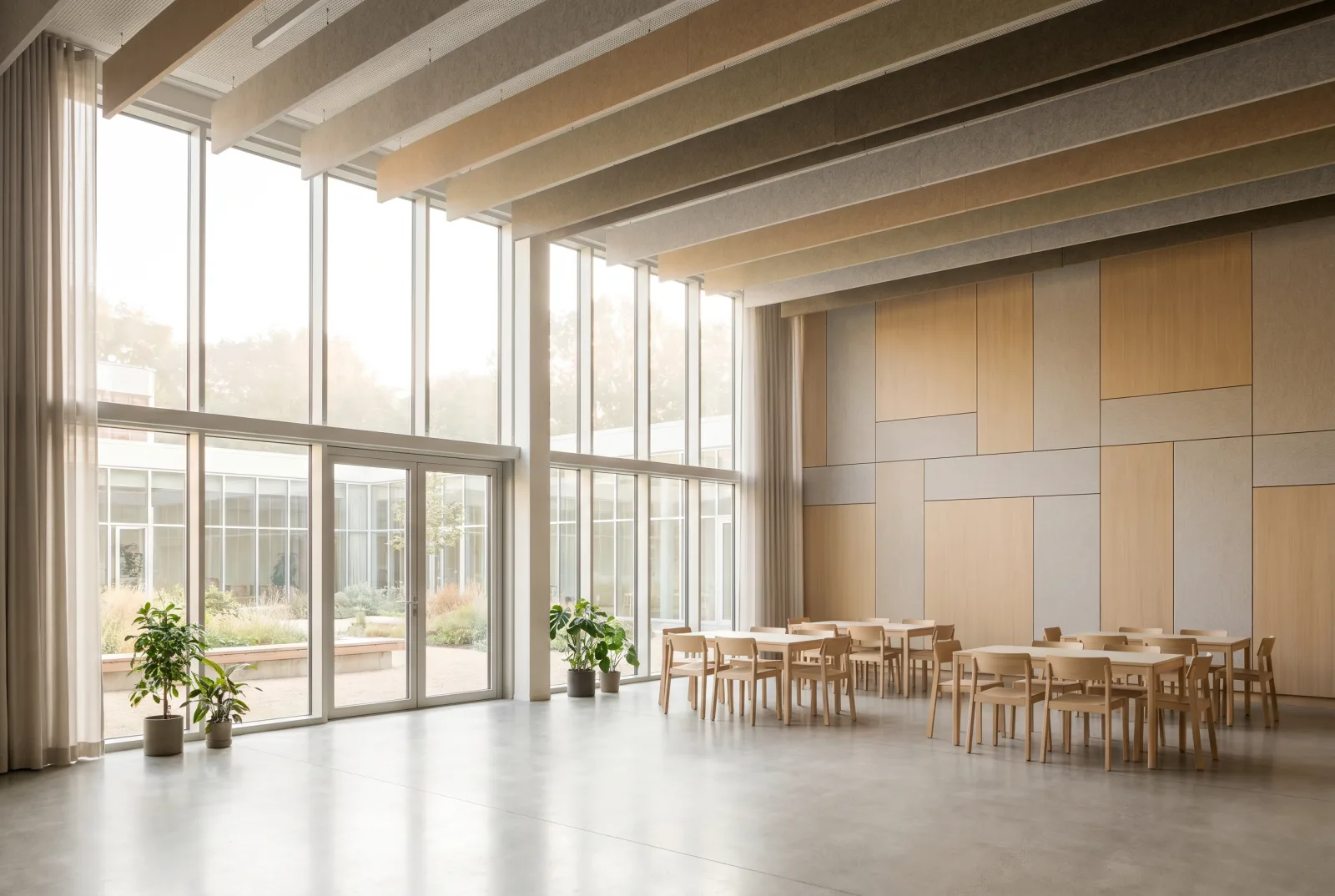
Large, very reverberant volumes where the ceiling is the first lever.
Public-building acoustics →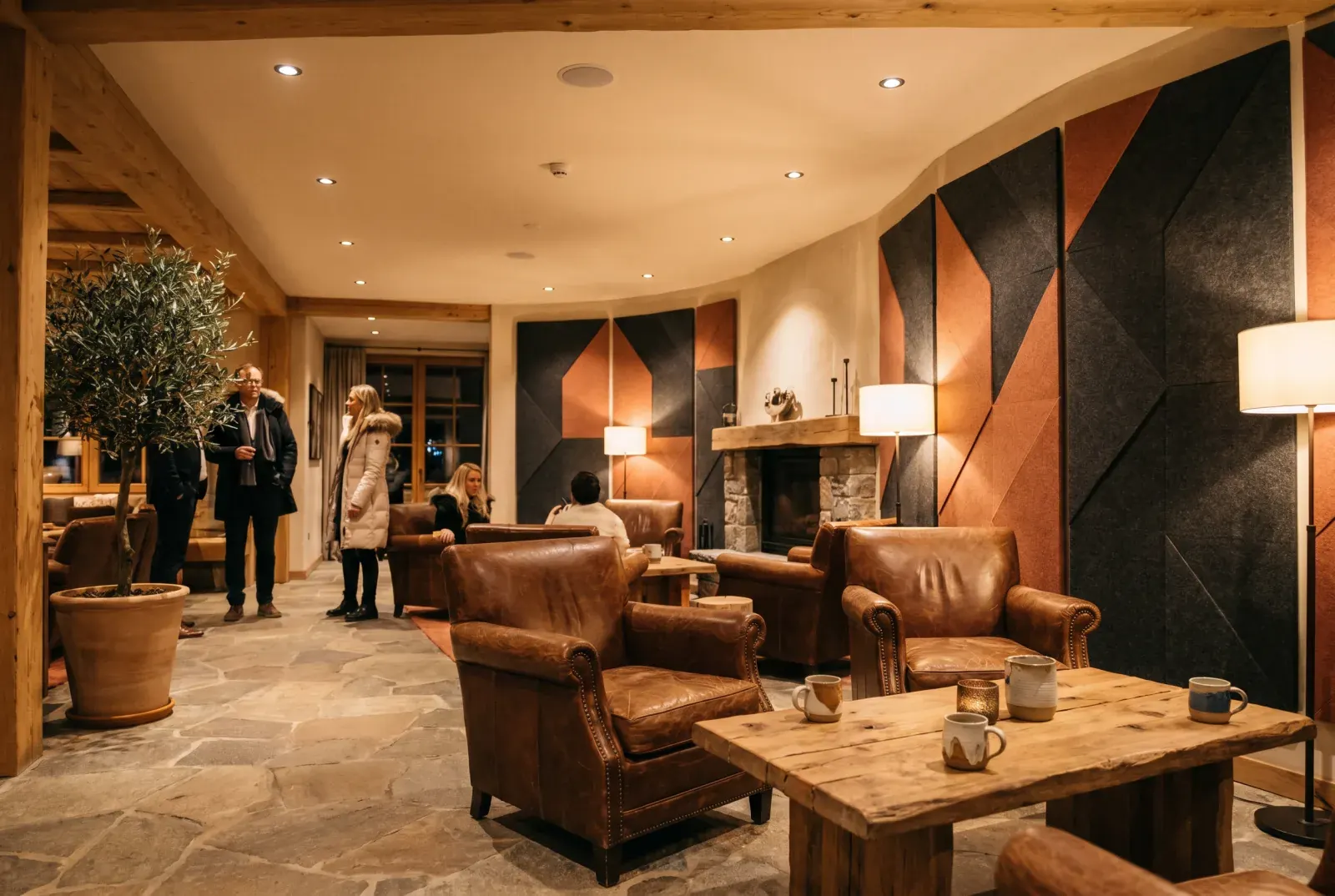
Atriums and reception halls with high ceilings, treated without touching the ceiling.
Hotel acoustics →
A mass of absorption up high, where the floor is already taken.
Office acoustics →The install
Baffles hang by cables and fixings to the ceiling or the roof structure, at the chosen height. The light weight of PET felt is a real asset here: thin cables are enough, the load on the structure stays minimal, and you avoid the rails and heavy frames of a false ceiling. We adapt the fixing system to the support, whether it is concrete, steel decking, metal beams or a timber structure.
The install is done at height, with a lift or a rolling scaffold, often in a space that stays in use. You can align the baffles, cross them in a chequerboard or vary the heights for a graphic look. The layout plan supplied with the order specifies the fixing points, the cable lengths and the mounting order, so the installer moves ahead without improvising.
Many technical teams fit them themselves from this plan. For a more complex job, a very high ceiling or coordination with other trades, we schedule the deliveries around your timeline. DDP delivery worldwide, duties and taxes included, with no surprise on arrival.
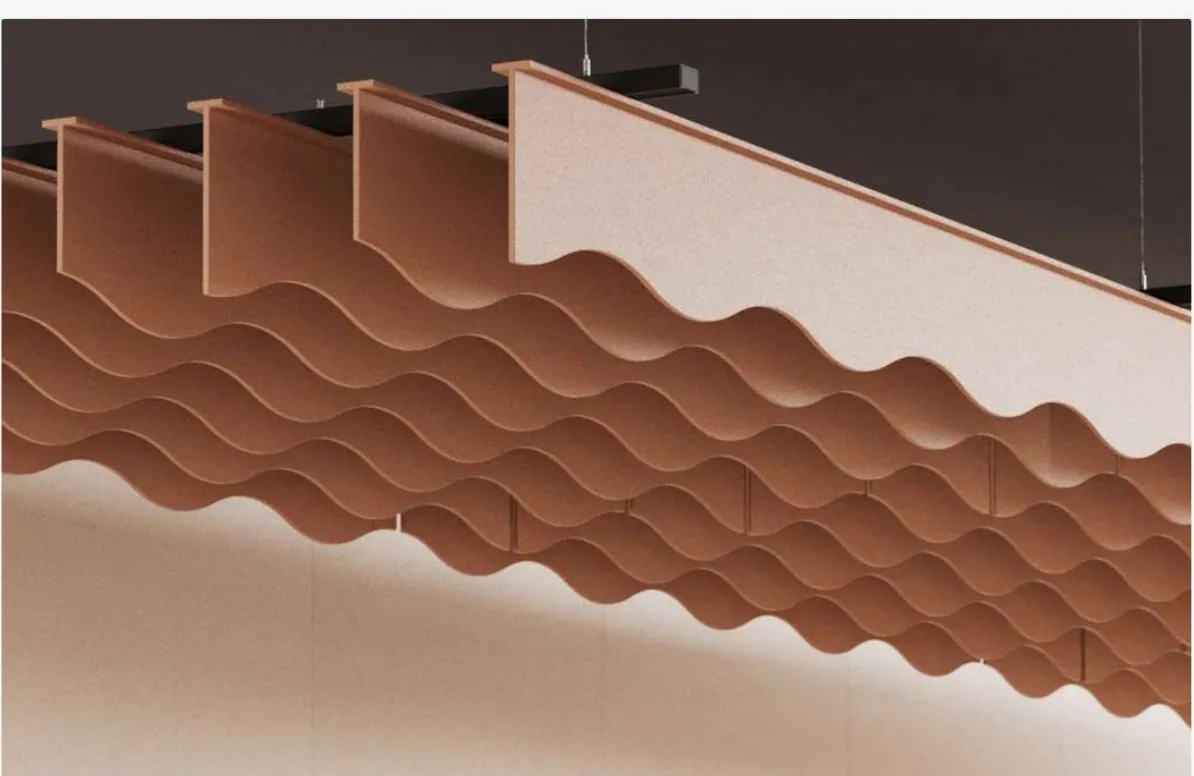
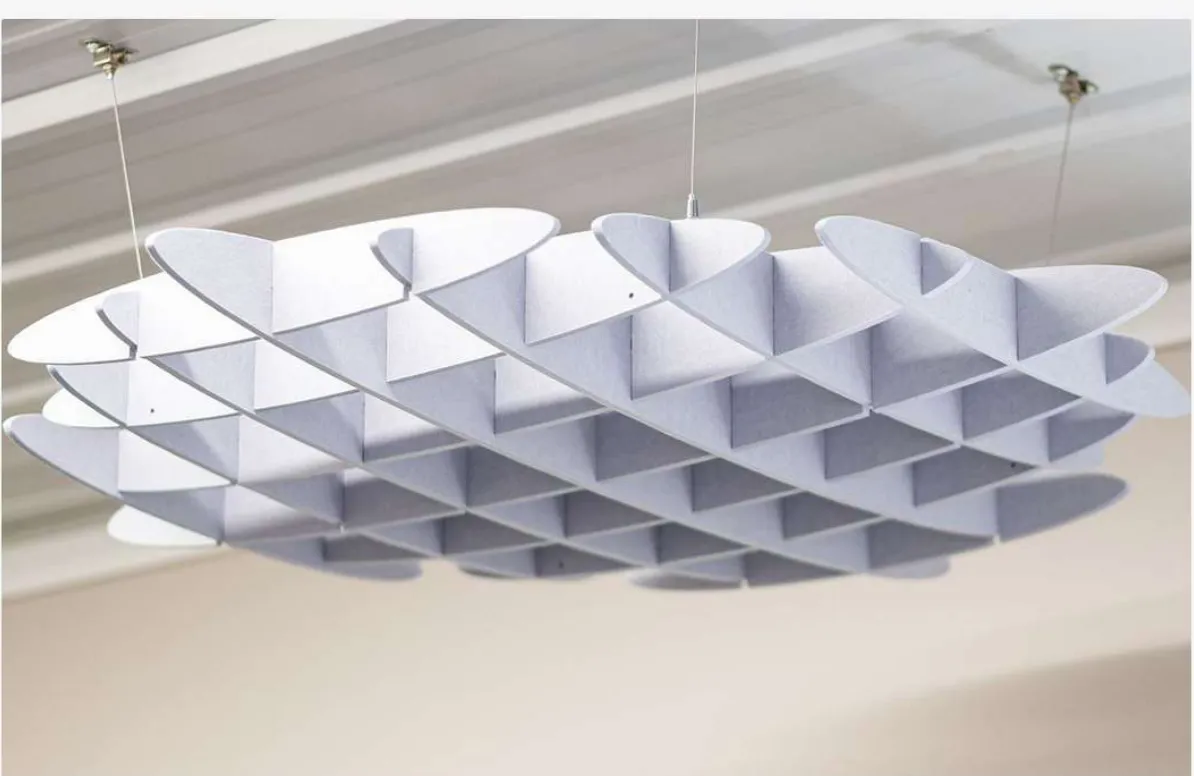
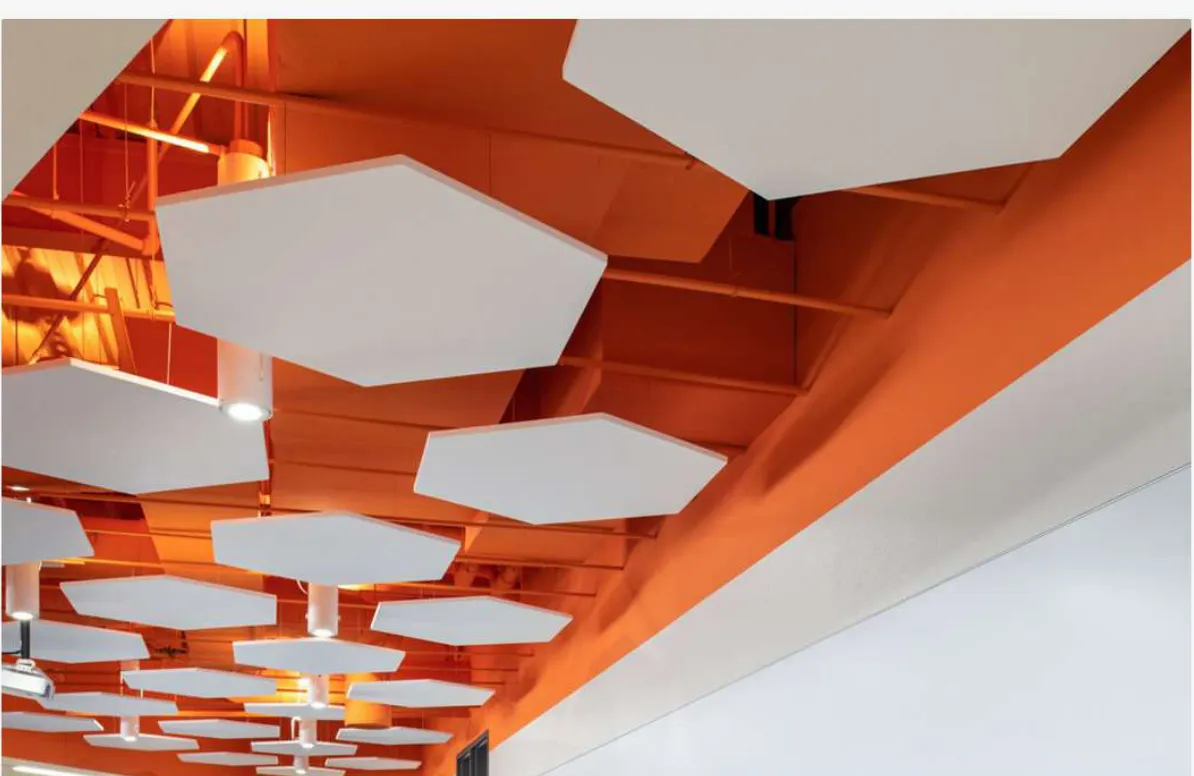
Canteens, lobbies, restaurants, gyms and multi-purpose halls receive the public: they require a suitable fire classification. Our baffles are classified EN 13501-1 B-s1,d0, the level expected in public-access buildings, and the classification report comes with every order, ready for the safety file or the inspection body. We check this point from the quote stage, along with the suspension and the clearances, to avoid the solution fitted then rejected by the commission.
The ACOUSTELIO difference
Baffles are not just a technical device: aligned or in a chequerboard, printed in your colours, they draw the ceiling and structure the space. You get maximum absorption and a visual signature, layout plan to back it up, approved on a proof before production. A logo, a gradient, a mood pattern: the felt takes high-definition printing without losing any of its absorbing power.
To combine with wall panels for the lateral reflections.
Maintenance
A ceiling treatment has to last for years without tying up your teams. PET felt answers this requirement well. It does not deform, does not crumble and does not release fibres the way bare mineral wool would: nothing falls onto the tables, desks or machines below. The material withstands the normal humidity of a heated space and keeps its shade over time.
On maintenance, an occasional dusting with a soft-brush vacuum is enough, once or twice a year depending on the setting. Suspended up high, baffles escape the knocks and everyday dirt, unlike a shoulder-height wall panel. In case of a local stain, a targeted dry clean solves the point without taking down the whole line.
How it works
Surface, height, materials, starting reverberation.
Fitting plan, approved visual, quote within 48 h.
Made-to-measure baffles, fire- and absorption-certified.
Delivered DDP with a fixing plan, within 10 to 15 days.
Send the plan of your space, layout plan and quote within 48 h.
Request my free quoteFrequently asked questions
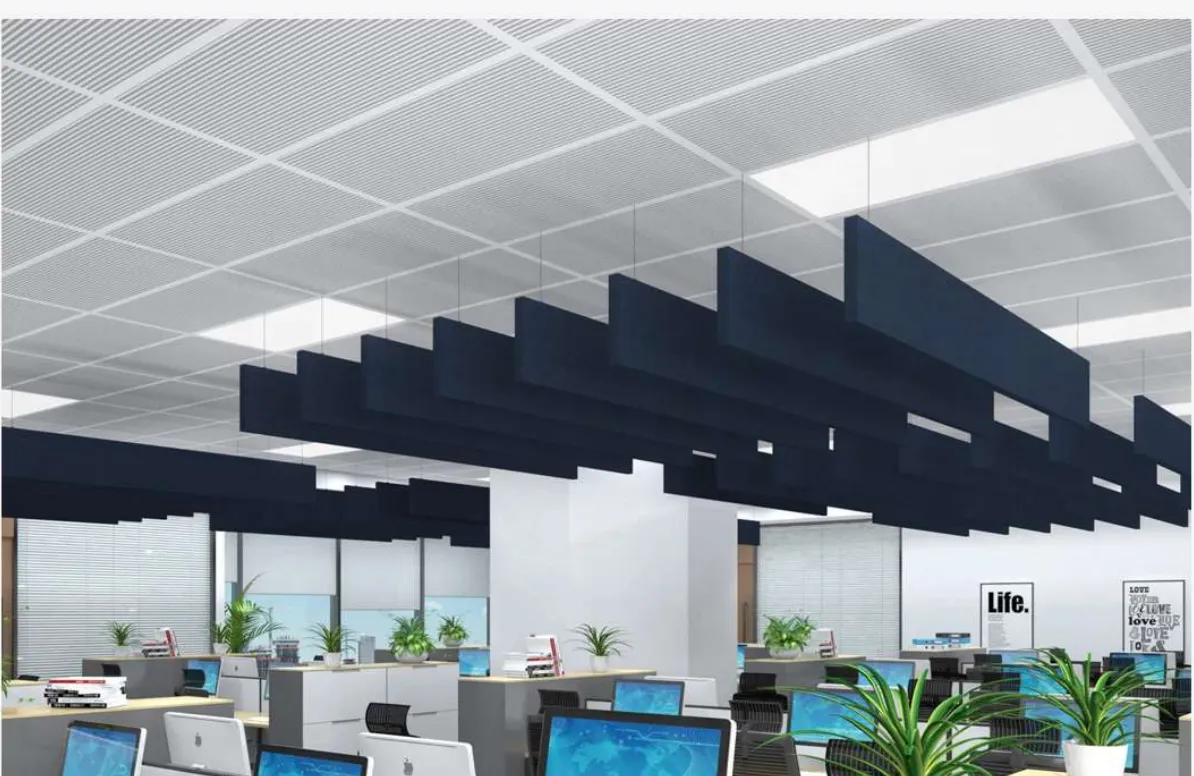
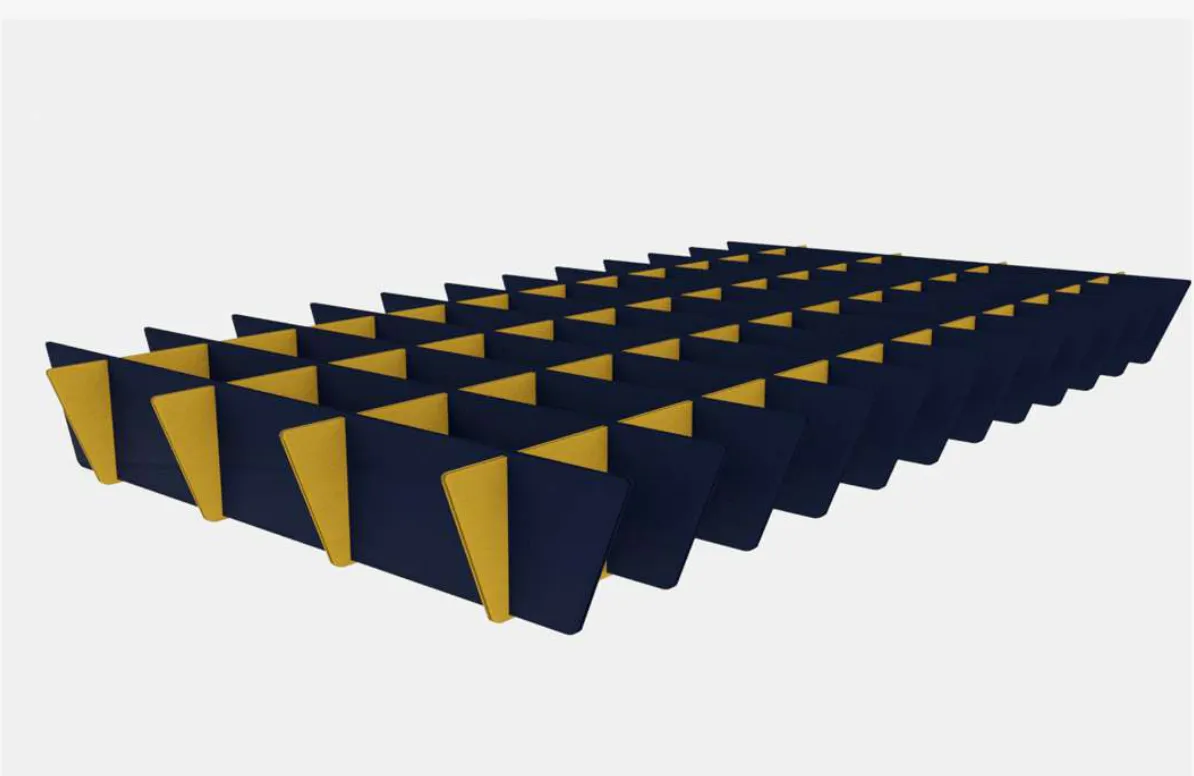
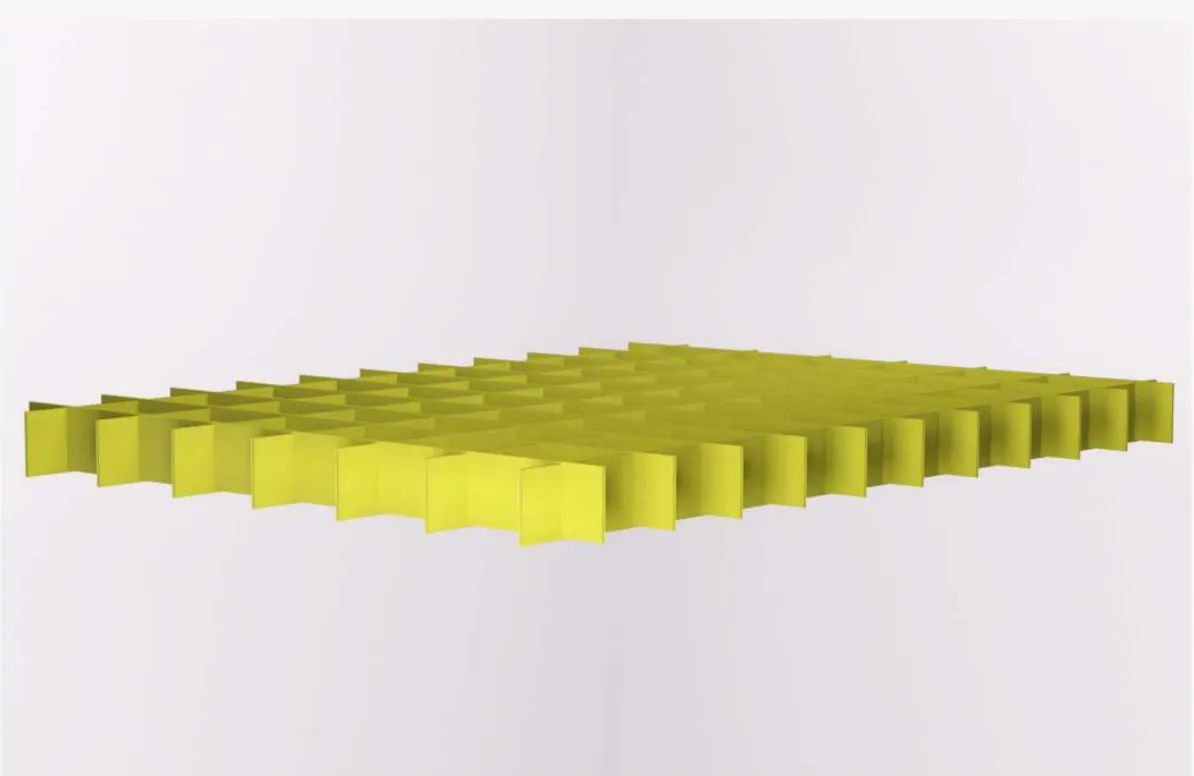
In a large volume, sound is settled from above. The ceiling is the biggest bare surface, and a baffle works there on both its faces, where a bonded panel offers only one.
The principle we apply to every volume, from the workshop to the reception hall.
Felt colour chart · 55
Every reference in this collection comes in the 55 colours of the PET felt chart, with free mixing between modules.
FC 100Neutrals & sands
FC 200Suns & greens
FC 300Powders & purples
FC 400Greys & blues
FC 500Deeps & reds
On-screen shades are indicative: felt is a melange material, physical samples prevail (sent with your quote on request).
2026 catalogue
36-colour chart, pattern boards, dimensioned ceiling systems, desk screens and certified performance data: everything you need to specify or price your project.
Send us the plan of your space, and we come back with a layout plan and a quote within 48 h.
Request my free quote