A noisy restaurant almost always comes down to an excess of hard surfaces that reflect voices and trigger the Lombard effect: every guest talks louder to be heard. The most effective remedy is to absorb sound at the ceiling and on the walls, treating 15 to 30 % of the dining room’s surfaces.
According to a British survey by Action on Hearing Loss, 79 % of customers have already cut short a night out at a restaurant or cafe because of noise. The din drives people away before the bill even arrives.
ACOUSTELIO manufactures made-to-measure acoustic panels in PET felt, with measured NRC 0,85 absorption and a B-s1,d0 fire rating required in public-access buildings. On our projects, we see an average of 50 % less reverberation, with a tailored quote within 48 h.
A noisy restaurant is not an inevitable side effect of a busy night. It is a physical problem, measurable and reversible: when voices bounce off the tile, the glass and a bare ceiling, the sound level spirals upward and the room becomes exhausting for everyone. The good news is that well-sized made-to-measure acoustic panels break that spiral without touching your decor.
In this guide, we lay out why a dining room becomes unbearable, what noise really costs your revenue, the sound levels measured in food service and the solutions ranked by order of effectiveness. With the budgets to match, because an owner rarely decides without figures.
Why does a restaurant get noisy even half full?
A restaurant gets noisy when the room’s reverberation amplifies conversations instead of absorbing them. Three mechanisms combine, and they feed on each other the moment the room fills up.
The first is reverberation. Tile, polished concrete, glazed bays, raw wood tables, a smooth ceiling: all these hard surfaces send sound back instead of dampening it. A voice then lingers one to two seconds in the room, overlaps with the next ones and creates that continuous din your customers describe in reviews. The mineral-heavy decor trends of the last decade have objectively made the phenomenon worse.
The second is the Lombard effect, described as early as 1911 by the French ENT doctor Etienne Lombard: when ambient noise rises, everyone raises their voice by reflex, by about 0.5 decibel of voice for every extra decibel of noise. As a result, each table feeds the noise of the others. The room runs away on its own, without any single customer being at fault.
The third is the cocktail party effect: our brain can isolate a voice in the din, but that cognitive effort is draining. Past a certain level, following a conversation becomes work. In plain terms, your dining room tires your customers out.
- Hard surfaces: glass, tile and a bare ceiling reflect up to 95 % of the sound energy that strikes them
- Lombard effect: every rise in ambient noise mechanically pushes guests to talk louder
- Overlapping voices: the longer the reverberation, the more conversations blend together and become unintelligible
- Operating noise: dishes, chairs moved around, the coffee machine and an open kitchen add to the background level
What sound levels do you actually measure in a restaurant dining room?
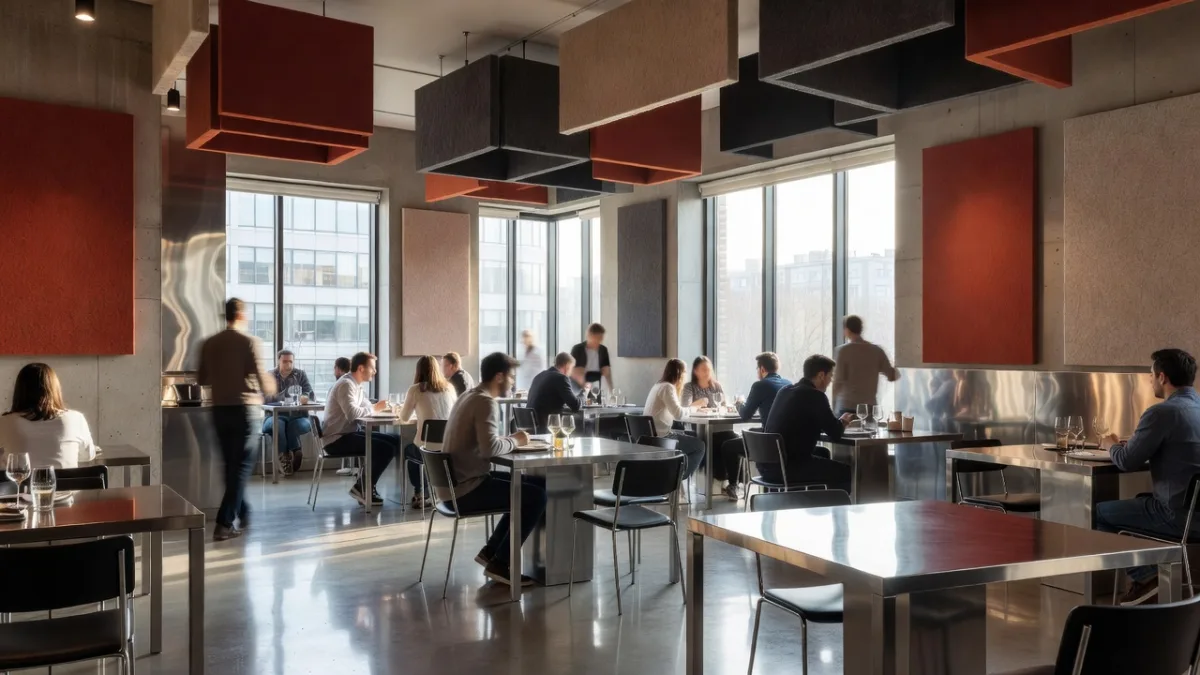
A comfortable restaurant dining room sits between 60 and 70 dB(A); above 75 dB(A), conversation takes effort, and above 80 dB(A) you enter the zone that workplace regulations treat as an action threshold. These orders of magnitude are worth knowing, because perception deceives: a “lively” room and a harmful one are separated by only a few decibels.
A useful reminder: the decibel scale is logarithmic. Going from 70 to 80 dB(A) is not 15 % more noise, it is ten times the sound energy. That is why a room tips so fast from lively to unbearable on a Friday night. Measure it yourself, mid-service, with a simple sound-meter app: the figure almost always surprises the owners we work with.
| Room atmosphere | Measured level | What your customers experience | Business impact |
|---|---|---|---|
| Quiet | 55 to 65 dB(A) | Normal conversation, no vocal effort | Longer meals, desserts and coffees ordered |
| Lively | 70 to 75 dB(A) | You have to raise your voice at 1 metre | Fatigue by the end of the meal, tables turning fast |
| Loud | 80 to 85 dB(A) | Shouted conversation, exchanges cut to a minimum | Shortened meals, negative reviews, lost customers |
| Harmful | Over 85 dB(A) | Hearing-risk zone with prolonged exposure | Staff exposed, legal obligation to act |
Readings taken in Parisian brasseries mid-service regularly top 80 dB(A). In other words, a noisy restaurant sometimes exposes its teams to levels comparable to a workshop, with no protection or hearing break.
What does a too-loud restaurant cost your revenue?
A too-loud restaurant loses money on four fronts: customer reviews, average check, retention and staff turnover. Noise is not a comfort detail, it is a silent leak in profitability. Silent for you, at least.
Let’s start with reviews. In the Action on Hearing Loss survey cited above, 79 % of respondents said they had cut a night out short because of noise. And the Zagat surveys of American restaurant customers already ranked noise as the top complaint, ahead of service. One word then keeps showing up in your Google reviews: “noisy”. It is visible to all your future customers, and it weighs on your overall rating.
The average check follows the same slope. When conversation becomes a chore, customers cut it short: no dessert, no second bottle, no coffee. At ACOUSTELIO, we find on our food-service projects that owners almost all mention this exact symptom: tables clearing too fast in the evening, with neither the kitchen nor the service to blame.
- Customer reviews: noise ranks among the first spontaneous complaints in food service, and it gets written in black and white in your Google reviews
- Average check: a shortened meal cuts into the add-on sale, where a good share of your margin is made
- Retention: a customer worn out by your dining room does not come back, even if the food was good
- Staff: INRS points out that the French Labour Code sets an action threshold from 80 dB(A) over 8 hours; hearing fatigue feeds order errors and turnover
Let’s be honest on one point: no one can promise you “+15 % revenue” after acoustic treatment, and be wary of anyone who does. On the other hand, removing a documented cause of shortened meals and negative reviews is an investment that stands up easily against what a half-deserted dining room costs on an evening.
Which solutions reduce noise in a restaurant, in order of effectiveness?
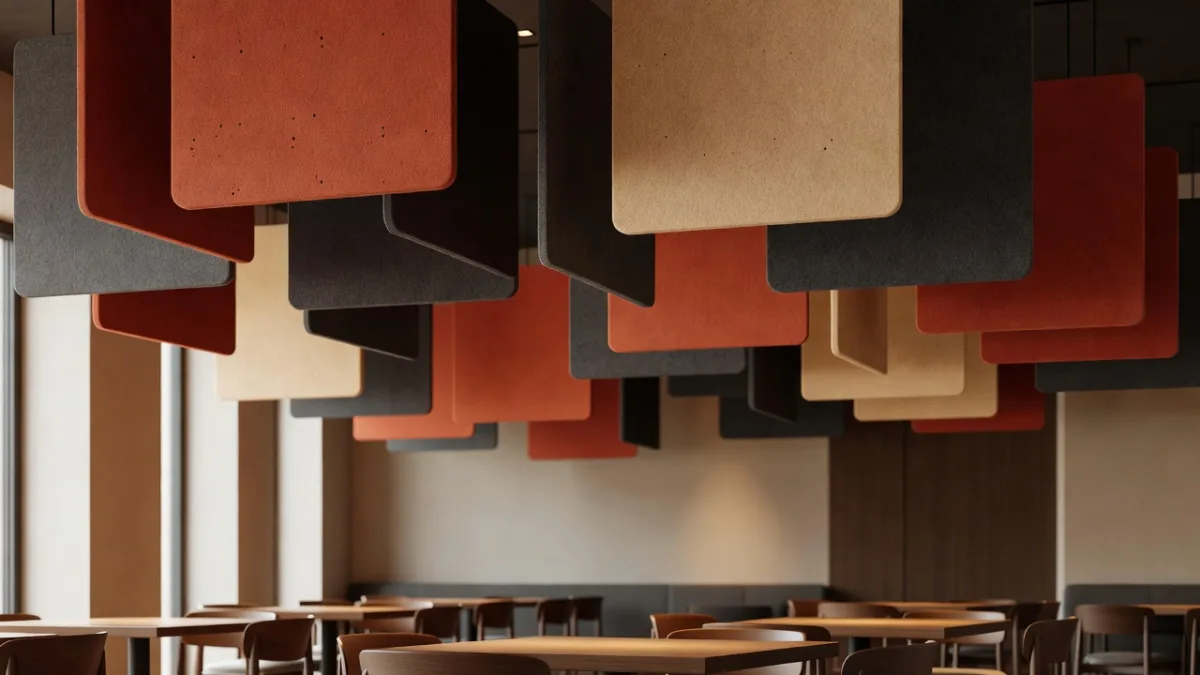
To reduce noise in a restaurant, the order of effectiveness is constant: the ceiling first, then the walls, next the furniture, finally the layout. This hierarchy follows from the room’s physics, not from a product preference.
The ceiling first. Always. It is the largest reflecting surface in your room, it faces every table at the same time, and it is free of furniture. Suspended acoustic ceiling baffles and rafts capture sound at the source of the reverberation, without sacrificing a single usable square metre. In a room with a high ceiling, it is the number one lever, by far.
The walls next. Acoustic wall panels mounted on the reflecting surfaces, first on the parallel walls that bounce sound back and forth, complete the ceiling absorption and treat the zones near the tables. Rely on the field rule we apply at ACOUSTELIO: treating 15 to 30 % of the wall and ceiling area is generally enough to transform how a room feels.
Furniture and layout come last, because they refine but do not correct. Padded banquettes, thick curtains, rugs under the tables: each element absorbs a little. Spacing the tables, moving the bar away from the dining zones, breaking up long sightlines with screens: each choice limits propagation. But none matches a treated ceiling.
- Ceiling: suspended baffles or rafts, the most effective lever per m², the effect is audible from the moment of install
- Walls: NRC 0,85 absorbing panels on the reflecting surfaces and the parallel walls
- Furniture: banquettes, curtains and rugs as a supplement, useful but not enough on their own
- Layout: table spacing and zoning the room to limit the build-up of voices
A point of vocabulary that spares a lot of disappointment: all of this is acoustic treatment, not soundproofing. If your problem is the neighbour upstairs hearing your music, absorbing panels will not fix it; that calls for soundproofing works. Our dedicated page on restaurant acoustics details the exact scope of each approach and our sizing method.
How do you treat the acoustics without spoiling your decor?
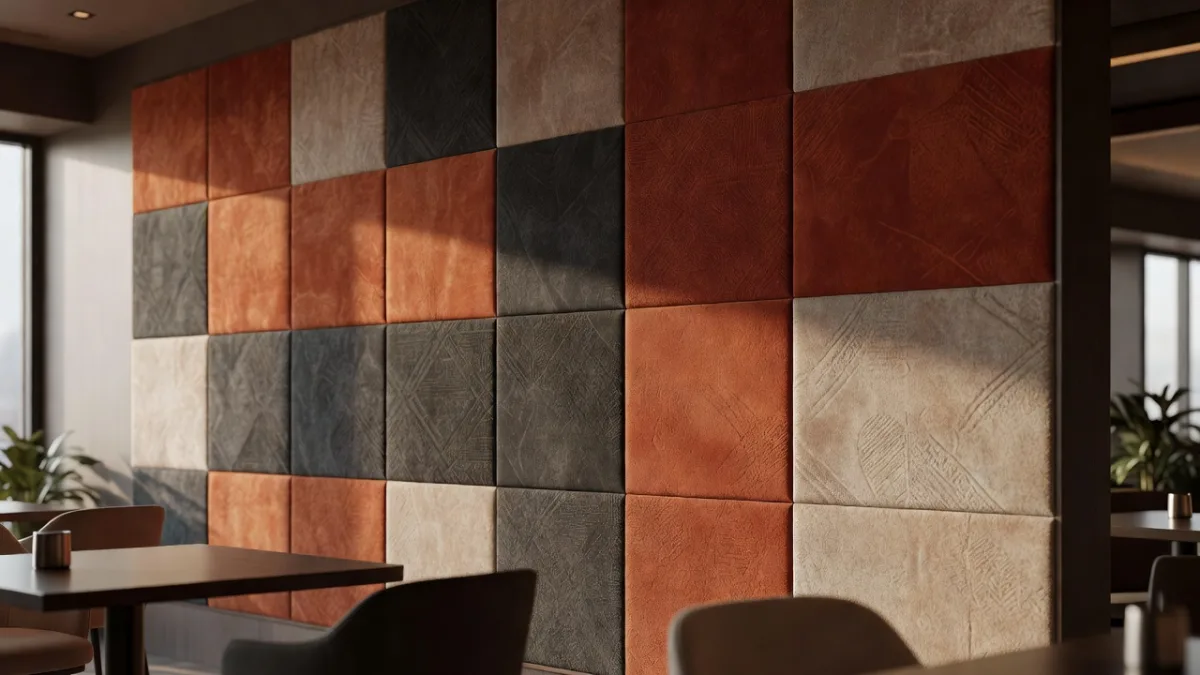
The acoustic treatment of a restaurant can vanish into the decor or become a design feature in its own right. It is the second option we champion, because an owner has already invested in their visual identity and has no desire to spoil it with grey tiles.
PET felt cuts into any shape and comes in dozens of colours. Better still: made-to-measure high-definition printing turns an absorbing panel into a wall mural, an interior sign or an echo of your graphic identity. The panel no longer hides, it shows off. Your customers see a design statement; you hear the difference.
In 2026, this dual reading has become a strong selling point for restaurateurs: the same budget buys the acoustic treatment and a signature decorative element. When you compare it with the cost of a painted mural that absorbs nothing, the trade-off is quick.
- Free shapes: panels cut into circles, waves or motifs matched to your world
- HD printing: visuals, textures or photographs printed directly onto the felt
- Colours: plain ranges to blend into the room or contrast boldly
- Approved proof (BAT): at ACOUSTELIO, no production starts before your artwork sign-off, and the compliant-or-remade guarantee applies
How much does acoustic treatment cost for a restaurant dining room?
The acoustic treatment of a restaurant dining room starts at 49 €/m² for a wall panel and 59 €/m² for ceiling and baffles at ACOUSTELIO, and the 15-to-30 % rule of treated surfaces lets you cost it up fast. Let’s take a concrete case, because abstract ranges help no one.
An 80 m² floor area room, an equivalent ceiling, around 100 m² of walls. A mid-range assumption: treat 25 % of the ceiling, that is 20 m² of baffles at 59 €/m², and 20 % of the walls, that is 20 m² of panels at 49 €/m². Total materials: about 2,160 €. The install stays simple, adhesive or clips on the wall and cable suspension at the ceiling, so it can be done without a long closure. Knowing that full treatments with a study billed by acousticians commonly run from 80 to 300 €/m² installed, the gap deserves a comparative quote.
Three factors move the bill, and it is best to know them before signing anything:
- Area to treat: a heavily glazed or very tall room calls for a coverage closer to 30 % than to 15 %
- Finish: a plain panel costs less than a made-to-measure cut with HD printing, the difference funds your visual identity
- Public-access-building compliance: the B-s1,d0 fire rating to EN 13501-1 is the level required in public-access establishments; at ACOUSTELIO the test report is supplied with every order, demand it everywhere else
- Lead times: count on a quote within 48 h and DDP delivery in 10 to 15 working days, duties included, EU and United Kingdom
Our stance is clear: start with the ceiling, measure the result, add the walls if needed. This step-by-step approach avoids over-treating, and it spreads the investment across two financial years if your cash flow requires it.
Frequently asked questions about noisy restaurants
Why did my restaurant get noisier after my renovation?
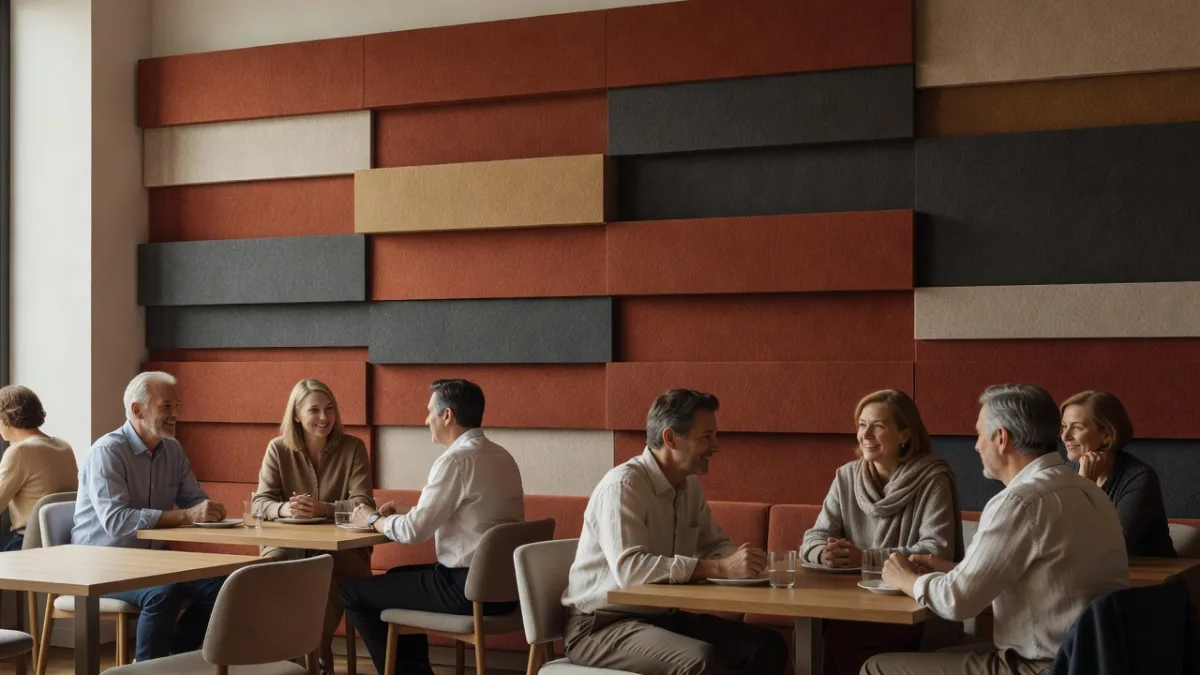
Because your renovation probably swapped absorbing materials for hard surfaces. Carpet turned into tile, a suspended ceiling taken down for exposed concrete, curtains removed in favour of large windows: each substitution raises the room’s reverberation. The industrial, mineral style, in heavy demand for a decade, is aesthetically successful but acoustically disastrous. The sound that was once dampened now bounces freely, the Lombard effect kicks in and the noise level climbs as soon as a few tables are occupied. The fix is not to go backwards: PET felt panels at the ceiling and on the walls restore the lost absorption while respecting your new decor.
What sound level should you aim for in a restaurant dining room?
Aim for 65 to 70 dB(A) mid-service for a lively but comfortable room, and rather 60 to 65 dB(A) for a fine-dining positioning. At these levels, two customers can talk at a metre without raising their voices. The second indicator to watch is the reverberation time: between 0.5 and 0.8 second, voices stay intelligible without the room feeling dead. The goal is never silence, a restaurant with no sonic life feels empty and unsettling. It is about controlling the runaway build-up of noise so that the buzz stays a pleasant backdrop rather than a wall of sound. A sound-meter app is enough to place your room before works.
How many acoustic panels do you need for a 100 m² dining room?
Count on 15 to 30 m² of absorbing surface for a 100 m² floor-area room, depending on the ceiling height and the proportion of hard surfaces. It is the field rule observed on our projects: treating 15 to 30 % of the wall and ceiling area is generally enough to halve the reverberation. A heavily glazed room with a concrete ceiling will sit at the top of the range, a room with banquettes and curtains at the bottom. Distribution counts as much as quantity: favour the ceiling, then the parallel walls that bounce sound back and forth. Our team sizes the exact surface for free at quote time, within 48 h.
Are acoustic panels allowed in a public-access restaurant?
Yes, provided their fire rating meets standard EN 13501-1 at a B-s1,d0 level, the standard required for finishes in public-access establishments. This point rules out decorative foams and certain entry-level panels sold online without a test report. Before any purchase, always ask the supplier for the fire-classification test report: without this document, your safety commission can require the panels to be taken down. At ACOUSTELIO, every order ships with its report, and the PET felt used gives off neither toxic fumes nor flaming droplets in a fire, which is exactly what the s1,d0 rating means.
Can you treat the acoustics without closing the restaurant?
Yes, in the vast majority of cases, acoustic treatment is installed without closing. Wall panels are fixed with adhesive or clips in a few hours, and ceiling baffles are hung by cables, all of it outside service hours or on a weekly closing morning. A medium-sized room is treated in one or two visits. It is a decisive advantage of panel-based acoustic treatment over heavy works: no dusty site, no loss of trading, no room shut off for weeks. PET felt is light, it requires neither structural reinforcement nor rework of existing supports in almost all rooms.
Does background music make the room noise worse?
Yes, in a reverberant room, music mechanically makes the problem worse instead of creating the intended atmosphere. It adds to the background level, triggers the Lombard effect and pushes every table to talk louder to get over it. Many owners then turn up the volume so the music stays audible, which ratchets the spiral up a notch. The right order of operations is unambiguous: treat the reverberation first, then set the music in a room that has become sound. After treatment, a much lower music volume is enough to create the atmosphere, because it is no longer competing with a din amplified by the walls and the ceiling.
You now know why a restaurant gets noisy, what levels to aim for and in what order to act. What remains is to cost your room: send us its dimensions and a few photos, and receive a tailored quote within 48 h, sized to the 15-to-30 % rule, with the artwork approved before production and delivery in 10 to 15 working days.