Meeting room acoustics are good when the reverberation time sits between 0.4 and 0.6 seconds, the target set by the French NF S31-080 standard. To reach it, treat the surfaces in this order: ceiling, wall facing the screen, back wall, then table and floor.
According to the Ifop survey run for the French National Hearing Day, 59 % of working people in France say they are bothered by noise at work. And on a video call, the flaw is heard twice: in the room, then again by every remote participant.
ACOUSTELIO manufactures PET felt panels certified EN 13501-1 (B-s1,d0), with an NRC 0,85 absorption coefficient: on our projects, we measure an average 50 % drop in reverberation. Custom quote within 48 h, proof approved before production.
A meeting room that echoes sabotages your video calls, because the microphone picks up the reverberation as much as the voice. The problem comes from the room, almost never from the equipment. That is the bad news. The good news: fixing the acoustics of a meeting room takes no building work, just made-to-measure acoustic panels in PET felt installed in half a day.
At ACOUSTELIO, we fit out 8 m² meeting rooms as well as 60 m² boardrooms, and the same story repeats itself: the company first invested in a high-end video bar, then found that remote participants still heard a distant, metallic voice. This guide walks through our field method, in the order we apply it on our own projects.
Why do your video calls sound bad despite recent equipment?
Video calls sound bad because the microphone captures the room’s reverberant field, not just the direct voice. An untreated glass-walled room bounces every word back 5 to 8 times before it dies away, and the microphone records all of it.
Your ear, on the other hand, knows how to sort it out. The brain filters the reflections and reconstructs intelligible speech, so the room feels roughly fine when you are in it. The microphone has no such filter. It adds the voice and its delayed copies together, and the result reaches your counterparts muddled: metallic voice, cathedral effect, swallowed sentence endings. Echo-reduction algorithms compensate for part of the problem, but they work on a signal that is already degraded. No DSP can rebuild a consonant drowned in 1.2 seconds of reverberation.
Three signs that the room is at fault, not your equipment:
- Metallic voice: remote participants describe your sound as a train station hall or a car park, typical of excess reflections
- Residual echo: your counterparts hear their own voice coming back, because your loudspeakers excite the room and the microphone picks the whole thing up again
- Intelligibility that comes and goes: the start of sentences gets through, the end gets lost, a sign of late reflections off the back wall
The cost is very real: longer meetings, information repeated, fatigue by the end of the day. The INRS ranks noise among the major workplace nuisances, with documented effects on stress and concentration.
What reverberation time should you aim for in a meeting room?
The target reverberation time for a meeting room sits between 0.4 and 0.6 seconds, the level recommended by the NF S31-080 standard for workspaces. Beyond 0.8 seconds, intelligibility drops and video calls become a chore.
The reverberation time, or RT, measures how long a sound takes to decay by 60 decibels after it stops. In practice, it is the length of the sonic “tail” you hear after a hand clap. We cover the measurement and the calculation in our guide to reverberation time, but keep these orders of magnitude in mind:
- 0.4 to 0.6 s: the target for a meeting room, clear speech in the room and on video calls alike
- 0.6 to 0.8 s: acceptable in person, already annoying for remote participants
- 0.8 to 1.2 s: the usual case for untreated glass-walled rooms, tiring meetings and muddled calls
- Above 1.2 s: the room is unusable for video conferencing without treatment
The NF S31-080 standard is not a legal requirement, but it serves as the reference in tenders and in HQE, WELL or BREEAM certifications. It defines three performance levels, from “standard” to “high performance”, and it is the benchmark we base our recommendations on. In 2026, with hybrid work now the norm, aiming for the bottom of the range (0.4 to 0.5 s) is in our view the right reflex: a meeting room now serves first and foremost as a video conferencing studio.
How do you diagnose your meeting room’s acoustics in 30 seconds?
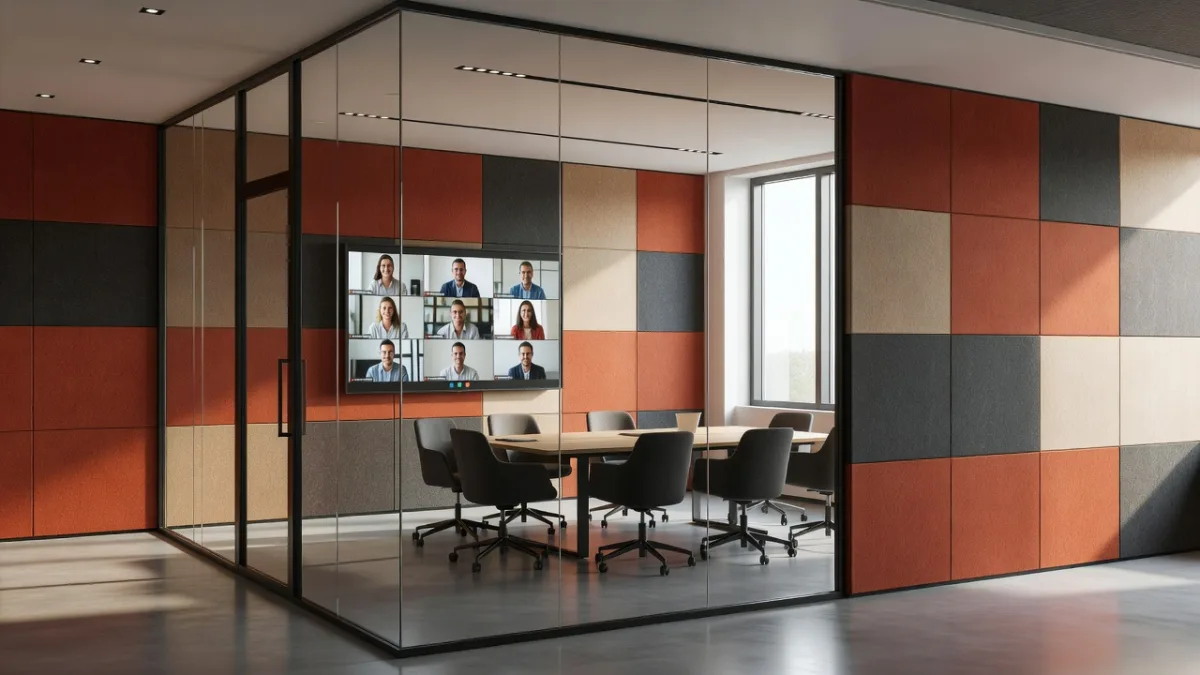
The clap test is enough for a first diagnosis: stand in the centre of the empty room, clap your hands hard and listen to the sonic tail. If the clap “floats” or rings for more than half a second, the room needs treatment.
This empirical test does not replace a sound level meter measurement, and we are the first to say so. But it separates problem rooms very well. A dry clap that dies instantly: the room is healthy. A resonance that lingers, an echo snapping between two walls, a metallic ringing: you have just heard what your microphone sends to your counterparts. Run the test in several spots, including where the video microphone sits, because that is where the diagnosis matters.
Then link each symptom heard on calls to its physical cause. That is the whole point of the table below, built from the complaints our clients report most often:
| Symptom on video calls | Acoustic cause | Priority treatment |
|---|---|---|
| Metallic voice, cathedral effect | Overall reverberation too long (RT above 0.8 s) | Absorbent ceiling or suspended baffles |
| Echo heard by remote participants | The microphone picks up loudspeaker sound reflected off the walls | Panels on the wall facing the screen |
| Distant voice, as if from the back of a cellar | Reverberant field dominating at the microphone | Ceiling absorption, above the table |
| Muddled sentence endings | Late reflections off the back wall | Panels on the back wall |
| Keyboards, cups and knocks amplified | Hard table and floor, no soft surface | Felt desk pads, rugs or carpet |
A word of caution on reading the table:
- Single symptom: treat the surface indicated as a priority, the gain is immediate
- Multiple symptoms: the room stacks up defects and it is the overall RT that must come down, following the order in the next chapter
- Lingering doubt: send us the dimensions and 3 photos of the room, we size the need within 48 h
In what order should you treat the room’s four surfaces?
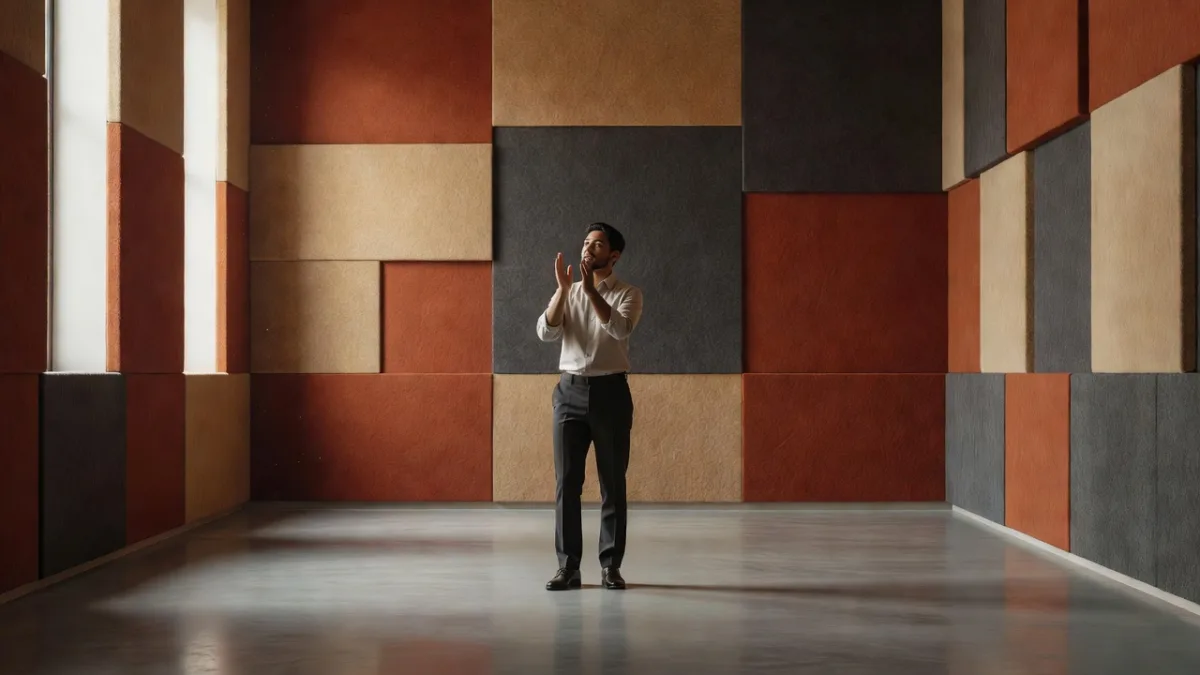
Always treat in this order: the ceiling first, then the wall facing the screen, next the back wall, and finally the table and floor. This order follows each surface’s decreasing acoustic yield, so every euro invested delivers its maximum effect.
At ACOUSTELIO, our projects show that the ceiling alone often delivers 60 % of the total gain. It is the largest free surface in the room, it looms over the meeting table, and it intercepts the voices of every participant wherever they sit. Panels glued directly or baffles hung on cables when a service void runs overhead: both work.
- 1. The ceiling: the surface with the best yield, treated with panels or baffles above the table to dry out the overall reverberant field
- 2. The wall facing the screen: the sound from the video loudspeakers hits this wall first and heads straight back to the microphone, a few wall panels there break the echo loop
- 3. The back wall: it sends back late reflections that blur word endings, treating it noticeably improves intelligibility
- 4. The table and floor: felt desk pads, rugs or carpet absorb the impact noises (keyboards, cups, chairs) that table microphones amplify
What about the glazing, then? You do not treat it, you neutralise it: when two glass walls face each other, reinforcing the absorption on the ceiling and the two solid walls is usually enough to compensate. The result: the light stays, the echo goes, and the meeting room’s acoustics balance out without touching the glass.
What mistakes waste the budget without improving the sound?
The costliest mistake is replacing the video conferencing equipment before treating the room. A 1,500 € microphone in a room reverberating at 1.2 s transmits a degraded signal that nothing can recover.
Frankly, swapping the video bar before hanging a single panel is like fitting new tyres to a car with no shock absorbers. We see it with a majority of our office clients: two generations of equipment purchased, zero wall treatment, and the same echo as on day one. Acoustically treating a meeting room almost always costs less than the audio equipment it finally allows to perform.
The other classic traps we come across in the field:
- Bare glass walls facing each other: two smooth parallel surfaces create a telltale flutter echo, you have to absorb on the remaining surfaces to break it
- Token treatment: two small decorative panels in a corner change nothing, the field rule is to cover 15 to 30 % of the wall and ceiling surface
- Thin budget foams: they only absorb the highs and leave the voice muddy, a thick PET felt with an NRC of 0,85 treats the whole speech spectrum
- Confusing treatment and soundproofing: absorbent panels clarify the sound inside the room, but they do not stop conversations from crossing a lightweight partition
- Room treated, open space forgotten: noise from the neighbouring floor plate comes in every time the door opens and pollutes the microphone, a global treatment of the office and open space fixes both problems at once
How do you size the treatment for a 30 m² room?
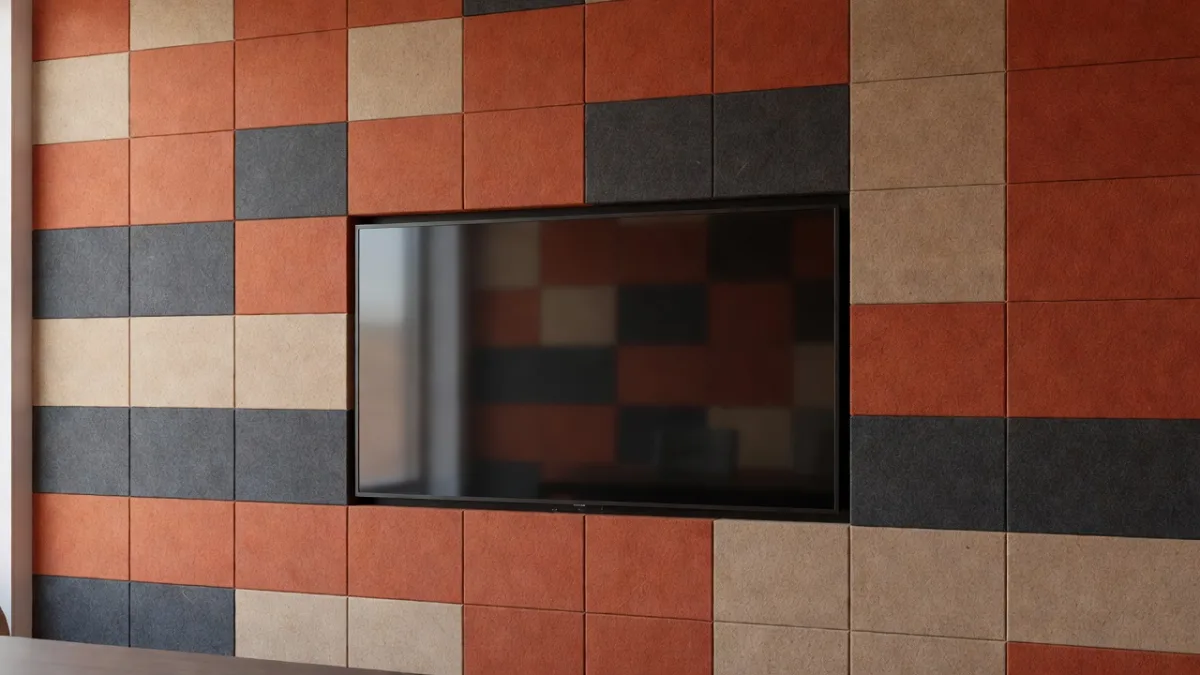
To fix the acoustics of a 30 m² meeting room under a 2.7 m ceiling, count on 16 to 17 m² of NRC 0,85 panels to go from an RT of 1.1 s to around 0.5 s. That represents less than 20 % of the available surfaces, walls and ceiling combined.
The calculation rests on Sabine’s formula: RT = 0.16 x V / A, where V is the room’s volume and A its equivalent absorption area. Our typical room measures 30 m² x 2.7 m, so 81 m³. Measured at 1.1 s (the usual case for a glass-walled room), it holds about 12 m² of absorption. To aim for 0.5 s, it needs 26. So 14 m² of equivalent absorption are missing, which means 16 to 17 m² of PET felt panels at NRC 0,85. The full method, with other room formats, is in our article on how many acoustic panels to plan for.
The split that works best on our projects:
- Ceiling: 9 to 10 m² of panels or baffles centred above the meeting table
- Wall facing the screen: 4 to 5 m² of wall panels at voice height, between 1 m and 2 m off the floor
- Back wall: 2 to 3 m² to kill the late reflections
- Indicative budget: from 49 €/m² for wall panels and 59 €/m² for ceiling solutions, so around 900 euros of materials for this typical room, delivered in 10 to 15 working days
Let us be honest about the limits: this standard sizing covers the vast majority of classic rectangular rooms, but a boardroom of 80 m³ and up, very tall or L-shaped, deserves an on-site measurement before ordering. When there is any doubt, we say so at the quote stage rather than after installation.
Can you fix the acoustics without making the room ugly?
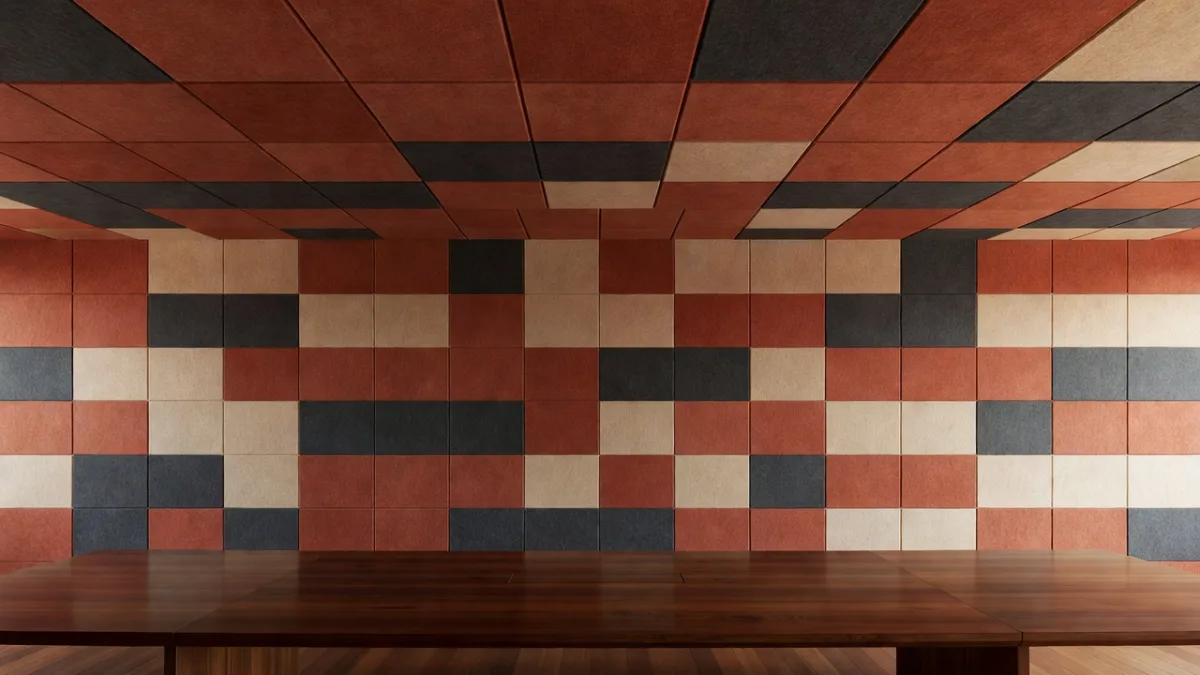
Yes, and it is even an opportunity to turn the meeting room into a branding asset. A printed acoustic panel absorbs just as much as a plain one, so the treatment can display your logo, a mural or your colours without losing a single point of NRC.
The meeting room is the space your clients, candidates and partners see the most. A checkerboard of grey foam would look out of place there, and that is precisely why many companies put off the treatment for years. Our stance: the panel should be shown off, not hidden. High-definition printing on PET felt turns the acoustic constraint into a canvas, and our made-to-measure service adapts formats, cuts and visuals to your brand guidelines, with a proof approved before production.
- Printed panels: logo, room signage or brand visuals directly on the absorbent surface
- Cut-out formats: lettering, geometric shapes or ceiling clouds that structure the room while absorbing
- Public-building compliance: B-s1,d0 fire rating under EN 13501-1, test report supplied with every order, a point landlords often require
- Responsible material: PET felt with a share of recycled content, lightweight, CE and FSC certified
At ACOUSTELIO, our projects show that rooms treated with printed panels become the most booked rooms on the floor. The sound comfort plays its part, the look does the rest.
Frequently asked questions about meeting room acoustics
Why does my meeting room echo even though it is brand new?
A new room echoes because contemporary materials are almost all reflective: glass partitions, concrete, painted plaster, a large laminate table and a hard floor. Sound bounces around without meeting a single absorbent surface, and the reverberation time easily climbs to 1 second or more. The building’s age changes nothing, it is the nature of the surfaces that counts. The most problematic rooms we treat are in fact often the most recent, because the architectural fashion for full-height glass multiplies smooth parallel surfaces. Fixing the acoustics of a new meeting room fortunately remains simple: covering 15 to 30 % of the walls and ceiling with absorbent panels is enough in the vast majority of cases.
What reverberation time should you aim for on quality video calls?
Aim for a reverberation time of 0.4 to 0.6 seconds, in line with the recommendations of the NF S31-080 standard for workspaces. Below 0.6 s, video conferencing microphones capture a clear voice and echo-cancellation algorithms work on a clean signal. Between 0.6 and 0.8 s, the discomfort appears for remote participants, even if the room feels fine in person. Beyond 0.8 s, intelligibility degrades sharply and no equipment compensates. For a room used mainly for video calls, we recommend the bottom of the range, around 0.4 to 0.5 s, where speech gains an almost studio-grade clarity.
Can a high-end microphone make up for bad acoustics?
No, a high-end microphone never fully makes up for a reverberant room, because it processes a signal that is already degraded. Recent video bars carry directional microphones and effective DSPs, and they improve things at the margin. But when the room reverberates beyond 0.8 s, the direct voice and its reflections reach the sensor mixed together, and no algorithm can cleanly separate the two. We systematically advise the opposite order: treat the room first, then assess the equipment. In most cases, the existing equipment turns out to be perfectly decent once the reverberation is halved, and the company saves the planned replacement.
How much does the acoustic treatment of a 30 m² meeting room cost?
Count on around 900 euros of materials for a 30 m² meeting room, based on 16 to 17 m² of PET felt panels at NRC 0,85. Our wall panels start at 49 €/m² and the ceiling solutions (panels and baffles) at 59 €/m². Installation can stay in-house: adhesive or clips on the wall, cable suspension on the ceiling, half a day is enough for a room this size. Add DDP delivery in 10 to 15 working days, duties included, across the EU and the United Kingdom. Every project starts with a custom quote within 48 h, built on your real dimensions rather than a generic package.
Do you have to drill the walls to install acoustic panels?
No, drilling is not required: our wall panels install with adhesive or clips depending on the substrate, and PET felt stays light enough to hold on a simple plasterboard partition. Adhesive suits permanent installations on sound walls. Clips make removal easy, a real advantage in leased offices where the lease requires restoring the premises. On the ceiling, the baffles hang on cables from discreet point fixings. Every order ships with installation instructions, and our conform-or-remake guarantee applies on a photo sent within 48 h of installation. No specialist trade is needed for a standard room.
Do acoustic panels make the meeting room confidential?
Not completely, and we have to be honest on this point: absorbent panels belong to acoustic treatment, not soundproofing. They reduce reverberation and slightly lower the overall sound level in the room, which already limits what escapes. But a conversation will always cross a lightweight partition or a poorly sealed door, whatever the interior treatment. Full confidentiality requires soundproofing work: partitions built up to the slab, high-performance glazing and doors. Our practitioner’s advice: handle the treatment first, which resolves 80 % of video call complaints, then assess whether soundproofing is still needed given the conversations actually held in the room.
Your meeting room deserves better than a car park echo and video calls everyone dreads. Send us its dimensions and a few photos: we calculate the surface to treat, the achievable RT and the exact budget, with a custom quote within 48 h, proof approved before production and delivery in 10 to 15 working days.