The noise level of a restaurant in full service most often sits between 70 and 85 dB(A). French regulations cover three areas: amplified music (102 dB(A) and 118 dB(C) over 15 minutes, decree 2017-1244), noise transmitted to neighbours (an emergence of 5 dB by day, 3 dB at night) and employee exposure (obligations from 80 dB(A)).
According to the IFOP survey run for the National Hearing Day, 92 % of customers say they are bothered by noise in restaurants and struggle to follow the conversation at their table.
ACOUSTELIO manufactures made-to-measure acoustic panels in PET felt (NRC 0,85, certified EN 13501-1 B-s1,d0) for hospitality professionals, with a custom quote within 48 h.
The noise level of a restaurant is governed by three distinct bodies of law: the public health code for amplified sound and neighbourhood noise, the labour code for your employees, and the penal code for disturbance of the peace. Yet no text caps the din of conversations, which remains the number one reason customers walk away.
This guide sets out the exact thresholds, the applicable texts and the concrete risks for a hospitality operator. At ACOUSTELIO, as a manufacturer of made-to-measure acoustic panels for restaurants, we watch operators discover the regulations at the formal-notice stage every single week. Better to know them beforehand. And above all, better to understand why a perfectly compliant establishment can still be unbearable for its customers.
What noise level do you actually measure in a restaurant?
A restaurant in full service commonly reaches 75 to 85 dB(A), the level of a busy street. A comfortable conversation requires staying under 70 dB(A), a gap that most tiled, glazed dining rooms never close on a Saturday night.
These figures come from field measurements, not brochures. At ACOUSTELIO, we record peaks of 88 dB(A) on our projects in 60-cover rooms with bare walls, with the music switched off. The noise came from voices and crockery alone. Here are the orders of magnitude we record by type of establishment:
- Tea room or quiet restaurant: 60 to 68 dB(A), conversation stays natural without raising your voice
- Classic brasserie in service: 72 to 80 dB(A), diners already have to speak up
- “Trendy” restaurant with tiling and polished concrete: 80 to 88 dB(A), talking becomes a strain beyond one metre
- Bar-restaurant with music on a Friday night: 85 to 95 dB(A), a zone of genuine hearing risk for staff
- Kitchen at the height of service: 80 to 90 dB(A) with the hood, the wash-up and call-outs, sometimes more
Keep one simple benchmark in mind: when your customers have to raise their voices at one metre’s distance, you are above 75 dB(A). And the phenomenon feeds on itself, because every table talks louder to drown out the next one. Acousticians call this the Lombard effect, and it can push a room up by 8 to 10 dB in twenty minutes.
What does decree 2017-1244 say if you play amplified music?
The decree 2017-1244 of 7 August 2017 imposes two ceilings on any public venue playing amplified sound: 102 dB(A) over 15 minutes and 118 dB(C) over 15 minutes. The second threshold, weighted in dB(C), specifically targets the low frequencies that subwoofers push through walls.
This text, codified in articles R1336-1 and following of the public health code, applies to restaurants as soon as the music goes beyond simple background sound. The legal criterion: a level above the equal-energy rule based on 80 dB(A) equivalent over 8 hours. In practice, a bar-restaurant that turns up the volume in the evening falls within the decree’s scope, a tea room with a discreet playlist does not. The full text is available on Legifrance (decree 2017-1244).
If you are within scope, the obligations go beyond the thresholds:
- Acoustic impact study: mandatory for enclosed venues that habitually play amplified music, with a limiter installed if the study recommends one
- Public information: display of the sound levels the public is exposed to
- Hearing protection: earplugs made available free of charge
- Hearing rest: quiet zones or rest periods allowing ears to recover
- Continuous recording: required for establishments with a capacity above 300 people
- Young audiences: thresholds lowered to 94 dB(A) and 104 dB(C) when children aged 6 and under are admitted
Our view as practitioners: many operators assume the decree does not apply to them because they are “not running a nightclub”. A frequent mistake. What counts is actual use, not the licence, and the health agency’s inspectors measure what comes out of your speakers on a Saturday at 11 pm.
How do the regulations protect your neighbours from noise?
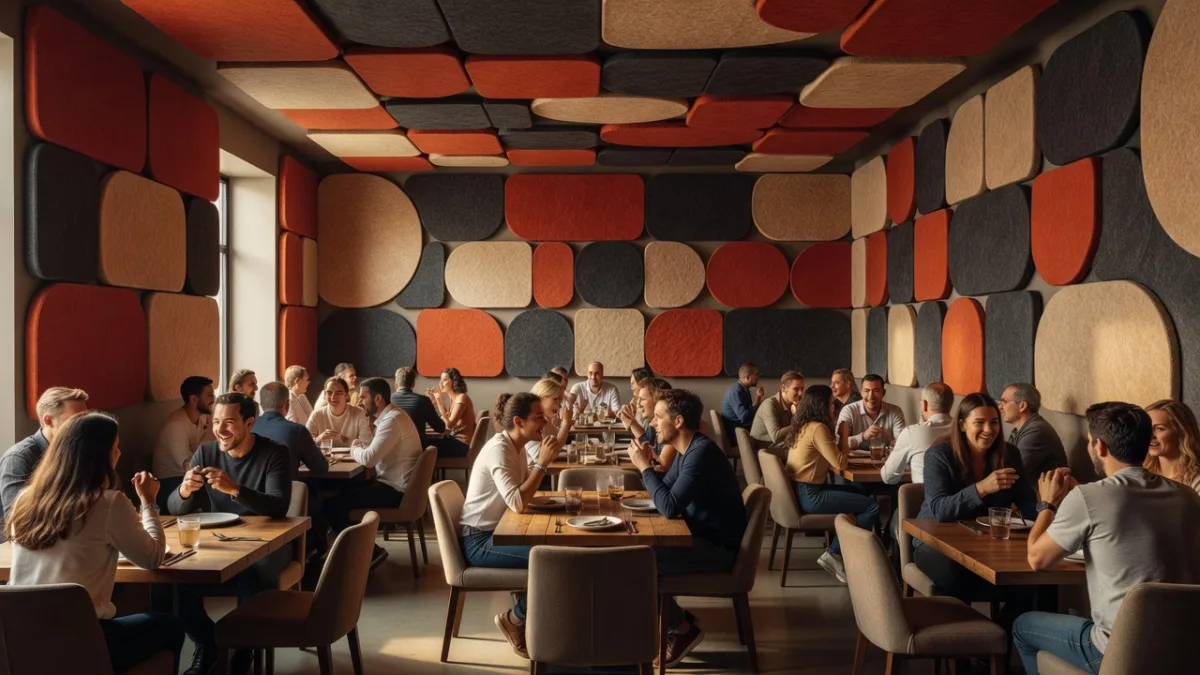
Neighbourhood noise from a business activity is judged by emergence: your restaurant must not exceed the usual ambient noise by more than 5 dB(A) by day (7 am to 10 pm) and 3 dB(A) at night (10 pm to 7 am). These values, set by article R1336-7 of the public health code, are assessed at the neighbour’s home, windows open or closed.
Three decibels is very little. A lively terrace, a poorly insulated extraction hood or a condensing unit on the facade is often enough to breach the night-time threshold. And unlike ordinary night-time disturbance, the offence is established with a sound level meter, with a correction factor depending on the duration of the noise. A spectral emergence also applies per octave band: 7 dB in the low frequencies (125 and 250 Hz), 5 dB in the mids and highs (500 to 4,000 Hz).
The sources of complaint we come across most often in the field:
- Late-night terrace: conversations and laughter after 10 pm, the leading cause of conflict in town centres
- Extraction and ventilation: hoods and condensing units running at night, a continuous noise that neighbours tolerate very badly
- Structure-borne music: low frequencies travelling through floors and party walls
- Early-morning deliveries: metal shutters and handling before 7 am
- Customers leaving: smokers gathering outside the venue, a legal grey area but a very real complaint
One point few operators see coming: a dining room that echoes makes the neighbourhood problem worse, because a noisy interior pushes everyone to talk louder, doors and windows included. Treating the indoor reverberation therefore also reduces what escapes outside.
What does the labour code say for your kitchen and floor staff?
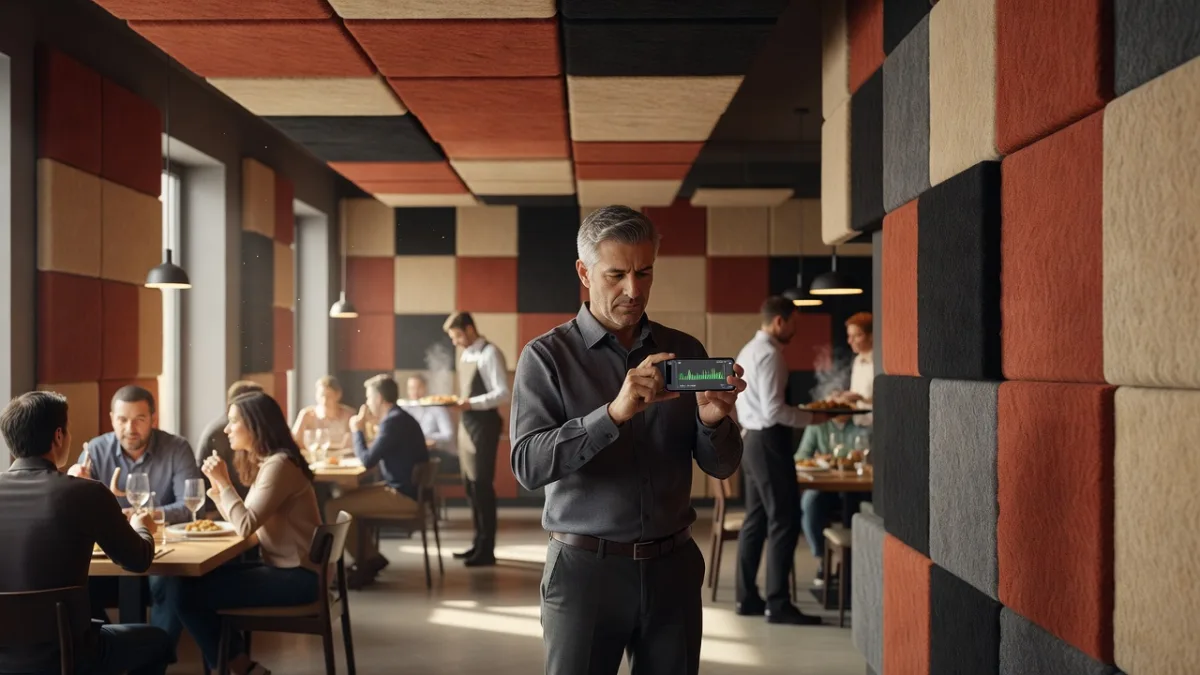
The labour code sets three noise exposure thresholds for your teams: 80, 85 and 87 dB(A) averaged over 8 hours. A kitchen at the height of service or a bar room at the weekend regularly reaches the first threshold, something many hospitality employers still ignore in 2026.
The obligations step up at each threshold, under articles R4431-2 and following:
- From 80 dB(A) over 8 h: individual hearing protection made available, employee information and training, risk assessment
- From 85 dB(A) over 8 h: hearing protection mandatory, noisy zones signposted, a noise reduction programme at source, reinforced medical monitoring
- 87 dB(A), the limit value: the level at the ear, protection included, never to be exceeded
- Peak levels: parallel thresholds at 135, 137 and 140 dB(C) for impulse noise, crockery and equipment impacts included
The technical reference on the subject remains the INRS, which points out that prolonged exposure at 85 dB(A) wears down hearing irreversibly. A waiter who works two back-to-back services in a room at 82 dB(A) takes a noise dose comparable to a workshop position. The result: fatigue, order errors, staff turnover. Noise is not just a customer comfort issue, it is an employer liability issue, and if occupational deafness is recognised, a claim for inexcusable fault can be pursued.
What concrete risks do you run if you exceed the thresholds?
A restaurant that exceeds the regulatory thresholds faces a graduated chain: inspection, formal notice, fine, then administrative closure in persistent cases. The sanction rarely lands overnight, but every step leaves a trace, including with the prefecture that manages your licences.
In detail, the inspector from the regional health agency or the municipal hygiene service establishes the offence with a sound level meter. The prefect then issues a formal notice to comply within a deadline. If nothing changes, class 5 fines follow (1,500 €, 3,000 € for repeat offences), the sound equipment can be confiscated and the establishment temporarily closed. In parallel, a neighbour can bring a civil action for abnormal neighbourhood disturbance, with damages at stake. The table below sums up the applicable texts:
| Situation | Applicable text | Threshold or criterion | Risk incurred |
|---|---|---|---|
| Amplified music in the dining room | Decree 2017-1244, art. R1336-1 public health code | 102 dB(A) and 118 dB(C) over 15 min | Fine of 1,500 €, confiscation, closure |
| Audience aged 6 and under | Order of 17 April 2023 | 94 dB(A) and 104 dB(C) over 15 min | Same sanctions, health agency inspection |
| Complaint from a neighbour | Art. R1336-6 to R1336-8 public health code | Emergence 5 dB(A) day, 3 dB(A) night | Formal notice, fine, civil litigation |
| Kitchen and floor staff | Art. R4431-2 labour code | Action from 80 dB(A), limit 87 dB(A) | Employer liability, inexcusable fault |
| Night-time disturbance, terrace | Art. R623-2 penal code, municipal by-laws | Noise audible from a home after 10 pm | Fine up to 450 €, terrace permit withdrawn |
The most underestimated risk, however, appears in no table: customer reviews. An administrative closure lasts a few weeks, but a “noisy restaurant” reputation on Google lasts for years. That is why regulatory compliance and acoustic comfort must be handled together, not one after the other.
How do you easily measure your restaurant’s noise level?
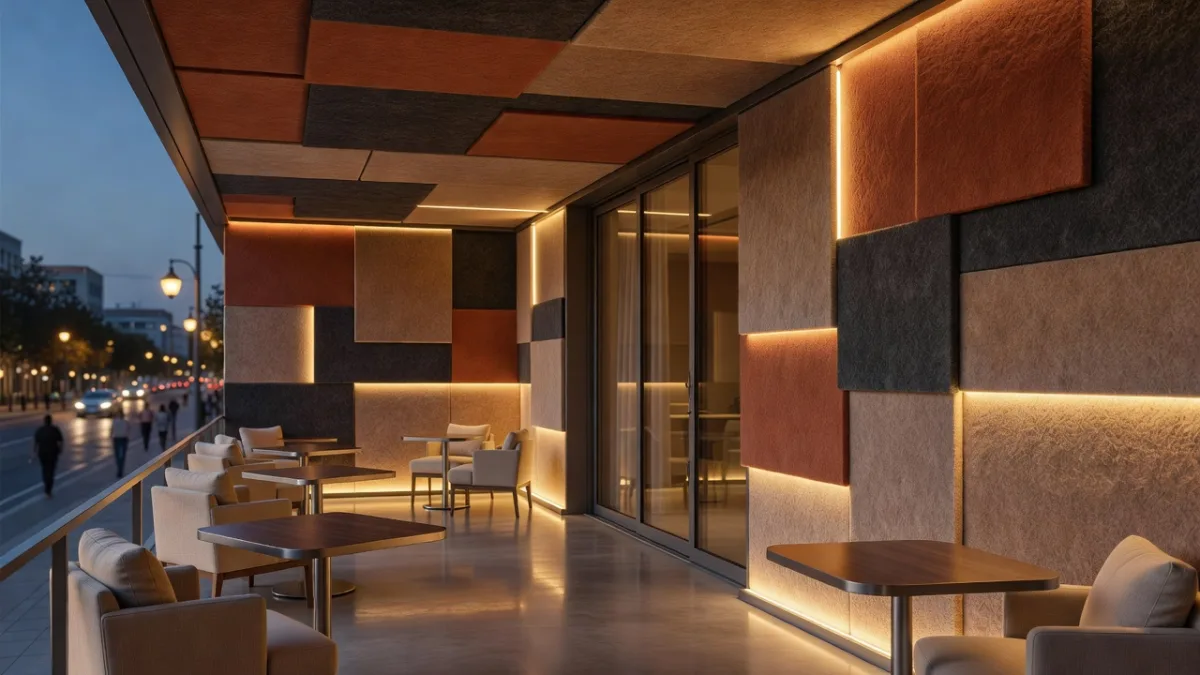
Measuring your restaurant’s noise level takes ten minutes and a smartphone for a first diagnosis, or a class 2 sound level meter for a legally usable value. The indicator to record is the LAeq, meaning the average level in dB(A) over a given period, not the instantaneous value that jumps all over the place.
Our field protocol, the one we apply before every project:
- A reliable app: NIOSH SLM on iPhone or an equivalent calibrated app, bearing in mind that a smartphone keeps a margin of error of 2 to 3 dB
- A representative moment: measure at peak service, Friday or Saturday between 8.30 pm and 9.30 pm, not on a Tuesday at 3 pm
- Ear position: sensor at about 1.20 m off the floor, in the middle of the tables, never pressed against a wall or a speaker
- Sufficient duration: at least 15 minutes of LAeq to smooth out the peaks of crockery and laughter
- Several points: entrance, centre of the room, back of the room and kitchen pass, because a dining room is never homogeneous
If you record more than 78 dB(A) on average, your room has a problem the regulations will never see but your customers already endure. And if a dispute is looming, only a reading taken by an acoustician or a court bailiff equipped with a compliant sound level meter will carry legal weight. The smartphone measurement is for deciding, not for pleading.
Why does the din of conversations remain your real problem?
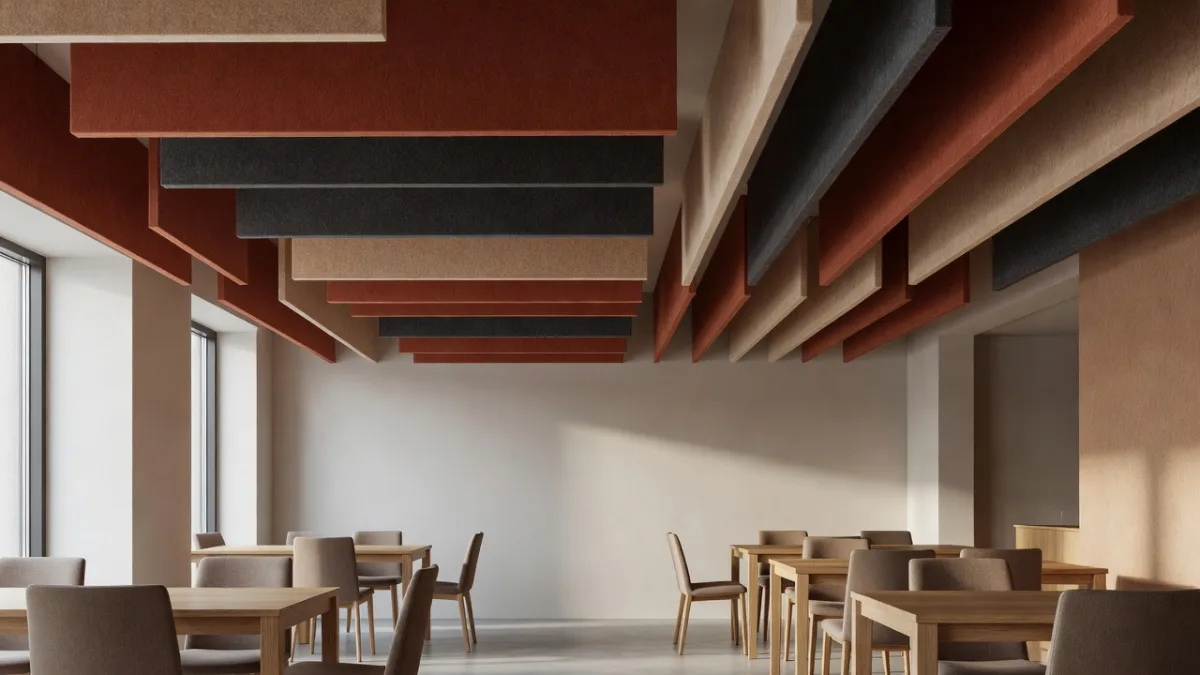
No text regulates the noise of conversations in your dining room, and yet it is what drives customers away. A restaurant can be irreproachable under decree 2017-1244 and still sit at 84 dB(A) of din, simply because its hard surfaces throw every voice back across the whole room.
The mechanism is well known: glass, tiling, polished concrete and bare ceilings reflect sound instead of absorbing it. The reverberation time stretches out, voices pile up, everyone talks louder, and 20 % of French diners consider a restaurant that is too noisy quite simply a bad restaurant. That side of the problem cannot be fixed with a limiter or house rules. It is fixed by treating the surfaces.
That is exactly what acoustic treatment with absorbent panels does:
- Measured absorption: our PET felt panels post an NRC of 0,85, up to 85 % of the noise absorbed at each reflection
- A reasonable surface: treating 15 to 30 % of the walls and ceiling is usually enough to transform a room
- Ceiling first: in a restaurant, ceiling baffles treat the largest free surface without touching the wall decor
- Public-building compliance: B-s1,d0 fire rating under EN 13501-1, test report supplied with every order
- Measured result: an average 50 % drop in reverberation on our projects
At ACOUSTELIO, our restaurant projects show that a treated room typically comes down from 82 to 74 dB(A) at peak service, without cutting the number of covers. For the detail of concrete solutions, room by room, our guide noisy restaurant: the solutions complements this regulatory article, and our dedicated page on restaurant acoustics presents the full approach.
Frequently asked questions about restaurant noise levels
What is an acceptable noise level in a restaurant?
An ambience of 65 to 70 dB(A) is considered comfortable for a restaurant, because it allows natural conversation at the table. Between 70 and 75 dB(A), the atmosphere becomes lively but stays tolerable for lunch. Above 78 dB(A), customers strain their voices and discomfort sets in, and above 85 dB(A) you reach the hearing-risk threshold defined by the labour code for your staff. No law caps the noise of conversations, but the customer experience settles the matter quickly: 92 % of French diners say they are bothered by noise in restaurants, according to the IFOP survey for the National Hearing Day.
Is a sound limiter mandatory in a restaurant?
A limiter is only mandatory if the noise impact study recommends one, for enclosed establishments that habitually play amplified music. A restaurant with simple, discreet background music generally falls outside the scope of decree 2017-1244, so no study and no limiter. On the other hand, as soon as you host DJ nights or concerts, or the volume exceeds the equivalent of 80 dB(A) over 8 hours, the impact study becomes mandatory and the limiter almost always follows. Its settings must then guarantee compliance with the 102 dB(A) and 118 dB(C) ceilings, as well as the emergence values at the neighbours’. A sealed limiter costs between 800 and 2,500 euros installed.
What does a restaurant risk if neighbours complain about noise?
A well-founded neighbourhood complaint exposes the restaurant to a prefectoral formal notice, a class 5 fine (1,500 euros, 3,000 euros for repeat offences) and, if nothing changes, a temporary administrative closure. The procedure starts with an emergence measurement taken with a sound level meter by the regional health agency or the municipal hygiene service: if your activity exceeds the background noise by more than 5 dB(A) by day or 3 dB(A) at night, the offence is established. The neighbour can also take the case to a civil court for abnormal neighbourhood disturbance and obtain damages, or even soundproofing works under penalty. Better to deal with the problem at the first letter.
How do you prove the noise level in a dispute?
Only a measurement taken with a compliant class 1 or class 2 sound level meter, by an acoustician or a court bailiff, carries real evidential weight before a court. Smartphone apps give a useful order of magnitude for managing your establishment, but their 2 to 3 dB margin of error and the lack of certified calibration disqualify them in litigation. For a solid file, have a report drawn up at hours representative of the activity, with measurements of the ambient noise and the residual noise to calculate the emergence. Budget 800 to 2,000 euros for a full acoustic study. It is also the document that protects you if the neighbour’s complaint is exaggerated.
Do the regulations impose a maximum noise level for customers’ conversations?
No, no text caps the din of conversations inside your dining room. Decree 2017-1244 targets amplified sound only, the public health code protects the neighbours, and the labour code protects your staff. Your customers’ acoustic comfort, meanwhile, is covered by no legal obligation. It is a regulatory blind spot, but not a commercial one: a customer who cannot hear themselves speak does not come back, however good the food. The only effective answer is acoustic treatment, meaning sound absorption by suitable materials to break the reverberation and bring the overall level of the room down by 6 to 10 dB(A).
What budget does acoustic compliance for a restaurant dining room require?
Count on from 49 euros per m² for wall panels and 59 euros per m² for ceiling solutions and baffles, knowing that treating 15 to 30 % of the surfaces is usually enough. For an 80 m² dining room, that often means 20 to 30 m² of panels, a budget in the region of 1,200 to 2,500 euros excluding installation, a far cry from the cost of an administrative closure or a lawsuit. Installation is by adhesive or clips on the walls and by suspension from the ceiling, without closing the establishment. At ACOUSTELIO, the custom quote is sent within 48 h, the proof is approved before production and delivery follows in 10 to 15 working days.
You now know the thresholds, the texts and the risks. What remains is to act on what the law does not measure: the real comfort of your dining room. Send us your plans or a few photos, and receive within 48 h a custom quote with the number of panels, the recommended layout and the expected acoustic gain for your restaurant.