Hotel acoustics are treated zone by zone: absorbent panels (NRC 0,85) to break the resonance of the lobby, the restaurant, the meeting rooms and the spa, and soundproofing for the bedrooms. Covering 15 to 30 % of the surfaces is usually enough to cut reverberation in half.
According to the OpinionWay study for Ecophon published in January 2026, 92 % of hotel guests say they suffered at least one noise nuisance during their stay, and 81 % do not come back after a noisy night.
ACOUSTELIO manufactures PET felt acoustic panels printed in your colours, certified EN 13501-1 (B-s1,d0) with a measured NRC 0,85 absorption. Custom quote within 48 h for your property.
A hotel’s acoustics directly shape its online rating, because noise is the number one guest complaint on Booking and TripAdvisor. A lobby that echoes, a deafening restaurant or a meeting room where nothing can be understood project a downmarket image, whatever the room rate.
The good news is that most of these zones can be fixed quickly and without major work. At ACOUSTELIO, we design made-to-measure acoustic panels in PET felt for hoteliers who want to turn sound comfort into an upmarket argument, without closing the property or touching the decor. This guide walks through each critical zone, the right treatments and what the Atout France classification actually requires in terms of sound comfort.
Why does noise drag down your hotel’s reviews and RevPAR?
Noise is the leading cause of negative reviews in the hotel industry: 92 % of guests say they suffered at least one noise nuisance at a hotel, according to the OpinionWay study for Ecophon conducted in late 2025 among 1,012 French respondents. And the penalty is immediate, since 81 % of travellers say they do not return after a noisy stay.
Every revenue manager knows the mechanics. A review that mentions noise lowers the overall score, therefore the visibility on the OTAs, therefore the average rate you can defend. The result: RevPAR slides because of a problem that is often solved in a few days of installation. In 2026, 51 % of travellers specifically check reviews about noise levels before booking. Quiet has become a sorting criterion, on a par with breakfast.
- Online reviews: 22 % of guests bothered by noise leave a negative review to warn the next ones
- Loyalty: 81 % do not come back and do not recommend the property after a noisy night
- Average spend: 53 % of French guests say they are willing to pay more for a genuinely quiet room
- Market expectation: 88 % of guests expect hotels to invest in acoustic treatment
In other words, silence sells. A thick carpet and a few curtains are no longer enough: guests compare, rate and choose based on sound comfort.
What does a noisy hotel lobby say about your standing?
A noisy hotel lobby degrades the perception of quality within the first few seconds, before the guest even sees the room. And it makes sense: ceiling heights of 4 to 6 metres, marble floors, glass roofs, hard counters, all surfaces that reflect sound instead of absorbing it.
Under these conditions, the reverberation time frequently exceeds 2 seconds, whereas a comfortable lobby sits between 0.8 and 1.2 seconds. In practice, every wheeled suitcase, every group conversation and every ringtone bounces off the walls for two seconds. The din feeds on itself, guests speak louder to be heard, and the front desk becomes a friction point. Add a confidentiality problem: when a guest reads out a card number or negotiates an upgrade, the whole lobby gets the details.
- Volumes: the taller and emptier the room, the longer sound travels before dying away
- Materials: marble, glass and concrete reflect more than 95 % of the sound energy they receive
- Traffic: grouped arrivals, luggage and simultaneous conversations create a permanent background noise
- Confidentiality: a front desk that echoes exposes your guests’ private exchanges
At ACOUSTELIO, our hotel projects show that treating 15 to 30 % of a lobby’s surfaces cuts reverberation by an average of 50 %. The techniques to reduce reverberation in a large volume are well documented, but the lobby adds a strong aesthetic requirement: it is your shop window.
Which zones of your hotel should you treat first?
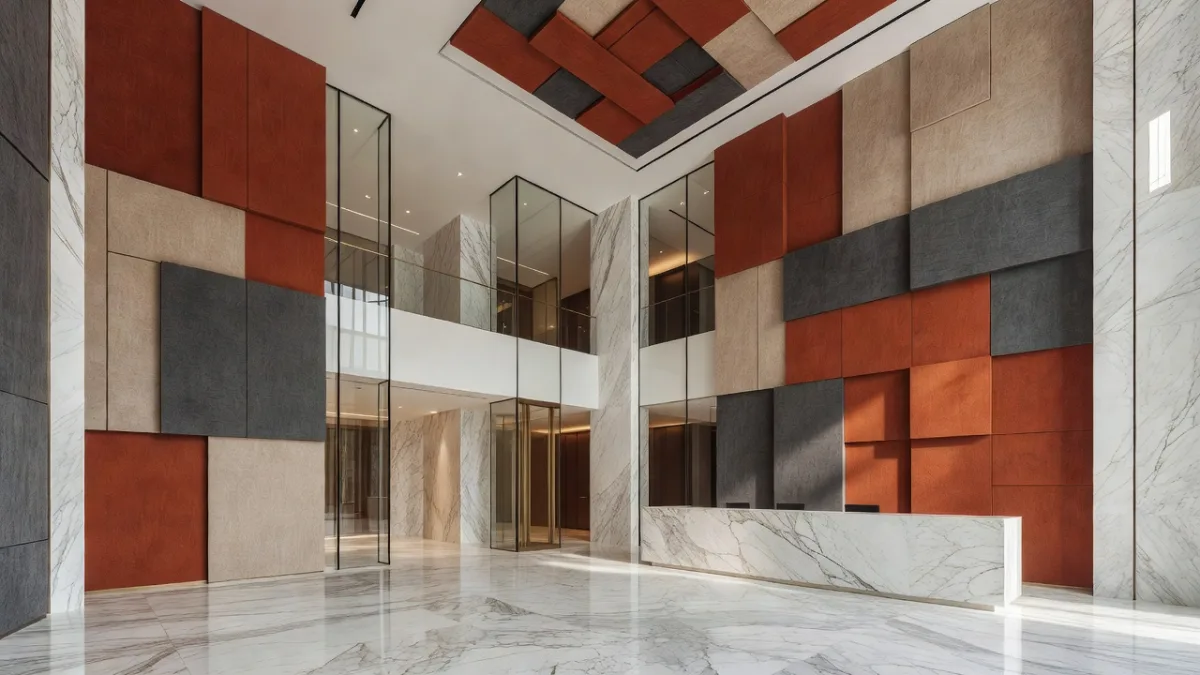
The critical zones of hotel acoustics are, in order of impact on guest reviews: the lobby, the bar and restaurant, the meeting rooms, the corridors, then the spa. Each zone has its own problem, so its own treatment, and that is exactly what our hotel acoustics solutions detail.
The hotel restaurant stacks up the handicaps: washable therefore hard surfaces, continuous service, and the cocktail effect where everyone raises their voice to cover the neighbours. Meeting rooms, for their part, are sold by the day: unintelligible speech at the back of the room, and the corporate client does not come back. As for corridors, they act as a propagation channel toward the bedrooms, with slamming doors topping the list of reported nuisances (51 % of guests, ahead of corridor noise at 50 %).
| Hotel zone | Acoustic problem | Suitable treatment | Expected gain |
|---|---|---|---|
| Lobby and front desk | Tall volumes, marble and glass, reverberation above 2 s | Ceiling baffles + printed wall panels | Resonance cut in half, discreet exchanges at the front desk |
| Bar and restaurant | Cocktail effect, conversations climbing in volume | Absorbent ceiling + panels between banquettes | Intelligible conversations, guests who linger |
| Meeting rooms | Unintelligible speech at the back, participant fatigue | Wall panels on rear and side walls | Clear voice without a microphone, a room corporate clients book |
| Corridors | Footsteps, slamming doors, voices carrying to the bedrooms | Ceiling panels and corridor ends | Reduced propagation toward the bedrooms |
| Spa and pool | Tiling and water, metallic resonance | PET felt baffles kept away from the pools | A hushed atmosphere worthy of a wellness area |
| Bedrooms | Noise from neighbours, the corridor and equipment | Soundproofing (doors, walls) as a priority | Quiet nights, calmer guest reviews |
- Lobby: absolute priority, because it forges the first impression and concentrates the traffic
- Restaurant and bar: second urgency, because a guest who cannot hear themselves talk cuts the meal short and spends less
- Meeting rooms: a direct revenue lever, the room rents better when speech is clear in it
- Spa: the zone where the promise of relaxation makes the slightest echo unbearable
A point of honesty: not everything is equal. If your budget only covers one zone this year, treat the lobby. That is where the perception of quality is decided.
Noisy bedrooms: why is acoustic treatment not enough?
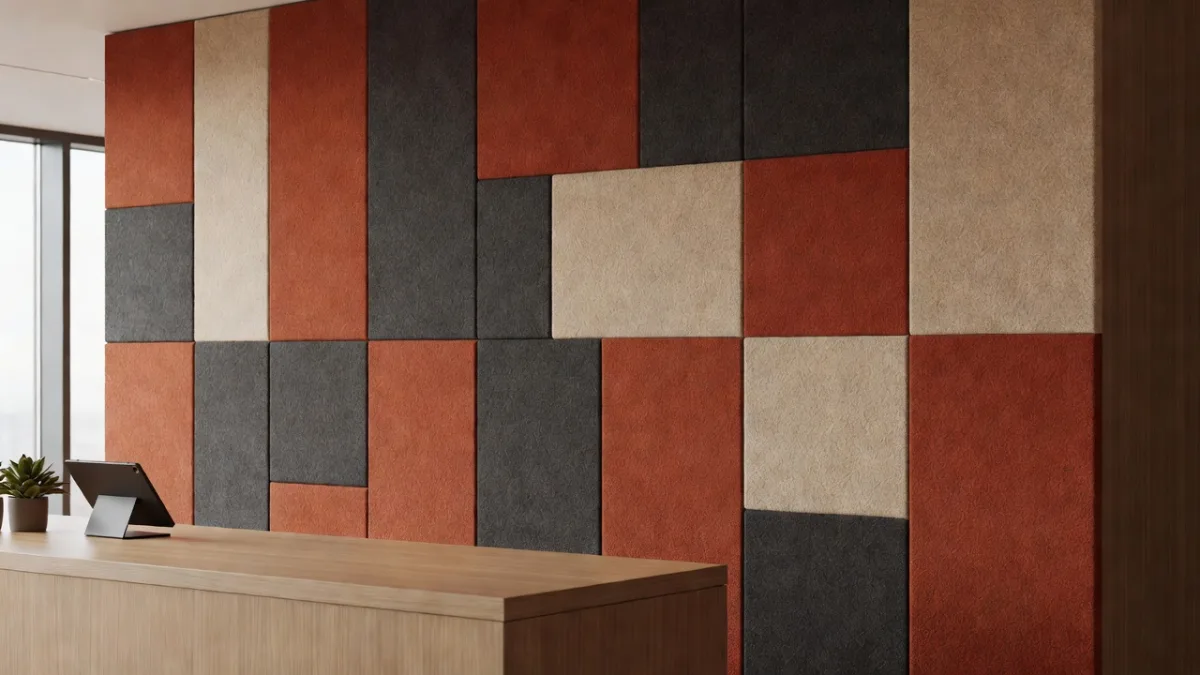
The hotel bedroom is first and foremost a soundproofing matter, not an acoustic treatment matter. The distinction is crucial: treatment absorbs sound inside a room, while soundproofing blocks the sound that passes through walls, doors and floors.
Yet what wakes a guest at 2 am is the neighbour’s television or the door slamming in the corridor. Absorbent panels in the bedroom will change almost nothing, and we would rather tell you plainly than sell you the wrong product. The World Health Organization recommends staying below 40 dB at night in sleeping rooms; to get there, you have to work on the doors (seals, automatic drop-down thresholds), the linings of partition walls between rooms and the technical equipment. We have detailed exactly what acoustic treatment covers and where its scope ends.
- Treatment: absorbs a room’s internal resonance, ideal for the lobby, restaurant, meeting rooms and spa
- Soundproofing: blocks transmission between spaces, the only effective answer for the bedrooms
- Doors: a bedroom’s first weak point, a perimeter seal often changes everything
- Equipment: ventilation and air conditioning, cited by 33 % of guests as a source of annoyance
On the other hand, treating the corridors with absorption reduces the sound level that reaches the bedroom doors. The two approaches therefore complement each other, but each in its place.
Does sound comfort count in the Atout France classification?
Yes, sound comfort is one of the roughly 240 criteria of the French hotel classification. The Atout France reference framework requires a non-noisy sound environment, with no repetitive noise coming from the common areas or neighbouring rooms, a point checked during the mystery visit for the 4 and 5 star categories.
In practical terms, a property aiming to move upmarket can no longer ignore its acoustics: the inspector stays incognito and experiences the hotel like a guest. A lobby that echoes or a deafening restaurant weighs on their overall assessment of comfort, because the framework values the real experience and not just the list of amenities. And even at 3 stars, where the sound criterion is not eliminatory, noise is still judged by your real inspectors: the guests who rate you on Booking.
- 1 to 3 stars: no formal requirement on the sound environment, but guest reviews already punish it
- 4 and 5 stars: a non-noisy sound environment verified during the mystery visit
- Mystery visit: the assessor sleeps on site and rates the lived experience, not the intentions
- Renewal: the classification is replayed every 5 years, neglected acoustics can cost a star
Our practitioner’s reading: the classification formalises what the market already demanded. Aiming for 4 stars with a noisy hotel lobby means starting with an avoidable handicap.
How do you integrate acoustics into the decor of an upscale hotel?
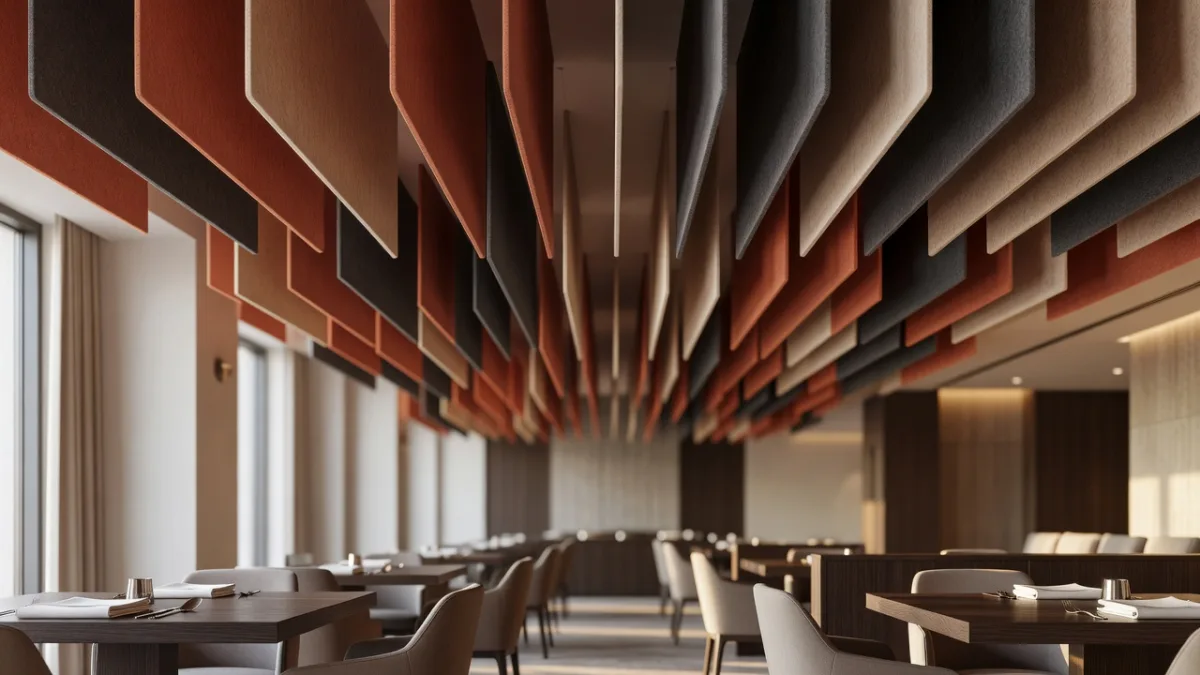
Today’s acoustic panels fit into a hotel’s artistic direction instead of distorting it. High-definition printing on PET felt turns each panel into a decor element: a wall mural in the lobby, a signature pattern in the restaurant, tones matched to your brand guidelines in the meeting rooms.
It is a complete reversal from the grey ceiling tiles that long served as the default answer. An art director can now design the acoustic treatment the way they design a headboard. Our made-to-measure workshop cuts the panels to the formats you want, prints your visuals and validates every project with a proof before production. And because a hotel is a public-access building, the fire rating matters as much as the aesthetics: our PET felt is rated B-s1,d0 under the EN 13501-1 standard, with the fire test report supplied with every order.
- HD printing: photos, patterns or solid colours printed directly on the absorbent panel
- Free formats: wall strips, frames, suspended baffles or islands cut to shape
- Public-building compliance: B-s1,d0 fire rating required in common areas, test report supplied
- Material: PET felt with a share of recycled content, light and stable over time
Frankly, it is the part of the job we like best: when the panel that fixes the lobby becomes the decor element guests photograph.
How do you treat your hotel’s acoustics without closing the property?
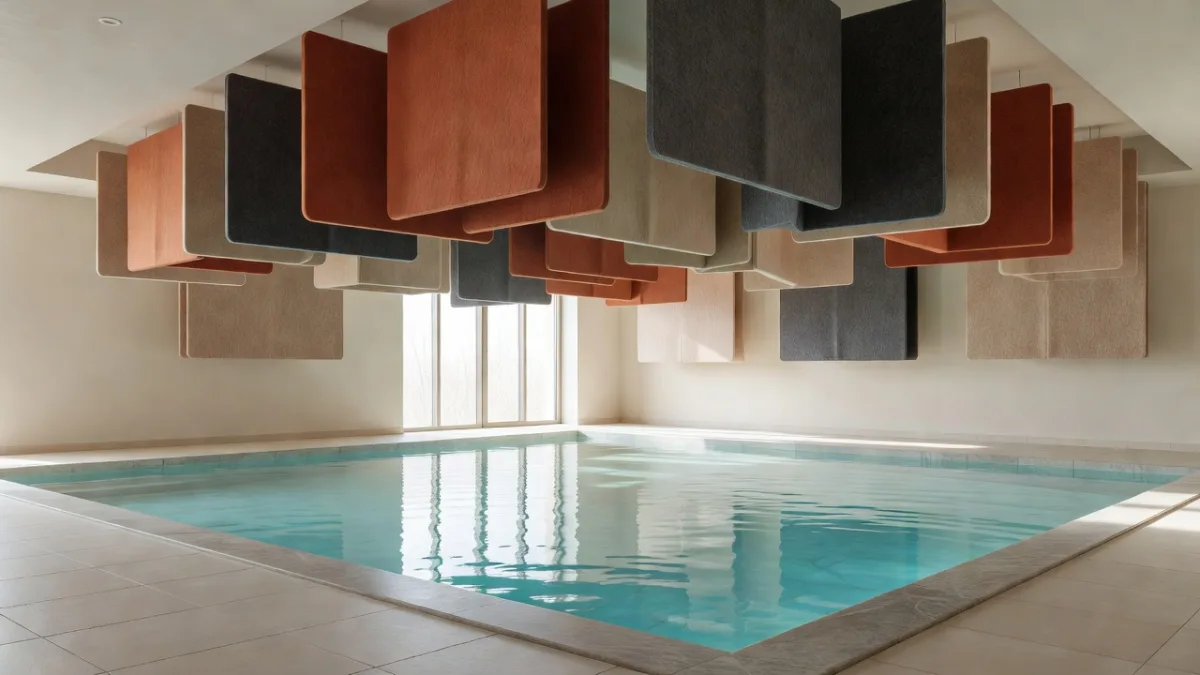
Acoustic treatment with panels is installed while the site stays in operation, with no closure and no lost business. Installation is done with adhesive or clips on the walls, and by cable suspension on the ceiling: no chasing, no plastering, no repainting.
That is the whole difference from a soundproofing project, which takes bedrooms out of service for weeks. At ACOUSTELIO, our projects show that a zone such as a lobby or a restaurant is usually treated in one day of installation, scheduled during off-peak hours or a weekly closing day. Your teams keep control of the schedule, and your guests only see the result. On timing, count on a quote within 48 h, a proof approved before production, then DDP delivery in 10 to 15 working days across the EU and the United Kingdom, duties included.
- Wall installation: adhesive or clips, no structural drilling or heavy intervention
- Ceiling installation: baffles and islands suspended on cables, height-adjustable
- Site nuisance: no dust and no odour, the zone reopens the same day
- Guarantee: conform or remade, on a simple photo sent within 48 h of receipt
A piece of field advice: proceed wing by wing or zone by zone, starting with the most visible spaces. You spread the investment and you measure the gain at every step.
Frequently asked questions about hotel acoustics
What is the main source of noise in a hotel?
Slamming doors come first, cited by 51 % of guests in the OpinionWay study for Ecophon of January 2026, just ahead of corridor noise (50 %) and neighbouring rooms (40 %). Ventilation and air conditioning follow at 33 %. In the common areas, the problem is different: it is the reverberation off hard surfaces that amplifies conversations and service noise. So two families of nuisances, two answers: soundproofing for the noise that passes through the walls toward the bedrooms, and acoustic treatment with absorbent panels for the resonance of the lobby, the restaurant or the corridors. A zone-by-zone diagnosis avoids investing in the wrong place.
How do you reduce noise in a hotel lobby without major work?
The fastest method is to install absorbent panels on 15 to 30 % of the lobby’s surfaces, combining wall panels and baffles suspended from the ceiling. That coverage is usually enough to cut reverberation in half, which is what we see on average across our projects. Installation is done with adhesive, clips or cables, in one day for most lobbies, without closing the front desk. And because PET felt panels print in high definition, the treatment can take the form of a decorative mural or tones matched to your brand guidelines. The lobby gains in calm and in standing, without heavy work or dust.
What is the difference between acoustic treatment and soundproofing for a hotel?
Acoustic treatment absorbs sound inside a room to reduce resonance, while soundproofing blocks the sound that passes from one space to another. For a hotel, the split is fairly clear: the lobby, the restaurant, the meeting rooms, the corridors and the spa call for treatment, because their problem is echo and din. The bedrooms call first for soundproofing, because the annoyance comes from the neighbours, the corridor and the technical equipment. The two approaches complement each other: a corridor treated with absorption transmits less noise to the bedroom doors. But confusing the two leads to ineffective investments.
Do acoustic panels hold up in a hotel spa or pool?
Yes, PET felt copes well with the ambient humidity of a spa, because this polyester fibre absorbs almost no water and does not warp the way wood-based or plaster-based materials would. A few precautions remain necessary: favour a ceiling or high-level installation, away from direct splashing and jet-cleaning zones, and ensure proper ventilation of the room. Around a tiled indoor pool, suspended baffles break the metallic resonance typical of pools and restore the hushed atmosphere expected of a wellness area. We validate each configuration at the quote stage, based on the humidity level and the air handling.
Does sound comfort count toward getting 4 or 5 stars?
Yes, the Atout France classification framework requires a non-noisy sound environment for 4 and 5 star hotels, with no repetitive noise coming from the common areas or neighbouring rooms. This point is checked during the mystery visit, during which the assessor stays like an ordinary guest. For the 1 to 3 star categories, the criterion is not formally required, but noise is still punished by online reviews, which often carry more weight than the plaque. A property preparing to move upmarket therefore has every interest in treating its acoustics before the classification visit, starting with the lobby and the dining areas.
How much does acoustic treatment cost for a hotel?
At ACOUSTELIO, wall panels start at 49 €/m² and ceiling solutions (baffles and islands) at 59 €/m². For a lobby of 100 m² of floor area, treating 15 to 30 % of the surfaces most often represents a few thousand euros, a far cry from a soundproofing project. The budget depends on the surface to cover, the panel formats and the prints chosen, which is why every project goes through a custom quote, sent within 48 h with a layout plan adapted to your zones. DDP delivery takes 10 to 15 working days in the EU and the United Kingdom, duties included, and installation is scheduled without closing the property. The return on investment then shows up in the reviews.
Noise is not an operating inevitability: it is a short, quantifiable and profitable project that protects your online rating and your market positioning. Send us the plans or a few photos of your critical zones and receive your custom quote within 48 h, with a visual simulation of the panels in your decor.