Acoustic treatment reduces the reverberation of sound inside a room using absorbent materials, whereas soundproofing blocks the transmission of noise between two spaces using the mass of the walls. A restaurant that echoes is a treatment problem, a noisy neighbour is a soundproofing problem.
The social cost of noise in France reaches 155.7 billion euros a year according to the 2021 ADEME and Conseil national du bruit study, a large share of it tied to workplaces and public venues that are too reverberant.
ACOUSTELIO manufactures made-to-measure acoustic panels in PET felt with a measured NRC of 0,85, an EN 13501-1 B-s1,d0 fire rating required in public-access buildings and a custom quote within 48 h.
Acoustic treatment is the subject our clients get wrong most often. Nine requests out of ten start with “I want to soundproof my restaurant”, when the problem described (din, unintelligible conversations, end-of-service fatigue) is about absorption, not soundproofing. And the confusion costs real money, because the two treatments use neither the same materials nor the same budgets.
At ACOUSTELIO, we design made-to-measure acoustic panels in PET felt for restaurants, offices, hotels and public-access buildings. Our business is precisely the treatment of rooms that echo. So it is worth setting out the definitions once and for all, with the physical metrics behind them, and showing you concretely when to choose one approach or the other.
What exactly is acoustic treatment?
Acoustic treatment covers all the techniques that improve sound comfort inside a single room, by reducing reverberation and echo. It acts on the sound emitted in the room, not on the noise coming from elsewhere.
In practice, when you speak in a room with bare walls, the sound wave bounces off every hard surface: concrete, glass, tiling, painted plaster. Each reflection prolongs the sound. As a result, conversations overlap, everyone raises their voice to be heard (that is the Lombard effect) and the overall level climbs by a few decibels. And an extra 3 dB is already a doubling of the sound energy in the room.
- Reverberation: persistence of sound after the source stops, measured by the reverberation time RT in seconds
- Echo: a late reflection perceived as a distinct sound, common in large empty volumes
- Intelligibility: the ability to understand speech, directly degraded when the RT exceeds 0.8 second in a restaurant or meeting room
- Absorption: the conversion of sound energy into heat by a porous material, the physical principle of treatment
In other words, correcting the acoustics of a room comes down to “soaking up” the excess sound with absorbent surfaces. It is finishing work, light and fast, without touching the structure of the building.
What is the difference between acoustic treatment and soundproofing?
Acoustic treatment handles sound comfort inside the room, while soundproofing blocks the transmission of noise between two spaces. The first relies on absorption by porous, lightweight materials, the second on the mass, decoupling and air-tightness of the walls.
It is a physical distinction, not a matter of vocabulary. A PET felt panel absorbs up to 85 % of the sound energy that hits it, but it weighs only a few kilos: it will never stop the music from the bar next door crossing the wall. Conversely, an 80 kg/m² lining wall stops that noise, and yet your room will keep echoing if its surfaces stay hard. The two logics are complementary, never interchangeable.
- Treatment: absorption, porous materials (PET felt, foam, wool), finishing installation, αw, NRC and RT metrics
- Soundproofing: mass and air-tightness, heavy materials (plaster, concrete, sandwiched mineral wool), second-fix work, Rw and DnT,A metrics in decibels
- Simple test: if the offending noise is born in the room, treat it; if it comes from next door or outside, soundproof it
The table below sums up the differences we explain to our clients every week:
| Criterion | Treatment | Soundproofing |
|---|---|---|
| Goal | Reduce reverberation in the room | Block noise between two spaces |
| Physical principle | Absorption (porous, lightweight materials) | Mass, decoupling, air-tightness |
| Metrics | αw, NRC, reverberation time RT | Rw, DnT,A (in decibels) |
| Type of work | Wall panels, baffles, finishing installation | Lining walls, screeds, heavy build-ups |
| Indicative budget | From 49 €/m² of panel | 80 to 200 €/m² of treated wall |
| Effect for neighbours | Low (drop in ambient level) | Strong (transmission blocked) |
| Typical case | Restaurant or open space that echoes | Music or voices coming from the next unit |
How does the absorption of acoustic materials work?
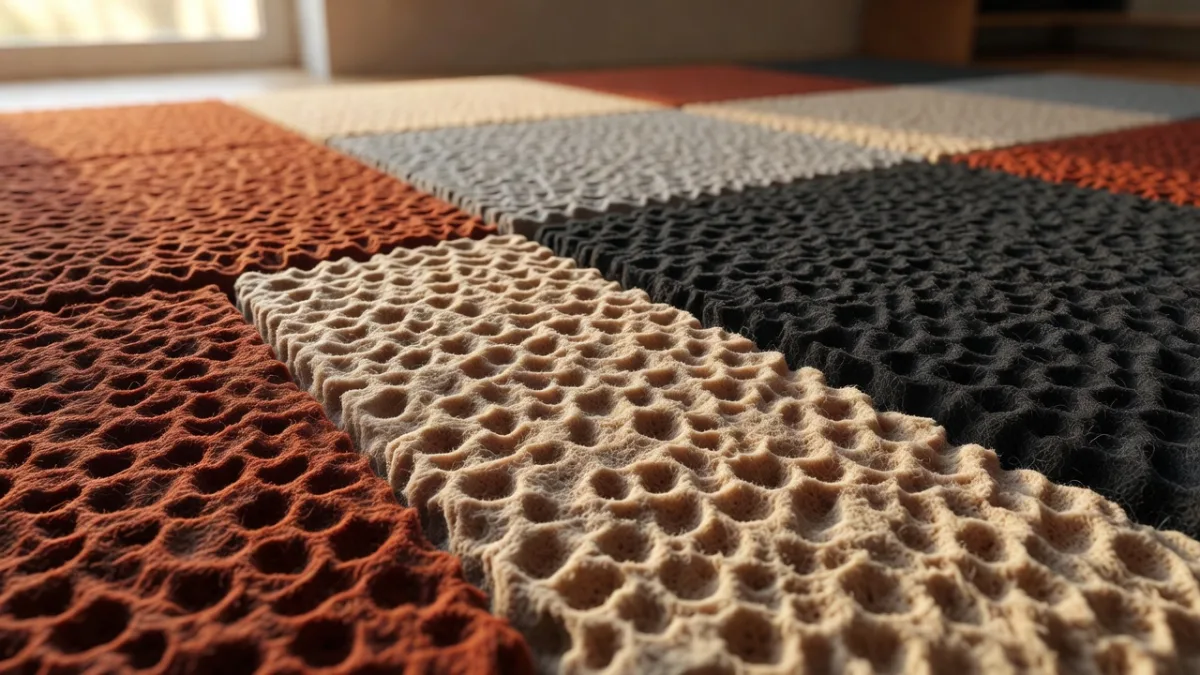
An absorbent material converts sound energy into heat through the friction of air within its pores. The larger the absorbent surface installed, the more the room’s reverberation time drops.
The physics fits into one formula, Sabine’s: RT = 0.16 × V / A, where V is the volume of the room and A the equivalent absorption area. A 300 m³ room with 20 m² of absorption reverberates for 2.4 seconds. Push it to 60 m² of absorption, and the RT falls to 0.8 second. The din deflates into a hushed atmosphere, without touching either the load-bearing walls or the partitions.
When a sound wave hits a PET felt panel, the air vibrates in the thousands of microscopic channels of the felt. The friction dissipates the energy. That is why effective absorbers are porous and fibrous, never smooth and hard. A mirror, a picture window or a painted wall reflect more than 95 % of the incident sound; an ACOUSTELIO panel absorbs up to 85 % of it.
- Thickness: the thicker the panel, the better it absorbs the low frequencies, the hardest to treat
- Air cavity: an air gap behind the panel or a suspension from the ceiling improves bass absorption
- Position: treating the first reflection surfaces (ceiling, walls facing the sources) delivers more result than scattering the panels at random
- Surface area: on our projects, treating 15 to 30 % of the wall and ceiling surface is usually enough
What do the αw coefficient and the NRC measure?
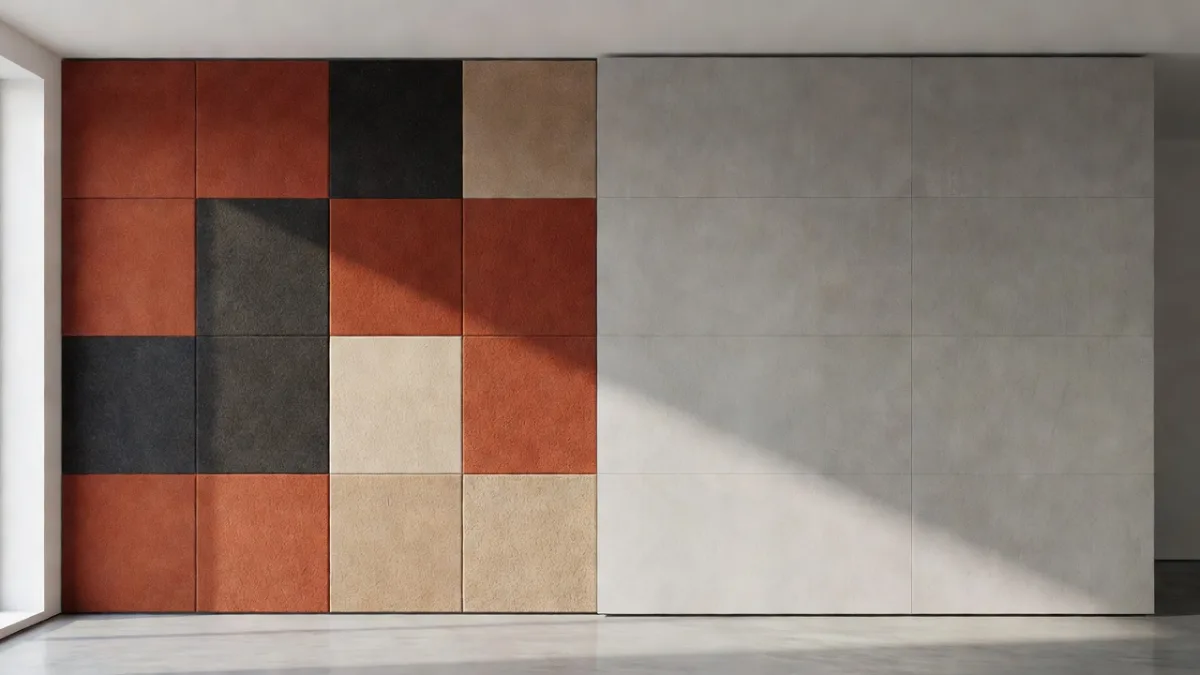
The αw coefficient and the NRC both measure the share of sound energy absorbed by a material, on a scale from 0 (everything reflected) to 1 (everything absorbed). An NRC of 0,85 means that 85 % of the sound hitting the panel does not come back into the room.
The two indices do not come from the same standards, and that is one more source of confusion. The αw (weighted sabine alpha) comes from the European standard EN ISO 11654, which ranks absorbers from class A (αw of 0.90 to 1.00) to class E. The NRC (Noise Reduction Coefficient) is the American index from standard ASTM C423: it is the average of the absorption coefficients measured at 250, 500, 1,000 and 2,000 Hz, the frequencies of the human voice. Serious manufacturers publish one or the other with a laboratory test report. Be wary of product sheets that claim “high absorption” with no figures at all: we come across them regularly, and the real measurements hold nasty surprises.
Our PET felt panels post a measured NRC of 0,85. We detail the test method and how to read the absorption classes on our page dedicated to the NRC absorption coefficient, with the reports supplied with every order.
When should you choose acoustic treatment over soundproofing?
Choose treatment when the sound nuisance is born inside the room, and soundproofing when the noise crosses a wall. The diagnosis comes down to one question: where is the noise that bothers you coming from?
In 2026, demand leans heavily toward treatment, because the codes of interior design have changed: hard floors, glass walls, exposed concrete, generous ceiling heights. Aesthetically, it is superb. Acoustically, it is a disaster, and the Ifop survey run for the National Hearing Day confirms it: more than one working person in two says they are bothered by noise at their workplace.
- Treatment alone: a room that echoes, restaurant din, a tiring open space, a hotel lobby where you cannot hear each other
- Soundproofing alone: road traffic, a music-loving neighbour, a confidential meeting room to protect from the corridor
- Both combined: a noisy restaurant that ALSO adjoins housing, a studio, a first-floor sports hall
- Classic mistake: doubling up a wall to “reduce the noise” of a room that echoes, and so spending three times more for zero result on reverberation
Let us be direct: if a contractor offers you a lining wall to solve an internal din problem, ask for a second opinion. And conversely, no absorbent panel will silence the nightclub below. A good diagnosis avoids both dead ends.
How do you apply acoustic treatment in a restaurant, office, hotel and public building?
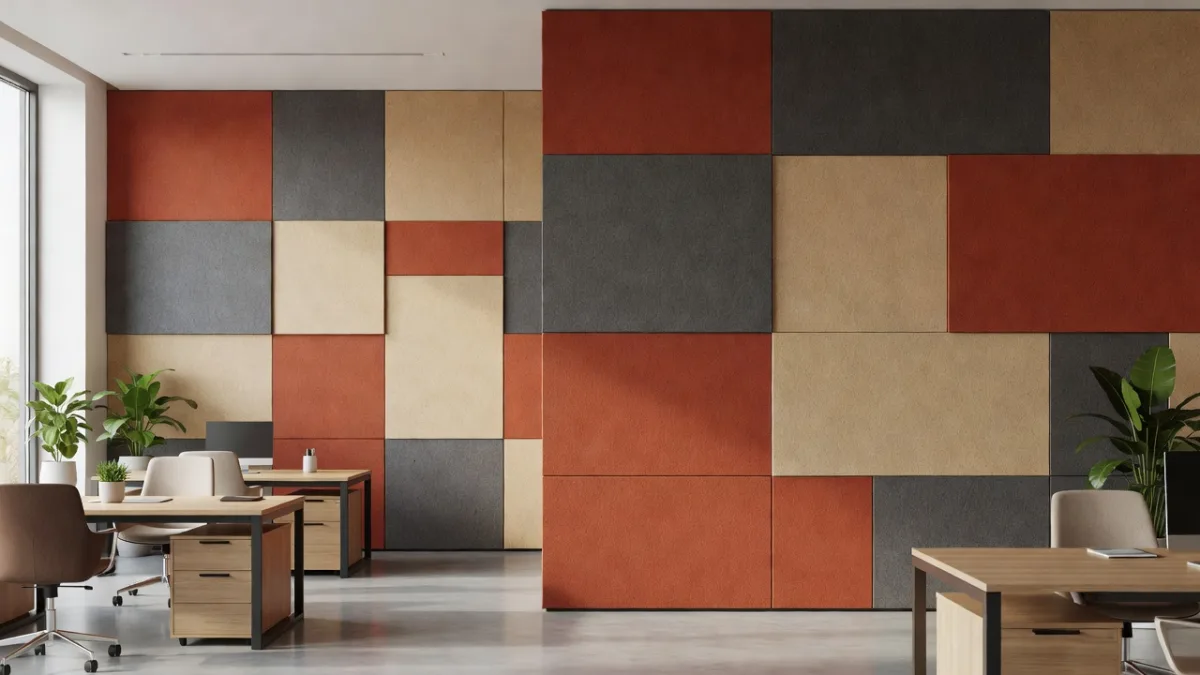
An absorption treatment is sized room by room, based on the volume, the materials in place and the use. At ACOUSTELIO, our projects show an average 50 % reduction in reverberation with 15 to 30 % of treated surface.
In a restaurant, the sound level in full service commonly reaches 75 to 85 dB, the threshold where customers cut their meal short and staff finish the day exhausted. Acoustic wall panels printed in your colours treat the problem without spoiling the decor: the panel becomes an assumed graphic element, not a grey patch to be hidden.
In the office, the NF S 31-080 standard sets acoustic performance levels by type of space, and open spaces rarely earn the “high-performance” rating without treatment. Our office acoustics page details the typical configurations: baffle ceilings above call zones, wall panels in meeting rooms, screens between workstations.
In a hotel, the black spot is in the common areas: lobby, breakfast room, spa. And in public-access buildings, the constraint becomes regulatory. The decree of 25 April 2003 sets maximum reverberation times in teaching and healthcare premises, and any installed material must meet the required fire rating. Our panels are classified EN 13501-1 B-s1,d0, the level required in public-access buildings, with a test report supplied with every order.
What are the limits of an absorption treatment?
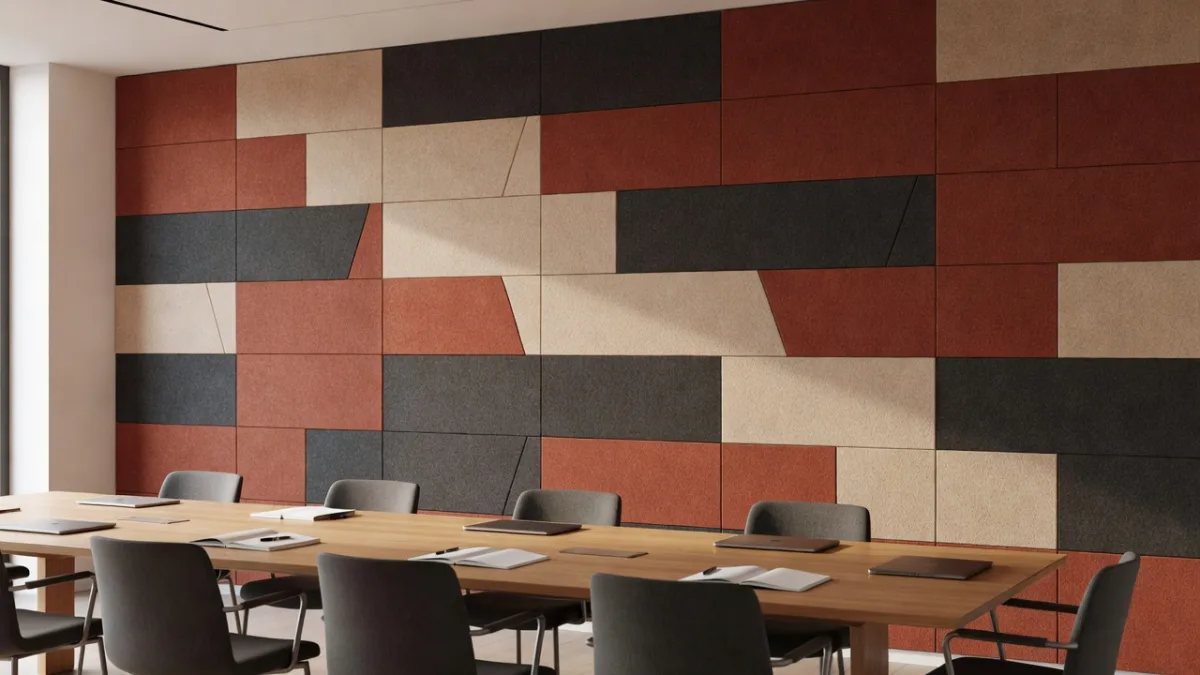
Acoustic treatment does not block the transmission of noise between two units and never replaces soundproofing. It reduces the ambient level and reverberation, nothing else.
We prefer to say it plainly, because transparency avoids disappointment. An absorption treatment lowers the overall level of a noisy room by 3 to 6 dB in the good cases: that is very perceptible to the ear, but it will not turn a canteen into a library. Likewise, absorption plateaus: beyond a certain percentage of treated surface, each additional panel brings less and less. Hence our field rule of 15 to 30 %, instead of selling you useless m².
- Outside noise: treatment has no effect on noise crossing a facade or a floor slab
- Low frequencies: deep bass (amplified music, machines) demands thickness or specific systems
- Empty room: an RT measured without furniture or people will always be longer than in real conditions, to be factored into the diagnosis
- Placement: a correct area badly positioned gives a mediocre result, panel position matters as much as its surface
At ACOUSTELIO, our projects show that success comes down to three things: a realistic RT target, honest sizing and thoughtful placement. That is exactly what our made-to-measure support covers, from layout to proof approved before production.
Frequently asked questions about acoustic treatment
Do absorbent panels reduce noise coming from the neighbours?
No, an absorption treatment does not act on noise transmitted through a wall. Absorbent panels reduce reverberation and the sound level inside the room where they are installed, but they are too light to block a wave crossing a wall, a floor or a ceiling. For neighbour noise, you need mass, decoupling and air-tightness: that is the domain of soundproofing. Treatment does bring an indirect benefit, though: by absorbing sound in your own unit, it lowers the level reaching the walls, so the nuisance transmitted to the neighbours drops slightly. Useful for a ground-floor restaurant, but not enough on its own.
What surface of panels is needed to treat the acoustics of a room?
The rule observed in the field is to treat 15 to 30 % of the combined surface of the walls and ceiling. For a 100 m² restaurant floor with a 2.8 m height, that represents around 30 to 60 m² of absorbent panels, to be placed first on the ceiling and on the walls facing the noise sources. The precise calculation depends on the volume of the room, the starting reverberation time and the target: around 0.8 second for good intelligibility in a restaurant or meeting room. ACOUSTELIO sizes this area during the custom quote, delivered within 48 h with a layout matched to your plan.
What is the difference between the αw coefficient and the NRC?
The αw and the NRC measure the same thing, the absorption capacity of a material, but under two different standards. The αw is the European index from standard EN ISO 11654: it weights the absorption measurements across the whole spectrum and ranks products from A (highly absorbent) to E. The NRC is the American index from standard ASTM C423: it averages absorption at 250, 500, 1,000 and 2,000 Hz, the frequencies of speech. An NRC 0,85 panel therefore absorbs 85 % of the vocal energy hitting it. The two indices overlap largely in practice, and what matters is demanding a laboratory test report rather than a marketing promise.
Is acoustic treatment mandatory in public-access buildings?
Yes, in several categories of public-access buildings. The decree of 25 April 2003 sets maximum reverberation times in teaching and healthcare premises and sensitive establishments: a classroom or a school refectory must meet precise values according to their volume. Beyond the RT, any material installed in a public-access building must satisfy the reaction-to-fire requirements, generally the B-s1,d0 rating of standard EN 13501-1 for wall and ceiling coverings. That is the rating of our PET felt panels, and the test report is supplied with every order for your compliance file with the safety commission.
How much does a professional acoustic treatment cost?
At ACOUSTELIO, wall panels start at 49 €/m² and ceiling solutions (baffles and suspended panels) at 59 €/m². For a 100 m² room needing 40 m² of treatment, the material budget therefore sits between roughly 2,000 and 2,400 €, excluding installation. Installation stays simple: adhesive or clips on the wall, cable suspension on the ceiling, which most of our clients handle in-house or entrust to their fit-out contractor. Compare that with soundproofing, which mobilises a drywaller and heavy work for 80 to 200 €/m² of wall: treatment remains the best result-to-price intervention when the problem is reverberation. DDP delivery in 10 to 15 working days, duties included.
Can you combine treatment and soundproofing?
Yes, and it is even the right approach as soon as a unit stacks up both problems: a room that echoes and neighbours to protect, a studio, a first-floor sports hall. The two treatments do not get in each other’s way, they reinforce each other. Soundproofing is done first, because it touches the structure: lining walls, floating screed, decoupled ceiling. Treatment then comes as a finish, with absorbent panels sized on the final volume of the room. Working the other way round sometimes forces you to remove the absorbers to redo the walls. On a new-build project or a heavy renovation, get both items priced together: a shared diagnosis avoids duplication and oversights.
You now know whether your project is about treatment, soundproofing or both. If your room echoes, the solution is light, fast and measurable: absorbent PET felt panels, sized on your volume and printed in your colours. Request your custom quote: reply within 48 h, layout included and proof approved before production. To dig deeper into the social cost of noise, the reference study is published by ADEME.