Reducing open plan office noise rests on three combined levers: absorb the reverberation by treating the ceiling and walls, separate noisy activities from focus zones, then frame usage with simple team rules. Treating 15 to 30 % of the surfaces is generally enough to bring the ambient level back under the recommended 55 dB(A).
According to the Ifop barometer run for France’s National Hearing Day (JNA), 52 % of French workers say they are bothered by noise in their workplace, and each exposed employee loses on average 30 minutes of focus per day.
ACOUSTELIO manufactures made-to-measure acoustic panels in PET felt, with a measured absorption of NRC 0,85, a B-s1,d0 fire rating certified to EN 13501-1 and a tailored quote within 48 h.
Open plan office noise is not an inevitable feature of an open floor; it is a problem of reverberation and organisation that can be corrected. And the data is stubborn: 30 minutes of focus lost per day per employee, roughly 120 hours a year, for a space that was meant to smooth collaboration.
This guide is aimed at office managers, HR directors and leaders who want to put numbers on the problem before investing. In it we detail the figures, the regulatory framework and the hierarchy of solutions. At ACOUSTELIO, we design made-to-measure acoustic panels in PET felt for offices and open plan spaces, and we find on our projects an average 50 % reduction in reverberation with a treatment of only 15 to 30 % of the surfaces. In other words, there is no need to re-partition everything to get the calm back.
Why does open plan office noise drag down focus and productivity?
Open plan office noise degrades performance because it fragments attention: an employee interrupted by a conversation takes on average 23 minutes to get back to their initial level of focus, according to the work of Gloria Mark at the University of California. The loss is therefore not the sound volume itself, but the repetition of interruptions.
The surveys run by Ifop for the JNA put figures on the phenomenon. In concrete terms:
- 52 % of workers: the share of French employees who say they are bothered by noise and sound nuisance at work
- 30 minutes a day: the effective working time lost on average per exposed employee, close to 120 hours a year
- 23 billion euros: the estimated annual cost of the productivity loss linked to workplace noise in France, according to the JNA
- 54 % of workers: the proportion who blame office noise for a tiredness, weariness or irritability that spills over into their personal life
There is also a less visible effect: intelligible speech. INRS has shown that an understandable conversation disturbs focus more than a continuous background noise of the same intensity, because the brain cannot help decoding the words. That is why an open plan office at 55 dB(A) full of conversations is more tiring than a busy street at 65 dB(A). The upshot: the subject deserves better than a box of earplugs at reception.
What do the regulations say about office noise in 2026?
The French Labour Code sets no threshold specific to open plan offices: it imposes a general duty of prevention and an action threshold at 80 dB(A) over 8 hours, designed for industry. A noisy office floor therefore stays legal in the strict sense, but article R. 4213-5 requires premises to be designed so as to reduce noise to the lowest level compatible with the activity. In 2026, no open plan office reaches the regulatory 80 dB(A), and yet the annoyance is massive.
The useful reference for an office space is standard NF S31-080. It classifies tertiary spaces by activity type and defines three levels of requirement: standard, high-performance and very high-performance. Here are the targets to aim for, cross-checked with the INRS recommendations:
| Type of space | Target ambient level | Priority concern | Recommended treatment |
|---|---|---|---|
| Private office | 35 to 45 dB(A) | Confidentiality | Targeted wall panels |
| Open plan, focused work | 45 to 50 dB(A) | Reverberation and speech | Ceiling baffles + walls |
| Collaborative open plan | 50 to 55 dB(A) | Spatial decay | Baffles + desk screens |
| Meeting room | 35 to 45 dB(A) | Speech intelligibility | Printed wall panels |
| Break area, cafeteria | 50 to 60 dB(A) | Noise containment | Absorbing ceiling |
INRS has measured ambient levels of 50 to 60 dB(A) in French open plan offices, so above the comfort targets in most cases. These values do not put hearing at risk, but they install a daily cognitive fatigue. Our stance is clear: aiming for mere legal compliance serves no purpose in offices, it is the NF S31-080 target that should guide your project.
Where does the noise in an open plan office come from?

More than 70 % of the noise in an open plan office comes from speech: conversations between colleagues, phone calls and video calls consistently top the list of complaints cited in the Ifop surveys and the INRS studies. Equipment, for its part, plays a secondary but real role.
Before treating, you have to map. In our audits, we almost always find the same culprits:
- Intelligible speech: conversations and informal meetings held in the open, the most disruptive source for focus
- Video calls: since hybrid work became the norm, everyone talks loudly into their mic in the middle of the others
- Reverberation: hard floors, glazed bays, exposed concrete and bare ceilings that send sound back instead of absorbing it
- Equipment: printers, ventilation, the coffee machine, ringtones and notifications that add to the background level
- Circulation: the aisles crossing the floor carry conversations from one end to the other
The decisive point is reverberation, because it amplifies everything else. On a very reverberant floor, everyone talks louder to be heard, which raises the ambient level further: this is the cocktail effect. By breaking the reverberation with absorbing surfaces, you reverse the spiral, and the whole floor naturally lowers its voice. A matte room encourages calm, exactly like a library.
How do you reduce open plan office noise by treating the ceiling?
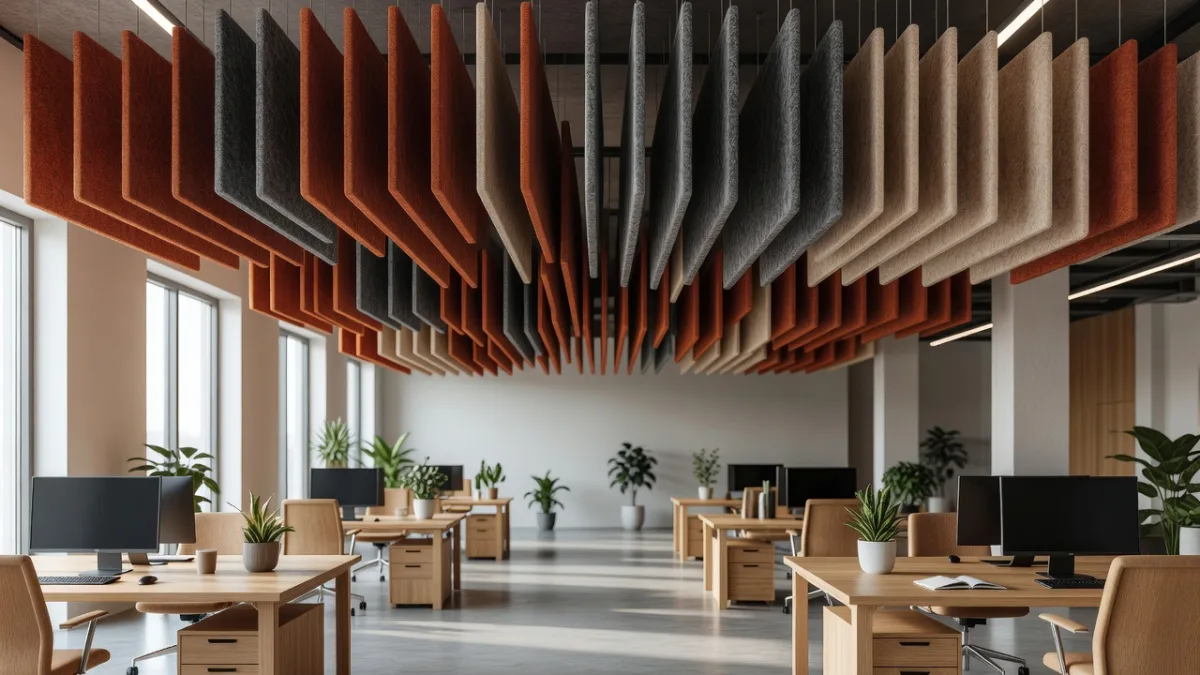
The ceiling is the first surface to treat to reduce open plan office noise, because it is the largest free surface and it overlooks every workstation. Acoustic baffles hung vertically capture sound on both faces, which doubles the absorbing area for the same amount of material.
Our ceiling baffles and panels in PET felt hang by cables, without drilling a technical ceiling or touching existing services. In practice, here is what makes the difference:
- Clear height: the baffles come down to the level where speech travels, whereas a plain suspended ceiling absorbs too high
- Double absorbing face: a vertical baffle works on both sides, so the yield per m² beats a horizontal panel
- Technical compatibility: cable suspension preserves access to the light fittings, the ventilation and the sprinklers
- Budget: our ceiling and baffle solutions start at 59 €/m², for a job usually done in a day without closing the floor
At ACOUSTELIO, we find on our projects that a ceiling treatment covering 20 % of the floor’s surface already produces a clear drop in reverberation, noticeable from day one by the teams. That said, let’s be honest: if your open plan office has 2.40 m of clear height, suspended baffles are not always possible, and the treatment then shifts to the walls and the desk screens.
Which wall panels and desk screens absorb the noise?
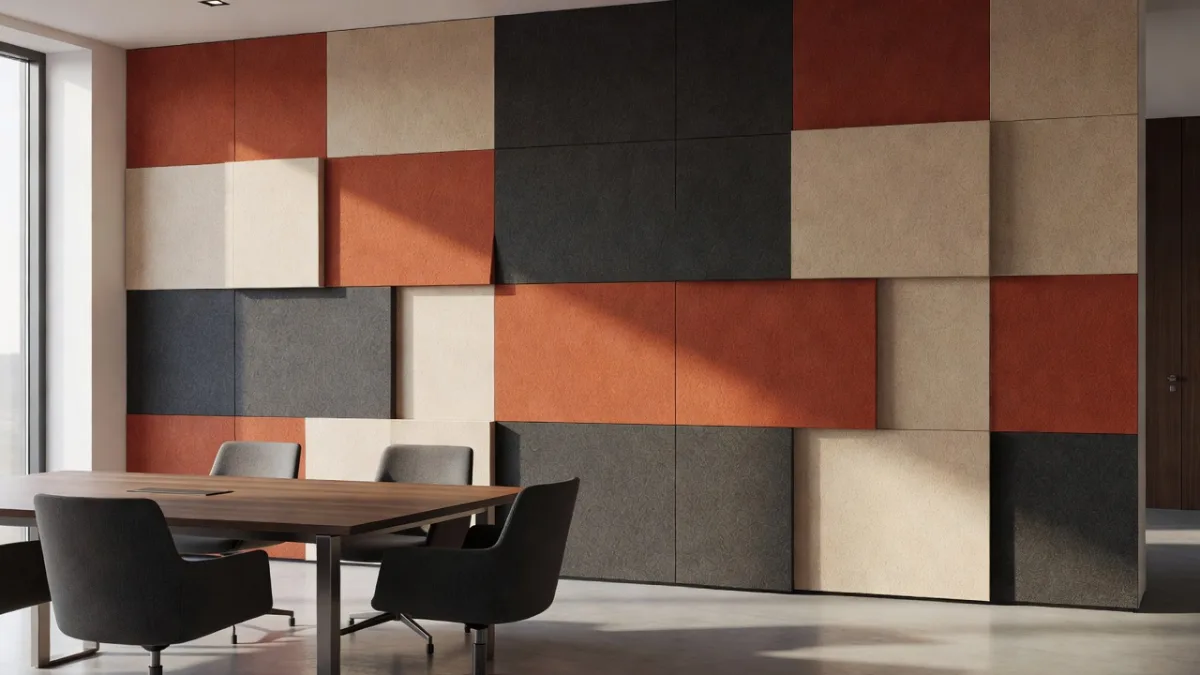
Wall panels complete the ceiling by breaking the lateral reflections, the ones that carry speech from one team to another. A PET felt panel with an NRC 0,85 coefficient absorbs up to 85 % of the sound energy that strikes it, a performance level measured in the lab that we document on our page dedicated to the NRC absorption coefficient.
The wall is also the chance to kill two birds with one stone. Our acoustic wall panels print in high definition in your colours: graphic mural, company branding, zone signage. The acoustic treatment becomes an assumed decorative element instead of a grey technical compromise. From 49 €/m², mounted by adhesive or clips, with no structural work.
- Priority placement: the walls parallel to each other, responsible for flutter echoes, and the surfaces behind the call zones
- Desk screens: absorbing screens between workstations that cut the direct propagation of speech at face height
- Useful surface: the 15-to-30 % rule of treated surfaces applies by combining walls and ceiling, no need to line the whole room
- Fire safety: in an office building as in a public-access building, demand a B-s1,d0 fire rating with a test report, supplied with every ACOUSTELIO order
A simple guide for your budget trade-offs: a well-placed treatment on 20 % of the surfaces beats a uniform coverage badly targeted on 40 %. Acoustics is a matter of position as much as quantity.
How do you organise the space and the teams against office noise?
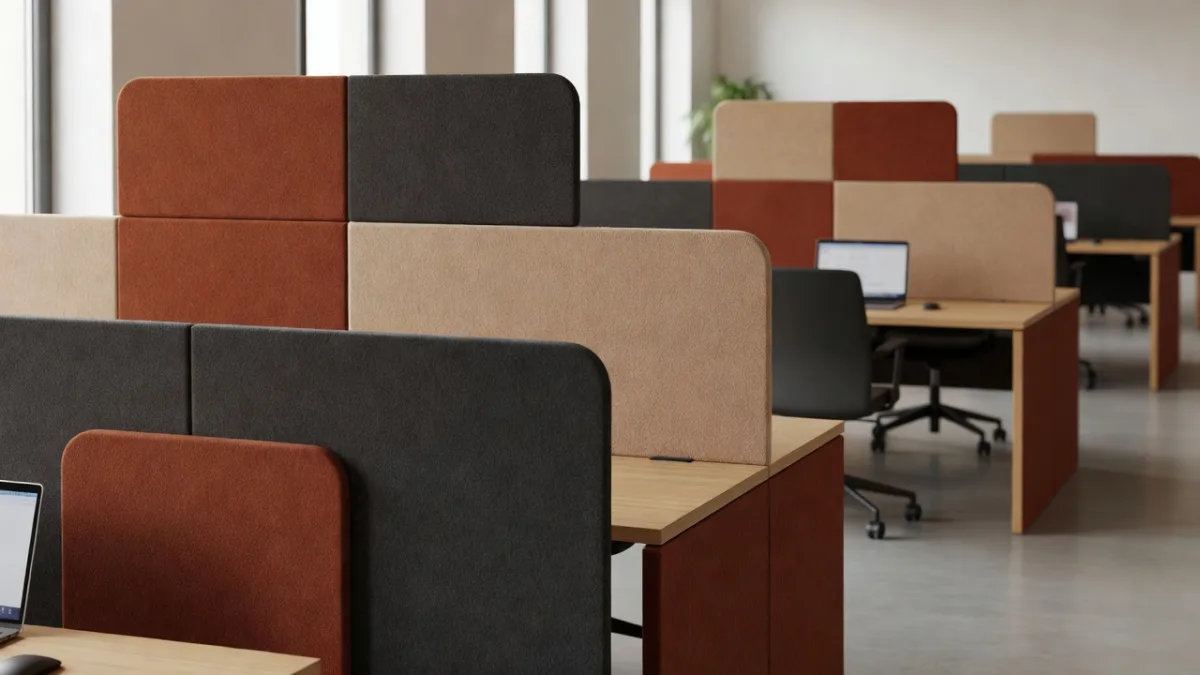
Acoustic treatment settles the reverberation, but not the organisation: a perfectly absorbing floor stays noisy if the video calls happen in the middle of the focus workstations. Zoning is therefore the second pillar of a serious approach against office noise.
The principles that work in the field:
- Zoning by use: group the chatty activities (sales, support) and move them away from the focus functions (accounting, development, legal)
- Dedicated call spaces: booths, small rooms or treated alcoves where calls and video calls of more than a few minutes move to
- Buffer zones: place storage, circulation or planted areas between noisy and quiet zones rather than butting them together
- Team sound charter: co-built and posted rules, such as spontaneous meetings limited to 5 minutes on the floor, ringtones muted, video calls in a room
- Quiet slots: two hours a day with no meeting or interruption, a simple arrangement that teams love
A practitioner’s tip: have the team vote on the charter rather than imposing it. Because a sound rule seen as surveillance is dead in three weeks, whereas a rule decided collectively lasts. And measure before and after: a spare sound meter costs less than 100 euros and puts the debate on solid ground in the management committee. For a complete approach suited to your floor, our page on acoustics for offices and open plan spaces details the project method, from diagnosis to install.
Which false good ideas against open plan office noise should you avoid?
Some popular solutions against open plan office noise treat neither the reverberation nor the sources, and burn budget for a marginal result. It is worth saying plainly, because these disappointments feed the false idea that an open plan office is beyond fixing.
What does not work, or not on its own:
- Green plants: their acoustic absorption is marginal compared with a real absorbing material; they improve the visual atmosphere, not the noise level
- Blanket noise-cancelling headphones: useful now and then, but as a sole answer they isolate colleagues, tire people over time and mainly signal that the space has failed
- Carpet alone: it dampens footsteps but absorbs almost none of the speech that travels at height
- Bargain foams: low absorption coefficients, fire rating rarely documented, fast ageing and a rehearsal-studio look
- Silence imposed from above: a memo with no physical treatment of the premises antagonises teams without changing the acoustics
Headphones deserve a nuance: in 2026, with hybrid work, they remain a good individual backup tool for deep-focus tasks. But when half the floor wears headphones all day, it is no longer a piece of equipment, it is an admission. INRS points this out in its publications on open plan offices: the effective approach acts first on the premises and the organisation, individual equipment coming only as a last resort, a principle detailed in its reference dossier on workplace noise.
Frequently asked questions about open plan office noise
What is the acceptable sound level in an open plan office?
A comfortable open plan office sits between 45 and 55 dB(A) depending on the activity, per the targets of standard NF S31-080: 45 to 50 dB(A) for work requiring focus, 50 to 55 dB(A) for collaborative activities. INRS measurements show that French floors often exceed these values, with levels recorded from 50 to 60 dB(A). Above 55 dB(A) continuously, the annoyance becomes significant for a majority of employees and fatigue sets in. The regulatory threshold of 80 dB(A) in the Labour Code protects hearing but says nothing about comfort: an open plan office can be legally compliant and cognitively exhausting.
Is open plan office noise covered by the Labour Code?
Yes, but indirectly: no article sets a threshold in decibels specific to open plan offices. The employer remains bound by the general duty of risk prevention and by article R. 4213-5, which requires premises to be designed so as to reduce noise to the lowest level compatible with the activity. The action threshold of 80 dB(A) over 8 hours concerns hearing protection, an extremely rare case in offices. In concrete terms, a bothered employee can rely on the single risk-assessment document, the works council or occupational medicine to raise the subject. The voluntary standard NF S31-080 then serves as a technical reference to ground the discussion.
How many acoustic panels do you need for an open plan office?
The field rule we apply at ACOUSTELIO: treating 15 to 30 % of the combined wall and ceiling surface is generally enough to transform an open plan office’s acoustics. For a 200 m² floor with a 2.70 m height, that means around 60 to 110 m² of panels and baffles, spread as a priority over the ceiling and the parallel walls. The result observed on our projects is an average 50 % reduction in reverberation. The exact quantity depends on the room’s materials, with concrete, glass and hard floors calling for more; that is precisely what the tailored quote determines, which we produce within 48 h from your plans and photos.
What is the difference between acoustic treatment and soundproofing?
Acoustic treatment improves the sound comfort inside a room by absorbing the reverberation, whereas soundproofing blocks the transmission of sound between two rooms. A PET felt panel at NRC 0,85 is acoustic treatment: it captures the sound energy that strikes its surface and brings down the open plan office’s ambient din. It will not stop you hearing the neighbouring meeting room through a lightweight partition, which is a matter of soundproofing, so of the mass and airtightness of the walls. For a noisy open plan office, it is indeed acoustic treatment you should aim for in 90 % of cases, and that is ACOUSTELIO’s trade.
Are noise-cancelling headphones enough in an open plan office?
No, noise-cancelling headphones are an individual supplement, not a collective solution. They help now and then on deep-focus tasks, but worn continuously they generate their own fatigue, cut useful interactions and fix nothing for meetings, calls or reception. The prevention logic championed by INRS in fact places individual equipment as a last resort, after treating the premises and organising usage. When a majority of colleagues work with headphones clamped on, it is the signal to treat the floor’s reverberation and zone the activities. Headphones then become what they should always have been: a chosen backup tool, not a protection endured.
How much does acoustic treatment cost for an open plan office?
At ACOUSTELIO, wall panels start at 49 €/m² and ceiling and baffle solutions at 59 €/m². For a 200 m² open plan office treated to the 15-to-30 % rule of surfaces, the budget therefore typically sits between 3,500 and 8,000 euros, simple install included by adhesive, clips or cable suspension. Compare that with the 30 minutes of productivity lost per day per employee: for a team of 20 people, the annual shortfall far exceeds the investment, often within the first year. The tailored quote is produced within 48 h, an artwork proof is approved before production and delivery takes place in 10 to 15 working days in the EU and the United Kingdom, duties included.
Open plan office noise can be measured, benchmarked and above all corrected: absorbing ceiling and walls, activity zoning and team rules form a trio that restores focus without sacrificing collaboration. If you want to precisely cost the treatment of your floor, send us your plans and a few photos: request your tailored quote, and within 48 h you will receive a made-to-measure proposal with the artwork approved before production.