To reduce reverberation in a room, cover 15 to 30 % of the wall or ceiling surface with absorbent materials: felt acoustic panels, suspended baffles, thick textiles. Hard surfaces bounce sound back, porous materials trap it. Treating the ceiling and the large bare walls delivers the fastest results.
Noise costs France 147.1 billion euros a year, according to the study published by ADEME and the Conseil national du bruit. A room that echoes drives customers away and wears out teams long before it drives away the decibels.
ACOUSTELIO designs made-to-measure acoustic panels in PET felt, with a measured NRC 0,85 absorption coefficient, an EN 13501-1 B-s1,d0 fire rating and a custom quote within 48 h.
A room that echoes is not a lost cause. Reverberation can be measured, corrected and guaranteed, provided you treat the right surfaces with the right materials. Reducing reverberation in a restaurant, an open space or a hotel lobby rests on a simple principle: replace surfaces that reflect sound with surfaces that absorb it.
At ACOUSTELIO, we manufacture made-to-measure acoustic panels in PET felt for restaurants, offices, hotels and public-access buildings. On our sites, reverberation drops by an average of 50 % after installation. This guide sets out the method we apply in the field: understand the phenomenon, identify the guilty surfaces, choose the right solution and avoid the mistakes that cost real money.
Why does your room echo so much?
Reverberation is the persistence of sound in a room after the source stops, caused by successive reflections off the walls. The harder and barer the surfaces, the longer the sound takes to die away.
In practice, tiling, glass, concrete or smooth plaster send back almost all the sound energy they receive. Every sentence spoken therefore bounces several times between the floor, the walls and the ceiling before disappearing. Sounds overlap, the overall level climbs, and your room becomes noisy even though nobody is shouting. Not at first, anyway.
Because noise breeds noise, the problem feeds on itself. When the background level rises, everyone raises their voice to stay audible. Acousticians call this the Lombard effect, and it is what turns a full room into an unmanageable din by 8.30 pm. Four factors determine the scale of the problem:
- Materials: tiling, glass and concrete reflect sound, while felt, textiles and porous materials absorb it
- Volume: the larger and taller the room, the longer sound travels before fading out
- Furnishings: a bare or hard-surfaced room slows no sound wave, so every surface stays active
- Geometry: two bare, parallel walls sustain sound bouncing back and forth, the flutter echo acousticians talk about
A slick, glazed, minimalist room often stacks up all four. That is exactly the profile of the restaurants and open spaces delivered over the past decade, which is why the subject keeps coming up.
How do you know if your room’s reverberation is too high?
The simplest test: clap your hands in the centre of the room and listen. If the clap lingers or leaves a metallic ringing tail, your reverberation time is too long. Another method: record yourself talking, then play it back. A voice that sounds hollow betrays excess reverberation.
The figures confirm what your ears detect. According to the INRS, more than three million French employees are exposed to potentially harmful noise levels. And the Ifop survey run for the National Hearing Day shows that nearly 6 working people in 10 say they are bothered by noise at work. A noisy restaurant also means tables that clear faster, but that do not get booked twice. A few benchmarks for reverberation time, expressed in seconds:
- 0.4 to 0.6 s: optimal comfort for an office, a meeting room or a medical practice
- 0.6 to 0.8 s: a realistic target for a lively but comfortable restaurant
- 1.2 s and above: difficult conversations, marked listening fatigue by the end of the day
- 2 s and above: typical of a tiled lobby or an empty room, treatment essential
You do not need a laboratory sound meter to place yourself. That said, a proper diagnosis before purchase avoids under-sizing the treatment, and so paying without results.
Which surfaces should you treat first to reduce reverberation?
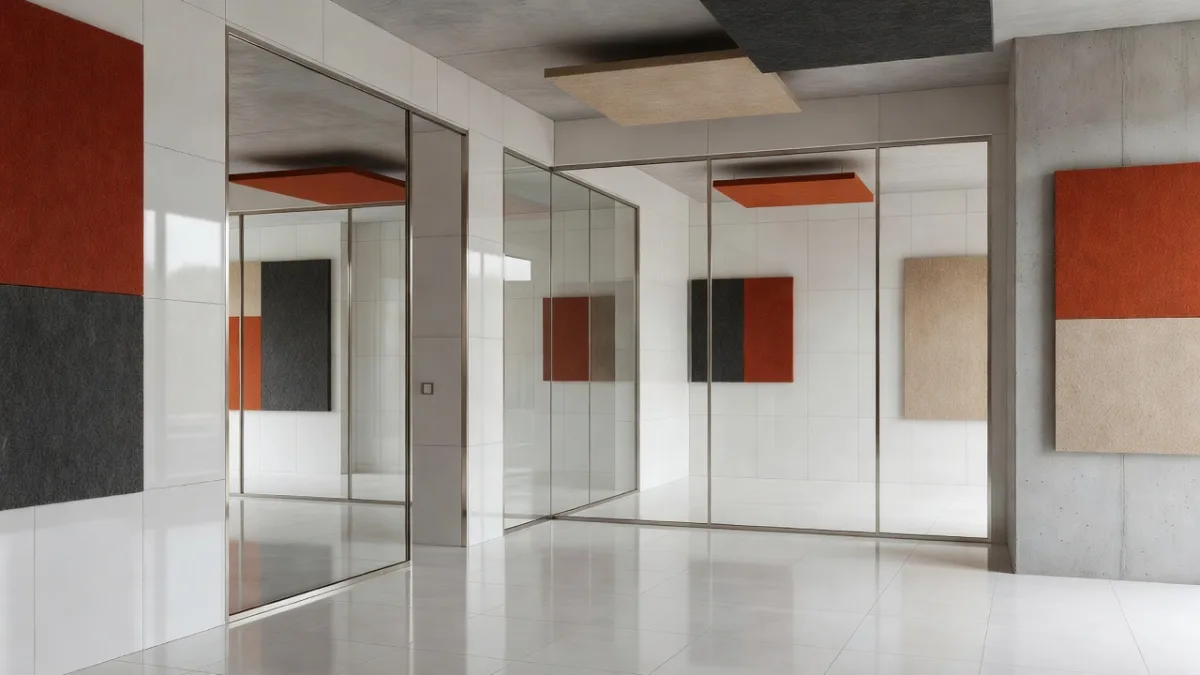
To reduce reverberation effectively, treat the ceiling and the large bare walls first. These are the surfaces that send the most sound energy back toward the occupants.
The ceiling comes first because it is the largest free surface in the room: it looms over every noise source and stays available even when the walls are taken up by display units, banquettes or decor. Next come the walls that face each other, responsible for the sound bouncing back and forth, then the areas near the glazing, which thick curtains can round out.
At ACOUSTELIO, our projects show that treating 15 to 30 % of the wall and ceiling surface is usually enough to transform the sound of a room. There is no need to line the whole space, but you have to aim well:
- The ceiling: the priority in tall volumes, tiled rooms and open spaces
- The large bare walls: especially the two parallel walls that sustain the echo
- Ear height: between 1 m and 2 m off the floor, where voices reflect first
- Around the glazing: curtains or panels nearby to break up the reflections off the glass
Better to concentrate the absorbent surface on two well-chosen zones than to scatter small decorative frames here and there. That is the difference between a visible fix and an audible improvement.
What are the concrete solutions to reduce reverberation in a room?
Every solution for reducing reverberation rests on the same lever: adding absorption. But their effectiveness ranges from marginal to tenfold, and that is precisely where budgets get lost.
The table below ranks the options by real effectiveness, with indicative costs and the lead times seen on the French market. It will help you split your budget between the solutions that do the heavy lifting and those that fine-tune the result.
| Solution | Effectiveness | Indicative cost | Lead time |
|---|---|---|---|
| ACOUSTELIO wall panels (PET felt, NRC 0,85) | Very high, up to 85 % of noise absorbed | From 49 €/m² | 10 to 15 working days |
| Ceiling baffles and panels | Very high, ideal for large volumes | From 59 €/m² | 10 to 15 working days |
| Thick curtains and drapes | Medium, useful near glazing | 30 to 150 € per window | Immediate |
| Thick rugs and carpet | Low to medium, as a complement | 20 to 60 €/m² | Immediate |
| Upholstered furniture and bookshelves | Low, diffusion rather than absorption | Variable | Immediate |
| Budget adhesive foam | Almost nil, non-compliant in public buildings | 10 to 20 €/m² | Avoid |
A word on how to read this table: textiles and furniture improve comfort, but they never replace a properly sized treatment. In a professional space, technical panels do the heavy lifting, the rest fine-tunes.
Are acoustic wall panels really effective?
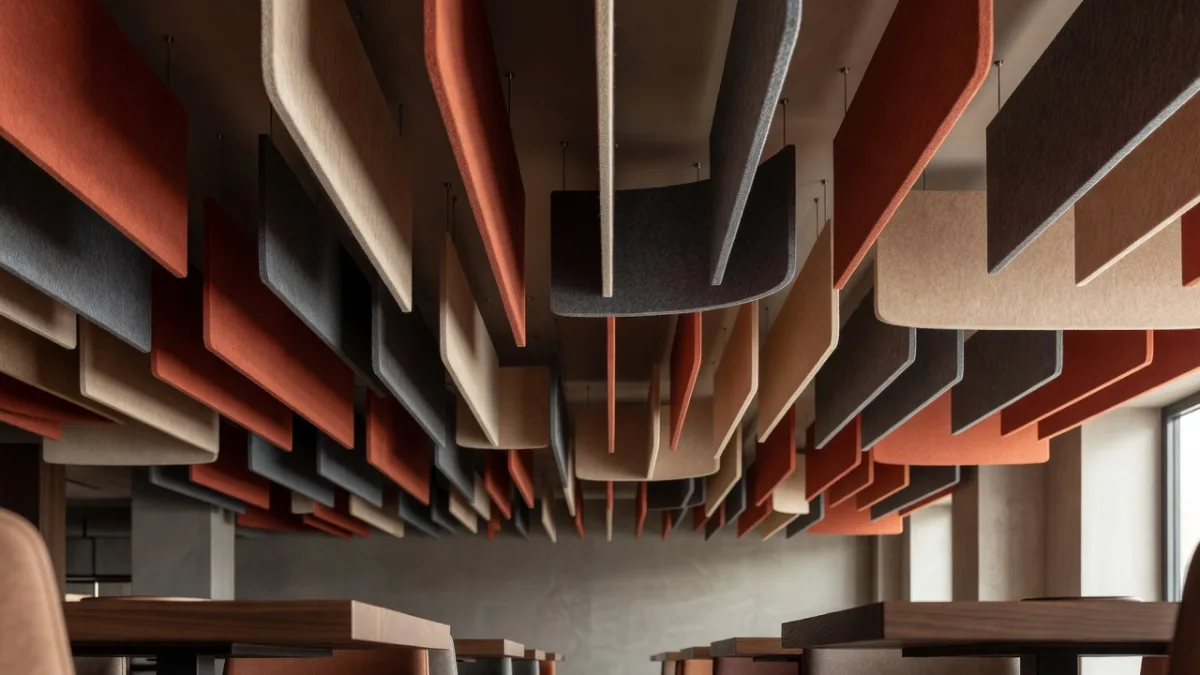
Yes, wall panels are the most cost-effective way to fix a room that echoes, on one condition: check their absorption coefficient before you buy. This coefficient, the NRC, indicates the share of sound actually trapped by the material.
Our acoustic wall panels in PET felt post a measured NRC of 0,85, meaning up to 85 % of the noise absorbed at each reflection. They install with adhesive or clips, without heavy work or closing your venue. And because PET felt prints in high definition, the panel becomes a support for decor, signage or branding in your colours. In 2026, nobody wants to hang grey studio foam in a restaurant dining room. Acoustic treatment can be shown off instead of hidden, that is even our stance:
- NRC 0,85: up to 85 % of noise absorbed, a performance measured in the laboratory and not estimated
- PET felt: light, durable, with a share of recycled material, CE marking
- High-definition printing: visuals, logos or solid colours to blend the panel into your decor
- Simple installation: adhesive or clips on the wall, without heavy drilling or specialist labour
Let us be honest about the limits: a wall panel does not correct the deep bass of a concert hall and does not block the neighbour’s noise. For a restaurant, an office or a lobby that echoes, on the other hand, it is the most effective investment per square metre.
Why does the ceiling change everything in large volumes?
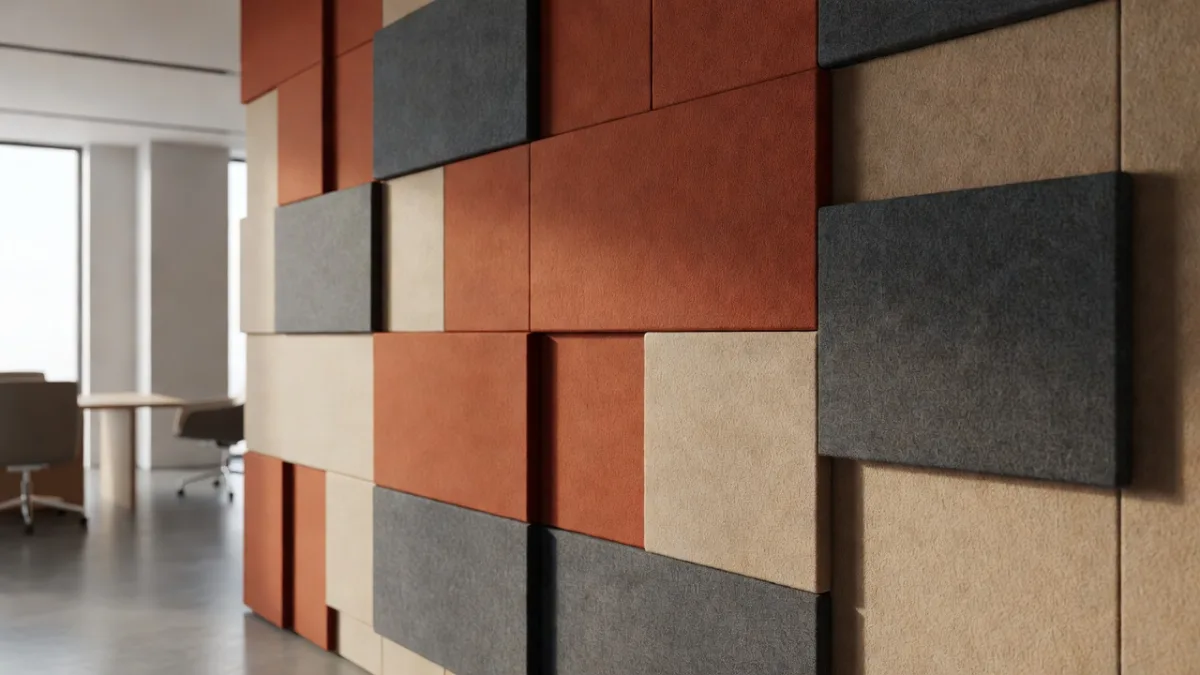
In a large volume, the ceiling often accounts for half the useful reflective surface. Treating it changes the sound perception of the whole room, without touching the walls or the existing decor.
Acoustic baffles and ceiling panels hang on cables, which makes them compatible with service ceilings, exposed ducts and suspended lighting. A vertical baffle absorbs on both faces, so every square metre installed works double. It is the solution we recommend as soon as the height exceeds 3 m or the walls are already occupied.
At ACOUSTELIO, on our restaurant acoustics projects we see an average 50 % drop in reverberation after installation. The result is heard from the first service: customers lower their voices, because they no longer have to force them. The most common configurations:
- Suspended baffles: large volumes, service ceilings, lobbies and sports halls
- Solid ceiling panels: restaurant dining rooms, open spaces, meeting rooms
- Grid layout: even spacing above the conversation zones
- Wall and ceiling mix: the best-performing combination when the resonance is severe
If your room combines a hard floor and a high ceiling, start at the top. You will get more effect from 20 m² well placed than from 40 m² scattered across the walls.
Are furniture and textiles enough to reduce reverberation?
No, furniture and textiles are not enough to reduce reverberation in a professional space. They help, and you should use them, but their absorbing power stays marginal against dozens of square metres of hard surfaces.
A fabric sofa absorbs a little, a full bookshelf diffuses sound, thick curtains calm reflections near the glazing. In a private living room, that mix can be enough. In a 120-cover restaurant with a tiled floor, no. And we would rather tell you before you spend 3,000 euros on made-to-measure curtains to gain 0.1 second of reverberation time:
- Thick rugs: useful on the floor, especially under traffic and conversation zones
- Curtains and drapes: effective in front of picture windows, provided they are heavy and pleated
- Textile seating: banquettes and upholstered chairs, a discreet but real contribution
- Green plants: very decorative, almost nil acoustically, do not count on them
So combine both registers: textiles and furniture for atmosphere and top-up, technical panels for measurable performance. It is this combination that produces a lively room without it being noisy.
What mistakes should you avoid before buying?
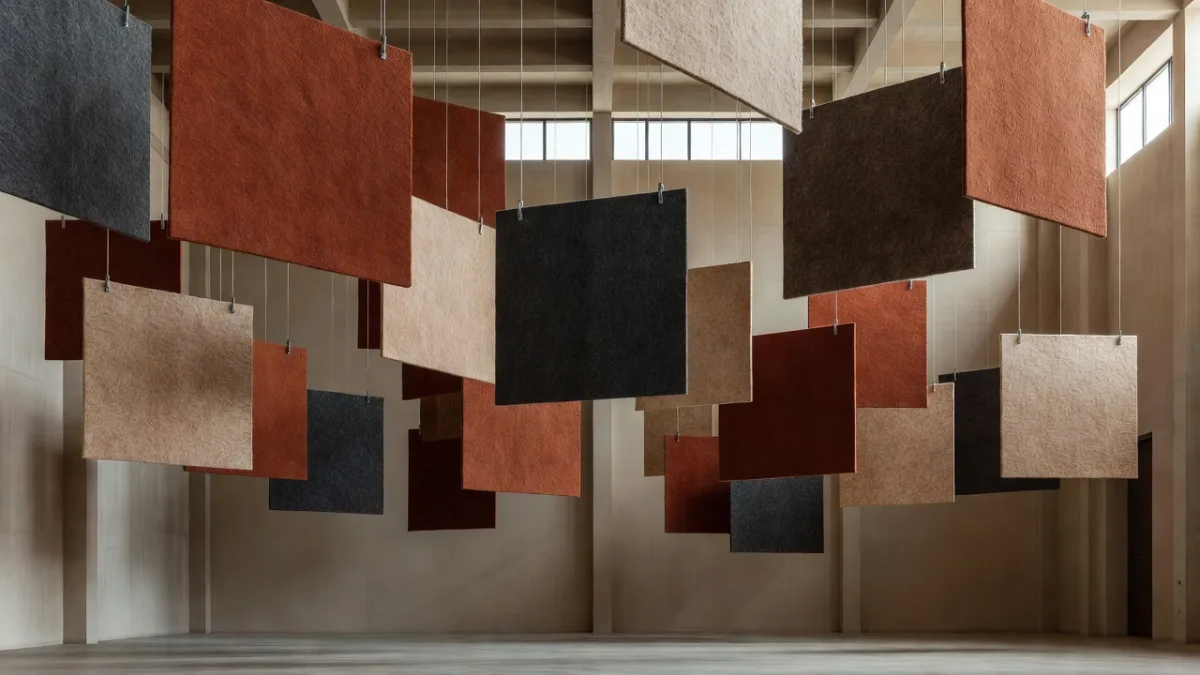
The most common mistake is buying absorbers before sizing the need. A few decorative frames on 80 m² of room change nothing, and the disappointment feeds the false idea that acoustic treatment does not work.
The second mistake, costlier still, hits public-access buildings. In these venues, exposed materials must carry an EN 13501-1 B-s1,d0 fire rating. Yet the budget adhesive foams sold online almost never reach it. In the event of an inspection or a fire, the operator’s liability is on the line. The classic pitfalls to steer clear of:
- Under-sizing: aim for 15 to 30 % of treated surface, not three token panels
- Confusing treatment and soundproofing: absorbing the internal echo does not block the neighbour’s noise, these are two separate jobs
- Ignoring the fire rating: demand the material’s fire test report, we supply it with every order
- Over-treating: a room saturated with absorbers becomes dead and uncomfortable, the aim is controlled sound, not studio silence
- Believing in egg cartons: their absorbing power is close to nil, the myth dies hard
A good supplier asks you for the room’s dimensions, its materials and its use before selling you anything. If they quote a price without asking a single question, be wary.
Frequently asked questions about reducing reverberation
What is the difference between reducing reverberation and soundproofing?
Reducing reverberation means absorbing sound inside a room to remove the echo and the din: this is acoustic treatment. Soundproofing means stopping noise from crossing a wall into another room or from the street: it takes mass, linings and heavy work. The two problems call for different solutions, and it is the most widespread confusion among our clients. Felt panels correct a room that echoes but will not stop the music from the bar next door. Before investing, then, identify your real problem: if the offending noise is born in the room itself, acoustic treatment is the right answer.
How many panels are needed to reduce reverberation in a 100 m² restaurant?
For a 100 m² restaurant with a hard floor, count on 25 to 45 m² of absorbent surface, or 15 to 30 % of the wall and ceiling surface. The exact quantity depends on the ceiling height, the materials in place and the comfort level targeted. A room 3.5 m high with tiling and picture windows will call for the top of the range, combining wall panels and baffles. At ACOUSTELIO, we size this need from your plans and photos, then send you a custom quote within 48 h with the exact recommended surface, which avoids buying too much or too little.
Is budget adhesive acoustic foam a good option?
No, budget adhesive foam is almost always money badly spent for a professional space. Its real absorbing power is low, because it is too thin to treat the frequencies of the human voice, and its visual finish downgrades a venue’s image. Above all, these foams almost never reach the B-s1,d0 fire rating required in public-access buildings, which exposes the operator during an inspection by the safety commission. A certified PET felt panel costs more per square metre, but it genuinely absorbs, blends into the decor and stays compliant. Over the life of the premises, the maths is quickly done.
How long before you see the difference after installation?
The improvement is immediate: reverberation drops as soon as the panels are in place, with no acoustic drying time or adaptation period. A restaurant treated in the morning sounds different at the evening service, and it is often the staff who notice first, before the customers. On our projects, the average drop reaches 50 % of the initial reverberation. On the overall timeline, count on a quote within 48 h, a proof approved before production, then DDP delivery in 10 to 15 working days across the European Union and the United Kingdom. In other words, less than three weeks separate your request from a transformed room.
Can you reduce reverberation without drilling the walls?
Yes, it is entirely possible to reduce reverberation without heavy drilling. Our wall panels install with adhesive or clips, two reversible and quick methods that suit tenants as well as buildings whose walls must not be altered. On the ceiling, the baffles hang on cables fixed to discreet anchor points or to the existing structure. Installation requires neither closing the venue nor calling in a drywaller. And if the installed result does not match the approved proof, our conform-or-remake guarantee applies: send a photo within 48 h and we remanufacture. The technical risk is therefore cut to a minimum.
What budget should you plan to treat a room that echoes?
Count on from 49 €/m² for PET felt wall panels and from 59 €/m² for ceiling and baffle solutions. For a 100 m² restaurant needing 30 m² of treatment, the material budget therefore starts around 1,500 to 2,000 euros, excluding custom-print options. That is far less than an advertising campaign, for an effect every customer notices the moment they walk in. The ACOUSTELIO quote details the recommended surface, visuals and lead times, it is free and supplied within 48 h. Be wary of very low offers: with no measured absorption coefficient or fire test report, the advertised price hides a product that treats nothing.
Your room echoes and you want a measurable result rather than a gamble? Send us your room’s dimensions and a few photos: ACOUSTELIO returns a custom quote within 48 h, with proof approved before production and DDP delivery in 10 to 15 working days. Request your free acoustic quote and get back a space where you can finally hear each other speak.