Acoustic felt is an absorbing panel made of polyester (PET) fibres, most often from recycled plastic bottles, heat-compressed into rigid boards of 9 to 24 mm. Light, free of irritating fibres and printable, it absorbs up to 85% of ambient noise and corrects reverberation in offices, restaurants and public buildings.
According to the study by ADEME and the French National Noise Council published in 2021, noise costs France 155.7 billion euros a year, and noisy workplaces weigh heavily in that bill.
ACOUSTELIO manufactures made-to-measure acoustic panels in PET felt, measured at NRC 0.85, certified EN 13501-1 to B-s1,d0 with test report supplied, and quotes your project within 48 h.
Acoustic felt has established itself in just a few years as the reference material for decorative acoustic treatment. And it is not a passing trend: no other absorber combines measured performance, light weight, absence of irritating fibres and graphic freedom at this level.
At ACOUSTELIO, we manufacture made-to-measure acoustic panels in PET felt for restaurants, offices, hotels and public buildings. This guide covers everything we explain to our clients every week: what this material really is, how it is made, what it absorbs, what it does not absorb, and how it compares with the other solutions on the market in 2026.
What exactly is acoustic felt?
Acoustic felt is a semi-rigid board of entangled polyester fibres that are then heat-compressed, designed to absorb sound waves instead of reflecting them. Its porous structure traps the energy of sound in millions of micro air cavities, where it dissipates as heat through friction.
Nothing to do with the wool felt of hats, then. We are talking here about a technical non-woven textile, whose fibres come mostly from the recycling of PET (polyethylene terephthalate) bottles. The recycled-content rate varies by manufacturer, often around 60%, sometimes more. Our recycled PET material page details the exact composition of our panels.
In practical terms, a felt panel is recognised by three features:
- Porous surface: sound enters the material instead of bouncing back, unlike plaster, glass or concrete
- Semi-rigidity: the board stands on its own, cuts cleanly and fixes without a frame or structure
- Low surface mass: count on 2 to 5 kg/m² depending on thickness, where a wood panel easily exceeds 10 kg/m²
One point that saves plenty of disappointment: felt corrects the acoustics of a room, it does not soundproof it. It reduces echo and reverberation inside a volume, but it will never block the noise from neighbours or the street.
How is acoustic felt made from recycled PET?
Manufacturing a PET felt panel turns used plastic bottles into a rigid absorbing panel, in five industrial steps. The key process is called heat compression: the fibres are heated to around 180 to 200 °C then pressed to the desired thickness.
The full journey is worth describing, because it explains the material’s qualities:
- Collection and sorting: PET bottles are sorted, washed and stripped of their caps and labels
- Grinding: they are reduced to flakes, themselves melted and extruded into polyester filaments
- Web forming: the fibres are carded then layered into thick, aerated webs
- Needle-punching and heat compression: thousands of needles entangle the fibres, then heat and pressure set the final density and thickness
- Finishing: digital cutting, 3D machining and, at our workshop, high-definition printing directly on the surface
Depending on the panel thickness, several dozen 50 cl bottles end up in a single square metre of felt. And it is heat compression that makes all the difference between two products of similar appearance: get the density wrong and absorption collapses. That is why we require laboratory test reports on every batch, not theoretical values.
What absorption performance can you expect from acoustic felt?
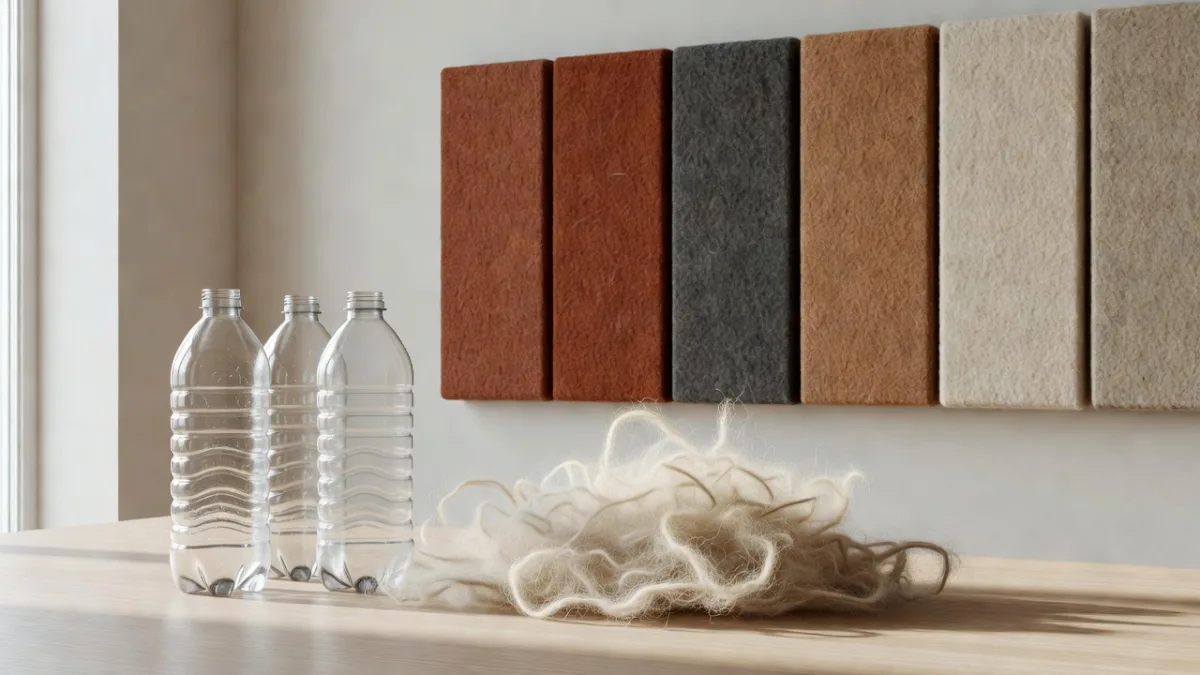
A quality PET felt reaches an NRC of 0.85, in other words it absorbs 85% of the sound energy that hits it across the frequencies of the voice. The NRC coefficient remains the most reliable indicator for comparing two panels, provided it is measured in a laboratory.
Three parameters drive the real performance:
- Thickness: 9 mm is enough for the highs, 12 mm covers the mid-range of the voice well, 24 mm reaches lower into the spectrum
- Density: compact felts sit between 150 and 280 kg/m³; too soft and the panel lets sound through, too dense and it reflects it
- Air gap: setting the panel 20 to 50 mm off the wall clearly improves absorption of the low frequencies, without changing product
There is no point, on the other hand, in covering every wall. The rule we apply in the field: treating 15 to 30% of the wall and ceiling area is generally enough to transform listening comfort. At ACOUSTELIO, we see on our projects an average 50% drop in reverberation after installing our wall panels, with before-and-after measurements to back it up. In a 120-cover restaurant treated in January, the reverberation time dropped below one second and the waiters stopped shouting the orders. That kind of detail does not show up on a spec sheet, but it is exactly what your teams notice.
Acoustic felt, foam, rock wool or wood: which to choose?
PET felt dominates the comparison of absorbers as soon as aesthetics, health and sustainability come into play. But each material keeps a home turf, and saying so clearly will spare you a bad purchase.
Melamine foam absorbs very well for a feather weight, and it stays relevant in a studio or a technical room. Its problem: it yellows under UV, it crumbles at the slightest knock and its visual finish stays poor. Fabric-wrapped rock wool offers the broadest absorption on the market, especially in the lows, but its irritating fibres call for careful wrapping and precautions during installation. Perforated wood or slats over felt bring real visual warmth, at a markedly higher price and weight. As for cork, it is appealing on paper, but its absorption stays middling and its brown tone imposes itself on your decor.
| Material | Absorption | Weight | Health and safety | Aesthetics | Indicative price |
|---|---|---|---|---|---|
| PET felt (ACOUSTELIO) | NRC 0.85 measured (12-24 mm) | 2 to 5 kg/m² | No irritating fibres, B-s1,d0 | HD printable, made-to-measure cutting | from 49 €/m² |
| Melamine foam | αw approx. 0.85 (40-50 mm) | 0.4 to 0.6 kg/m² | Safe but friable, yellows under UV | White or grey, technical look | 30 to 80 €/m² |
| Fabric-wrapped rock wool | αw 0.90 to 1.00 (40 mm) | 3 to 6 kg/m² | Irritating fibres, wrapping mandatory | Depends on the stretched fabric | 60 to 150 €/m² |
| Perforated wood or slats | αw 0.50 to 0.85 (depending on plenum) | 8 to 12 kg/m² | Safe, check adhesive VOCs | Warm, high-end | 90 to 250 €/m² |
| Expanded cork | αw 0.30 to 0.70 (25-50 mm) | 3 to 6 kg/m² | Natural and safe | Fixed brown tone | 25 to 70 €/m² |
Our position is owned: for a space open to the public where the visual finish matters, PET felt offers the best balance of performance, weight, health and price. But if your absolute priority is low-frequency absorption in a concert hall, a thick fabric-wrapped mineral wool remains technically superior.
What are the concrete everyday advantages of PET felt?
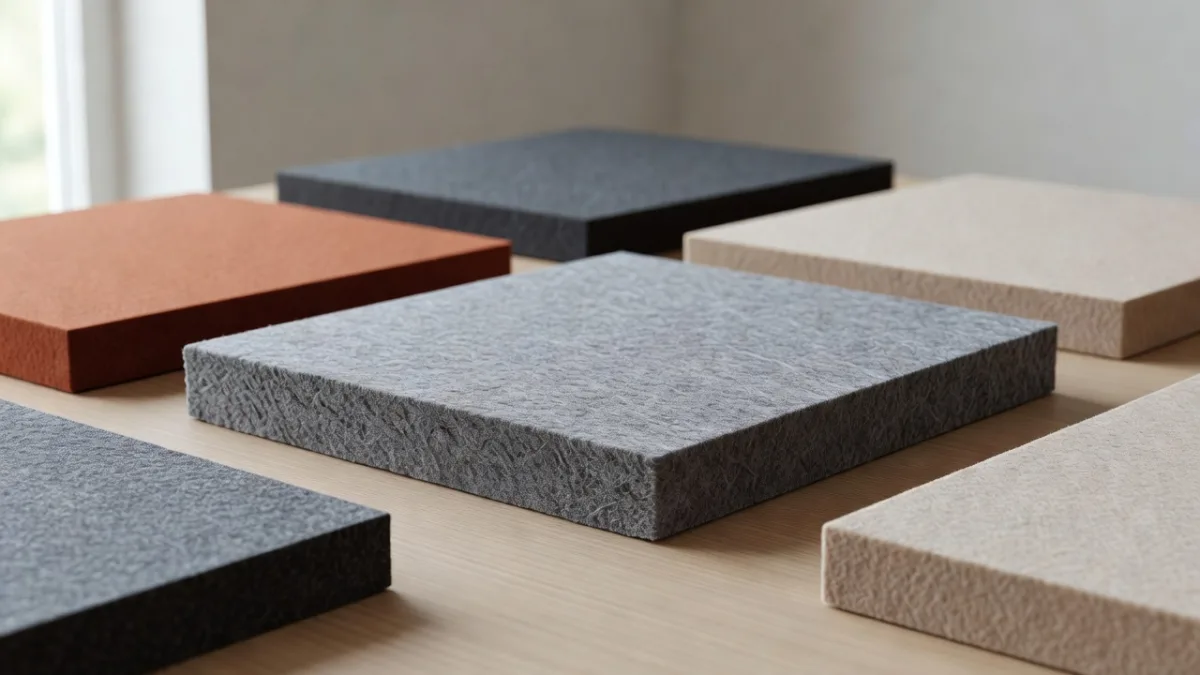
PET felt stacks up four practical advantages that other absorbers never offer together: light weight, safety, printability and impact resistance. And it is these details, more than the NRC, that change life on a job site and during the ten years that follow.
- Light weight: at 2-5 kg/m², a panel is fitted with adhesive or clips onto a standard plasterboard partition, with no reinforcement or structural drilling
- Safety: zero irritating fibre, handling with bare hands, no mask or gloves, and very low VOC emissions
- Printability: the surface accepts high-definition printing, your panel becomes a mural, signage or brand support
- Durability: felt takes everyday knocks, does not crumble and dusts off in a few minutes
- Fire safety: a felt certified EN 13501-1 to B-s1,d0 passes public-building safety commissions, test report in hand
Printing is the most underrated argument. A conventional absorber hides behind a neutral fabric, whereas a printed felt puts itself on show. This is precisely the logic of our made-to-measure workshop: your colours, your logo or a graphic creation, printed directly on the absorbing panel, with proof approved before production.
What are the honest limits of acoustic felt?
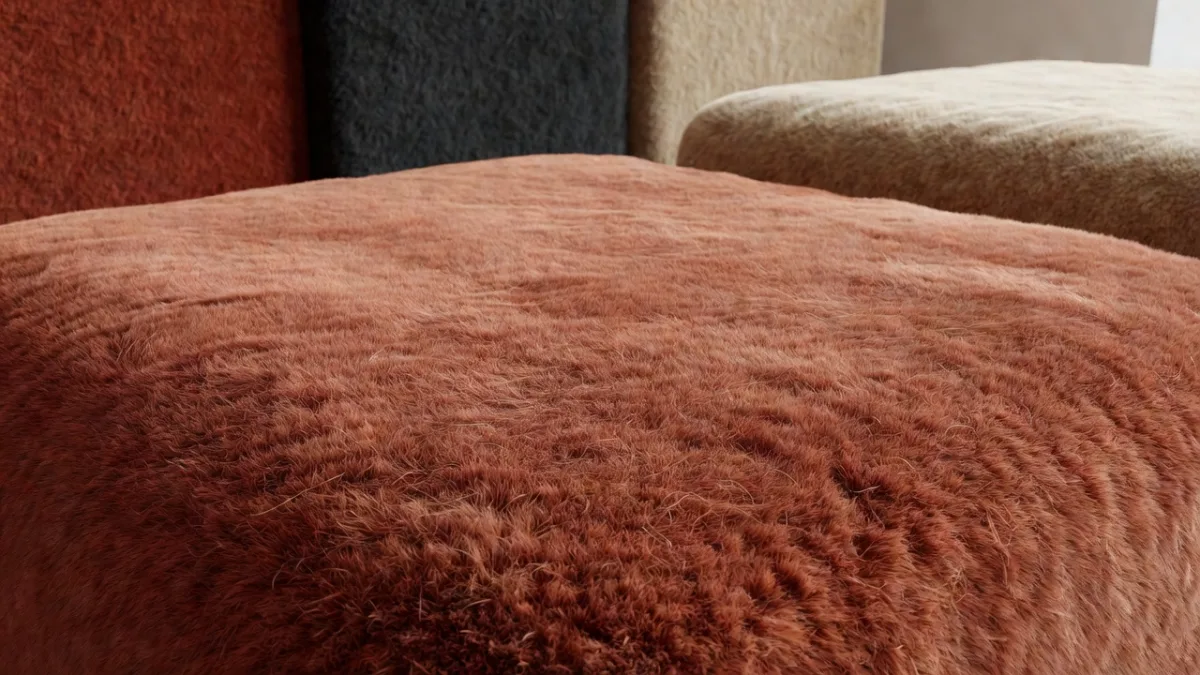
PET felt has real limits, and a serious supplier tells you about them before you order. Here are four we repeat at every quote, because a well-informed client never comes back disappointed.
- Low frequencies: at 9 or 12 mm fitted against the wall, felt absorbs little below 250 Hz; you need to go to 24 mm, add an air gap or combine with ceiling baffles
- Soundproofing: no absorbing panel blocks a noise that passes through a surface; for neighbour noise, mass and decoupling do the work, not felt
- Abrasive friction: in a narrow corridor where bags and trolleys rub constantly, the surface can pill over time; you then shift the panels above the contact zone
- Entry price: an entry-level foam costs less to buy; felt makes it back on lifespan and finish, not on the initial ticket
At ACOUSTELIO, we see on our projects that half of the market’s disappointments come from confusing correction with insulation. So it is worth repeating: if your problem is echo in the room, felt is the right answer. If your problem is noise coming in or going out, this guide will not replace an acoustician.
How do you maintain an acoustic felt panel?
A felt panel is maintained with a soft-brush vacuum, a few minutes per quarter is enough. Polyester is naturally hydrophobic and antibacterial, it retains neither moisture nor odours, which explains its longevity in restaurants.
For less ordinary situations, here is our protocol:
- Dust: vacuum with a brush head, along the surface, without pressing
- Fresh stain: barely damp microfibre cloth, by dabbing, never by rubbing
- Grease stain: lukewarm water with a drop of mild soap, then air drying
- To avoid: solvents, steam cleaners and hard brushes, which crush the fibres and degrade absorption
The result: a well-treated panel keeps its performance and appearance for more than ten years, even in intensive use. That is a real contrast with foam, which is often replaced after three to five years because it has yellowed or crumbled at the corners.
What is the real environmental impact of PET felt?

Recycled PET felt shows one of the best environmental balances among acoustic materials, because it makes use of an existing waste stream instead of drawing on a new resource. According to ADEME, recycled PET emits about 70% less CO2 than virgin PET in production.
Three arguments weigh objectively in its favour. First, the raw material: bottles already produced, collected and diverted from incineration. Next, logistics: a material two to four times lighter than its competitors cuts transport emissions by as much. Finally, end of life: a single-material 100% polyester panel can go back into a recycling stream, where composite sandwiches (foam bonded to wood, fabric over mineral wool) end up in landfill.
Let us be honest all the same: PET felt is still a plastic, and polyester recycling is not infinite. Noise, meanwhile, is a documented public-health issue, the INRS reminds us that prolonged exposure beyond 80 dB(A) creates a proven hearing risk, and the Ifop survey for the JNA in 2023 put at 52% the share of French workers bothered by noise at work. Treating a noisy space with a recovered waste rather than a virgin material is, in 2026, the most rational trade-off on the market.
Frequently asked questions about acoustic felt
Is acoustic felt really made from recycled bottles?
Yes, most felts on the market incorporate fibres from recycled PET bottles, with rates often close to 60%. The bottles are sorted, washed, ground into flakes then extruded into polyester filaments, which are then web-formed and heat-compressed into rigid boards. The exact rate varies from one manufacturer to another, and some low-end products mostly use virgin polyester without saying so. The right reflex is therefore to ask for the technical sheet and the share of recycled material before ordering. At ACOUSTELIO, the composition of our panels is documented on our dedicated recycled PET material page, with the associated CE and FSC certifications.
What thickness of acoustic felt should you choose for an office?
For an office or an open-plan space, a thickness of 12 mm is the best compromise between performance, bulk and budget. This thickness effectively absorbs the frequencies of the human voice, between 500 and 4,000 Hz, which represent most of the disturbance in a work environment. A 9 mm felt stays relevant as a decorative complement or for cladding large surfaces, while 24 mm is justified in meeting and video-conference rooms, where you seek deeper absorption. And if the wall allows it, mounting on battens with 20 to 50 mm of air gap further improves the result in the lows, without changing panel.
Does acoustic felt block neighbour noise?
No, an absorbing panel corrects reverberation inside a room but does not insulate against noise passing through the surfaces. Soundproofing relies on mass, sealing and decoupling of partitions, in other words on structural work. Felt, for its part, acts on the sound comfort of the volume where it is fitted: less echo, better speech intelligibility, a calmer atmosphere. The two approaches are complementary and often confused, including by unscrupulous sellers. If your problem comes from neighbours, the street or a machine in the next room, first have an insulation diagnosis carried out; the absorbing treatment comes afterwards, to finish off interior comfort.
Is PET felt safe for health?
Yes, PET felt is one of the safest acoustic materials on the market for occupants and installers alike. It contains no irritating mineral fibre, is handled with bare hands without a mask and shows very low emissions of volatile organic compounds, which makes it compatible with schools, nurseries and healthcare facilities. Its hydrophobic and antibacterial surface limits mould growth, even in a humid setting like a restaurant. The regulatory point remains: in public buildings, the fire classification takes priority. A felt certified EN 13501-1 to B-s1,d0, with test report supplied, passes safety commissions; a product with no test report exposes you to a rejection.
How do you clean a printed felt panel?
A printed panel is cleaned exactly like a plain felt: soft-brush vacuum for dust, barely damp microfibre cloth for marks. High-definition printing penetrates the fibres instead of forming a film on the surface, so it does not flake and withstands dabbing with lukewarm, lightly soapy water. Steer clear, however, of solvents, household alcohol and steam cleaners, which can alter the inks and crush the panel’s porous structure. On our restaurant projects, a few minutes of quarterly maintenance is enough to keep a flawless finish. And if a panel is truly damaged, you replace only the module concerned, not the whole wall.
How much does a PET felt panel cost?
Count on from 49 €/m² for professional-grade PET felt wall panels, and from 59 €/m² for ceiling formats and suspended baffles. The final budget depends on thickness, cutting, any printing and quantities. Relative to the surface actually useful, the investment stays contained: treating 15 to 30% of the walls and ceiling is enough in most spaces, which brings the cost of a 100 m² restaurant well below what our clients imagine on the first call. At ACOUSTELIO, every project starts with a tailored quote within 48 h, with proof approved before production and DDP delivery in 10 to 15 working days.
You now know what this material is worth, what it does very well and what it will never do. If your space echoes, send us its dimensions and a few photos: request your tailored quote, and within 48 h you will receive a costed proposal with the felt surface actually needed, no more, no less.