Sports hall acoustics are corrected by installing absorbent surfaces out of reach of the balls: baffles suspended under the roof structure and wall panels in the upper zone, until you reach an equivalent absorption area of at least half the floor area. Reverberation time then falls from 4 to 8 seconds to under 2 seconds.
The French decree of 25 April 2003 on noise limitation in educational buildings imposes this minimum 50 % absorption in large volumes, and sets a reference reverberation time of 0.5 second for standard rooms.
ACOUSTELIO manufactures PET felt acoustic panels certified B-s1,d0 to EN 13501-1, with an NRC of 0,85, and prices your sports hall project from your plans with a quote within 48 h.
An untreated sports hall stacks up everything that makes noise: a volume of several thousand cubic metres, bare walls and a measured reverberation time of 4 to 8 seconds. The result: PE teachers’ instructions become inaudible, coaches strain their voices and neighbours complain from the very first evening rental.
The good news is that a noisy sports hall responds well to treatment, because the problem is almost always the same: it lacks absorption. At ACOUSTELIO, we manufacture made-to-measure PET felt acoustic panels designed for local authorities and sports facility operators. This guide covers the causes, the regulations applicable in 2026, the zones to treat first and the real budgets.
Why are sports hall acoustics so catastrophic by default?
A sports hall concentrates the three factors that lengthen reverberation: an enormous volume, hard surfaces and a total absence of absorbent materials. Sound bounces around for 4 to 8 seconds before dying away, against 0.5 to 0.8 second in a properly treated classroom.
Take a standard French type C hall of 44 × 24 metres under a 9-metre ceiling: nearly 9,500 m³ of air, surrounded by cast concrete, metal cladding, glazing and a rigid sports floor. Nothing absorbs. Reverberation time is directly proportional to volume and inversely proportional to absorption area, as we explain in our article on reverberation time. Huge volume plus zero absorption equals record reverberation, the formula is merciless.
Worse still, the phenomenon feeds on itself:
- Lombard effect: as the ambient noise rises, everyone speaks louder to be heard, which pushes the overall level up further
- Parallel surfaces: two bare gable walls facing each other create sharp echoes, very distinct on a bouncing ball or a whistle blast
- Metal roofing: steel decking reflects the high frequencies and vibrates in the rain, adding noise where there is already too much
- Simultaneous activities: two classes or three badminton courts in the same volume, and the sound sources add up without ever fading out
In 2026, most sports halls in service in France date from the 1970s to the 1990s, a period when interior acoustics simply did not feature in construction briefs.
What are the concrete consequences of a noisy sports hall?
A noisy sports hall is first and foremost an occupational health and safety problem, before it is a comfort issue. Measurements published by acousticians place sound levels during a PE lesson between 85 and 95 dB(A), above the 80 dB(A) threshold at which the French Labour Code requires preventive action for an 8-hour exposure.
PE teachers are on the front line. They spend 20 to 25 hours a week in this din, strain their voices continuously and develop well-documented vocal pathologies and hearing fatigue. Frankly, open-plan office noise gets all the attention, but a PE teacher endures levels two to four times more energetic than a manager in a shared office.
In practice, here is what facility managers report to us:
- Inaudible instructions: beyond 2 seconds of reverberation, syllables overlap and speech intelligibility collapses beyond a few metres
- Degraded safety: an alert call, a whistle stopping play or an evacuation instruction must be understood instantly, and the din drowns them out
- Restless pupils: noise increases group excitement, especially in primary school, and undermines concentration on technical instructions
- Neighbour complaints: during evening rentals to clubs and associations, music and shouting cross the lightweight walls and end up as letters to the town hall
So yes, acoustic treatment of a sports hall is an investment in comfort. But above all it is a matter of occupational risk prevention and public peace.
What do the regulations say about sports hall acoustics?
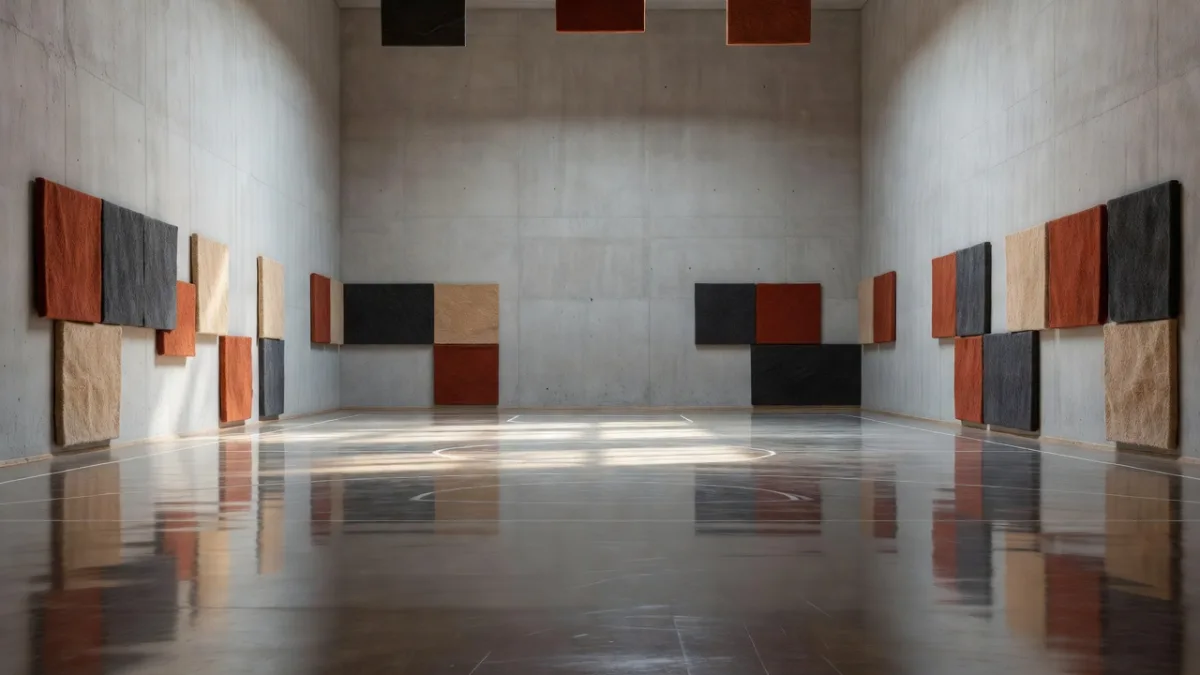
For sports halls in educational establishments, the reference text is the French decree of 25 April 2003 on noise limitation in educational buildings. For large volumes such as sports halls, this text requires an equivalent absorption area of absorbent finishes at least equal to half the floor area of the room.
The equivalent absorption area A is easy to calculate: A = S × αw, where S is the surface of absorbent material installed and αw its absorption index. A 1,000 m² school sports hall must therefore provide at least 500 m² of equivalent absorption. With a highly absorbent material you need less surface; with a mediocre one you need far more. The full text is available on Légifrance. The decree also sets reverberation times by room type, with a reference of 0.5 second for standard rooms.
Three nuances, however, are worth knowing:
- Scope: the decree covers new buildings and extensions of educational establishments, not existing municipal sports halls, which fall under best practice and renovation programmes
- Best practice: for a sports volume, engineering consultancies aim for a reverberation time of around 0.10 to 0.15 times the cube root of the volume, or 1.5 to 2 seconds for a typical hall
- Neighbours: noise emitted towards nearby homes, notably amplified music from fitness studios, remains governed by the French Public Health Code, with emergence capped at 5 dB(A) by day and 3 dB(A) at night
Our position is clear: the 50 % absorption rule is a regulatory minimum, not a comfort target. On our public building acoustics projects, we systematically aim for real speech intelligibility, not mere paper compliance.
How do you treat each zone of the hall despite ball impacts?
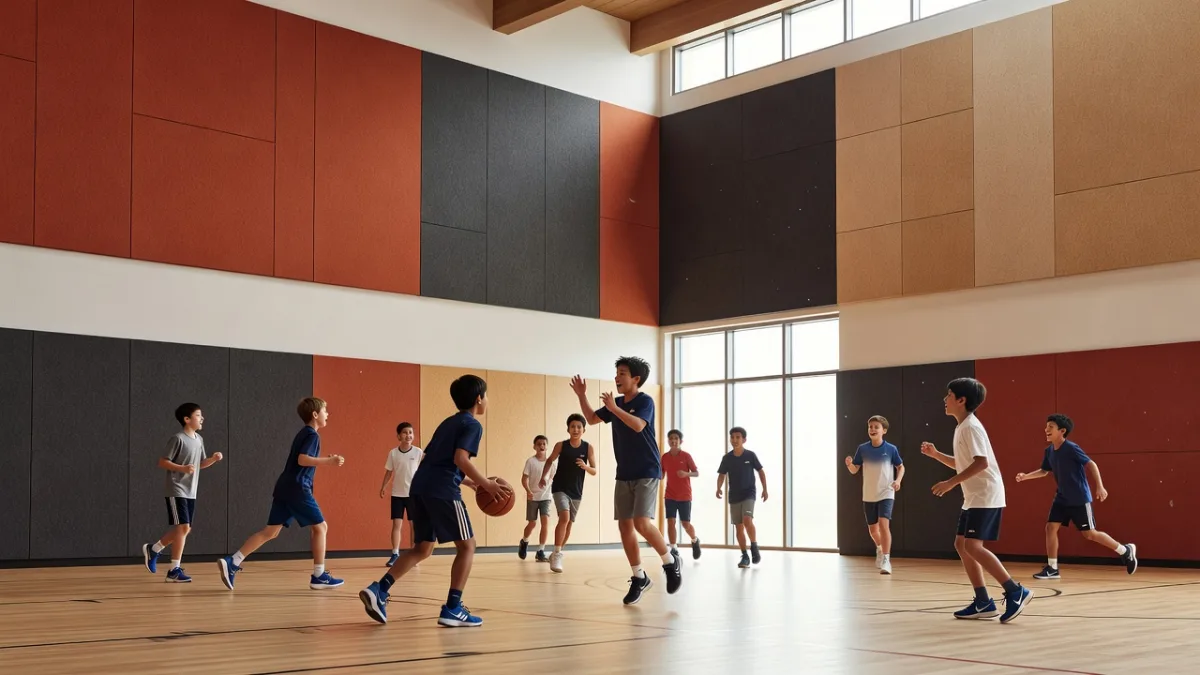
Rule number one in a sports hall: anything below 3 metres will take balls, shoulders and equipment trolleys. Acoustic treatment therefore concentrates on the ceiling and the upper part of the walls, where impacts almost never reach.
The ceiling offers the largest available surface, and that is where to start. Acoustic baffles suspended vertically under the roof structure absorb on both faces, which doubles their yield per square metre installed. They stay out of reach of volleyballs and handball shots alike, and their cable suspension adapts to existing steel structures. For impact resistance, the industry reference is the ball impact test of standard EN 13964, annex D: class 1A designates products validated for halls where ball games are played.
Here is the breakdown we apply in the field:
| Zone of the hall | Suitable treatment | Main constraint |
|---|---|---|
| Ceiling and roof structure | Cable-suspended baffles, double-sided absorption | Height: lift platform required, lightweight products essential |
| Walls, upper zone (above 3 m) | PET felt wall panels, glued or clipped | Occasional ball impacts: product without frame or stretched fabric |
| Walls, lower zone (0 to 3 m) | Left bare or fitted with dedicated sports padding | Direct impacts, abrasion, equipment trolleys |
| Gable walls behind the goals | Panels offset out of the line of shots | Repeated handball and futsal shots |
| Ancillary rooms (dojo, dance, fitness) | Wall panels and ceiling rafts | Mirrors and music: treat the ceiling and the opposite wall |
| Entrance hall and circulation areas | Printed decorative ceiling or wall panels | Absorption of at least half the floor area |
Two benchmarks to guide the trade-off:
- Ceiling baffles: the best performance-to-price ratio in a large volume, because each element absorbs on both faces and stays out of reach
- High wall panels: they break up the sharp echoes between parallel walls, which the ceiling alone cannot do, and install without heavy scaffolding
Which acoustic materials are compatible with a public sports building?
A sports hall is a public-access building: materials installed on the ceiling and walls must carry a B-s1,d0 fire rating to EN 13501-1. This is the criterion that immediately rules out the budget acoustic foams, rated E or untested, still seen far too often in private fitness studios.
We covered the fire classes in detail in our guide to the EN 13501-1 standard, but remember the logic: B for a very limited contribution to fire, s1 for low smoke production, d0 for no flaming droplets. The safety commission will ask for the classification test report, not a sales promise.
Beyond fire, the specification for a sports hall demands:
- High absorption: an NRC of 0,85 means 85 % of incident sound energy is absorbed, which limits the surface needed to reach the regulatory target
- Light weight: suspended under a steel structure, every kilo counts; PET felt weighs a fraction of a perforated wood panel
- Robustness: a one-piece felt panel, with no aluminium frame or stretched fabric, takes a ball impact with nothing to break or re-tension
- Hygiene and maintenance: no mineral fibres shedding above the athletes, a simple annual dusting is enough
At ACOUSTELIO, we see on our projects that PET felt has become the standard in sports facilities precisely for this combination: certified B-s1,d0 with a test report supplied with every order, a measured NRC of 0,85, and high-definition printing that turns the treatment into signage or club branding.
In what order should you treat a sports hall, and on what budget?
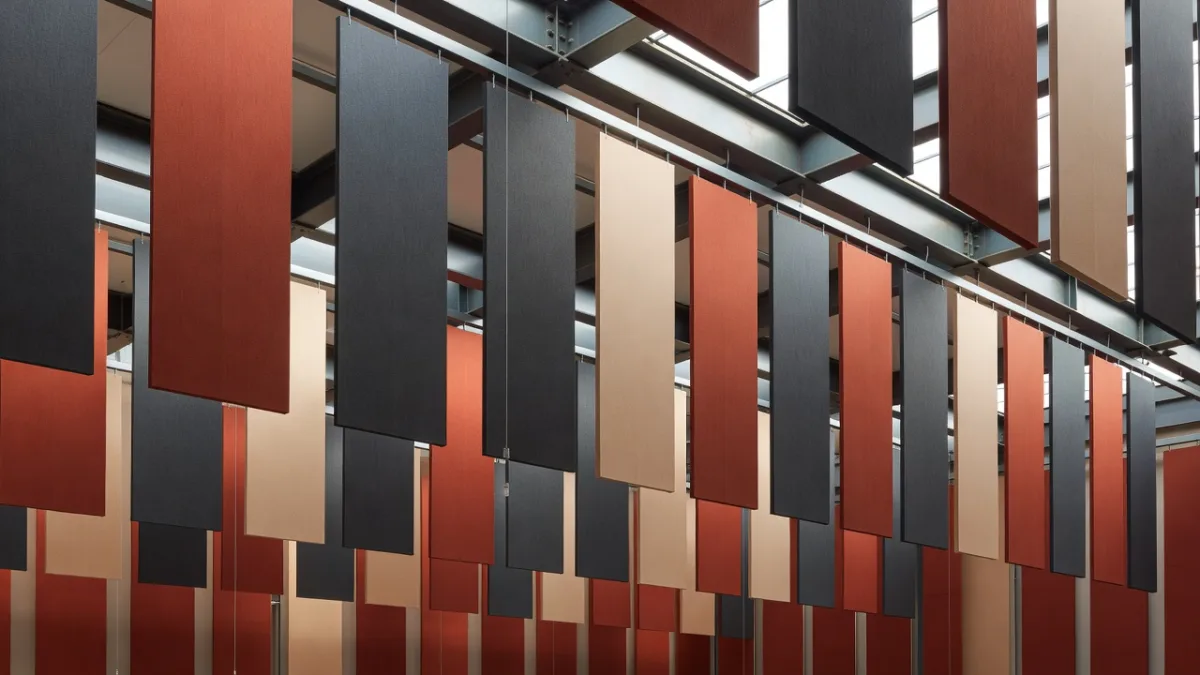
The effective sequence comes down to three steps: measure, treat the ceiling, then complete the upper walls. The ceiling alone delivers 50 to 70 % of the gain, because it concentrates the largest usable surface in the volume.
Start by putting figures on the situation: a reverberation time measurement by an acoustician, or at least an indicative reading, sets the starting point and the target. Then size the absorption. For a 1,056 m² school sports hall (44 × 24 m), the regulatory target of 528 m² of equivalent absorption represents around 620 m² of PET felt at αw 0,85. When the budget is tight, phase it: ceiling in year one, upper walls in year two.
On the numbers, here are our 2026 benchmarks:
- Wall panels: from 49 €/m², glued or clipped, within reach of a technical team equipped with a lift platform
- Ceiling baffles: from 59 €/m², cable-suspended under the roof structure
- Type C hall: budget 35,000 to 45,000 € of materials for a full compliant treatment, excluding installation
- Small 400 m² hall: around 240 m² of panels, or 12,000 to 15,000 € of materials
- Measured result: reverberation cut by 50 % on average across our projects, a hall at 5 seconds comes back down to around 2 seconds
At ACOUSTELIO, we see on our projects that installation rarely exceeds 30 % of the budget when it is phased during school holidays, lift platform included. The custom quote goes out within 48 h from a simple plan, with a proof approved before production and DDP delivery in 10 to 15 working days.
Fitness and CrossFit studios: why do you need both correction and insulation?
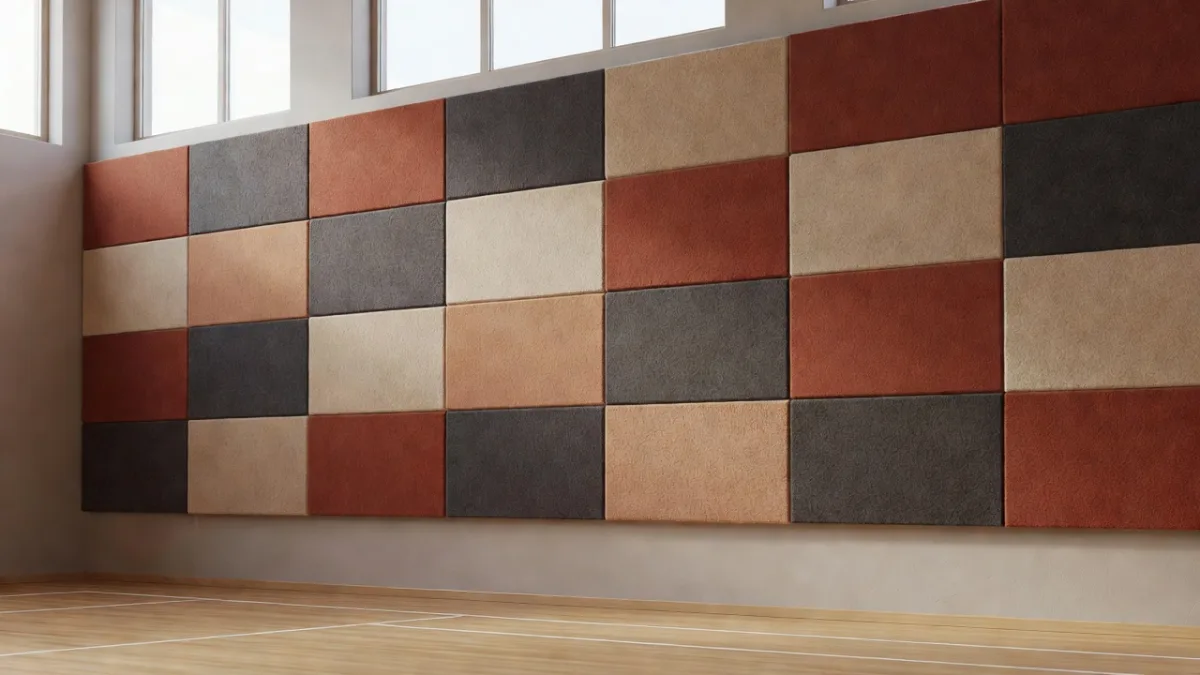
A fitness studio combines two distinct problems: internal reverberation that makes classes exhausting, and noise transmission to the neighbours that triggers complaints. Acoustic correction solves the first, never the second, and confusing the two gets expensive.
Inside, the music of a group class runs between 90 and 100 dB(A). In a tiled or bare-concrete room, that level turns into acoustic mush: the coach screams into the microphone, members leave drained. Absorbent wall panels and ceiling rafts bring reverberation below 1 second and make the coach’s voice intelligible, often with 3 to 4 dB less ambient level at equal music volume.
But for the neighbour upstairs, it is another story:
- Acoustic correction: it absorbs sound inside the room and improves occupant comfort, that is what our panels do
- Sound insulation: it blocks transmission through the walls, and it requires mass, decoupling and low-frequency treatment
- Impact loads: dropped bars in CrossFit travel through the structure; only damping tiles under the weightlifting zones attenuate them
- Legal framework: at the neighbours’, the emergence of activity noise is capped at 5 dB(A) by day and 3 dB(A) at night, and amplified music is subject to specific impact studies
Let us be honest: if your problem is a neighbour dispute over amplified music, our panels will improve interior comfort and shave off a few decibels, but they will replace neither a heavy lining nor an acoustician’s advice. The two projects run in parallel, not one instead of the other.
Frequently asked questions about sports hall acoustics
What reverberation time should you aim for in a sports hall?
Aim for 1.5 to 2 seconds in a large-volume sports hall, against the 4 to 8 seconds observed before treatment. Engineering best practice targets around 0.10 to 0.15 times the cube root of the volume: for a 9,000 m³ hall, that gives 2 to 3 seconds at most, and demanding projects go lower. In a small gym under 250 m³, the target is more like 0.6 to 0.8 second. Below these values, instructions become intelligible again at 15 or 20 metres and the Lombard effect disappears: users stop shouting to be heard, so the overall level drops twice over.
Does the French decree of 25 April 2003 apply to a municipal sports hall?
No, not directly: the decree of 25 April 2003 covers new buildings and extensions of educational establishments, including their sports halls. An existing municipal sports hall therefore has no regulatory obligation for internal acoustic correction. In practice, though, the 50 % equivalent absorption rule serves as the contractual reference in most renovation programmes, because schools use these facilities during the day. And the environmental obligations remain in every case: noise transmitted to nearby homes stays regulated, notably for the amplified music of group classes and evening club sessions.
Do PET felt panels withstand ball impacts?
Yes, provided you install them in the right place, that is, above the playing zone. A one-piece PET felt panel has no aluminium frame to bend, no stretched fabric to puncture, no plaster to crack: an occasional ball impact leaves no trace. Below 3 metres, on the other hand, no absorbent material survives direct impacts, shoulders and trolleys for long, and we recommend leaving that band bare or protecting it with dedicated sports padding. For ceilings in ball-game halls, check the impact resistance class of the EN 13964 annex D test required by your specification.
What budget should you plan to treat a school sports hall?
Budget 35,000 to 45,000 € of materials for a type C hall of 1,056 m² floor area, based on wall panels from 49 €/m² and ceiling baffles from 59 €/m². That amount corresponds to around 620 m² of PET felt, the surface required to reach the 50 % equivalent absorption imposed in large educational volumes. A 400 m² multi-purpose hall is treated for 12,000 to 15,000 € of materials. Installation generally adds 20 to 30 % when phased during school holidays. On our projects, this budget translates into reverberation halved on average, measurable at handover.
Should you treat the ceiling or the walls first?
The ceiling first, because it offers the largest usable surface and stays out of reach of the balls. Baffles suspended under the roof structure deliver 50 to 70 % of the total gain, with absorption on both faces of each element. Upper wall panels come next, and they play a role the ceiling cannot: breaking up the sharp echoes between parallel gable walls, highly damaging to intelligibility. If the budget forces phasing, treat the ceiling in year one and measure: when the result is still insufficient for speech, the second wall phase finishes the job.
Can you treat a sports hall without closing the facility?
Yes, and it is actually the usual case: acoustic treatment of a sports hall installs in a few days and phases zone by zone. Baffles hang on cables from a lift platform, wall panels glue or clip on, with no wet trades or heavy cutting. Most local authorities schedule the work during school holidays or off-peak slots, room by room, which avoids any full closure. The PET felt arrives cut to the dimensions approved on the proof, delivered in 10 to 15 working days, and generates neither mineral fibre dust nor solvent odour: the hall is usable the very evening of installation.
A sports hall where people can hear each other means audible PE lessons, coaches ending the day without a broken voice and evening rentals without letters from the neighbours. Send us your plans and usage constraints: we size the absorption zone by zone and you receive a custom quote within 48 h, B-s1,d0 fire test report included.