Plan acoustic panels over 15 to 30% of the combined surface of your walls and ceiling to correct the reverberation of a room. In practice: about 42 m² of NRC 0.85 panels for a 120 m² restaurant, 77 m² for a 200 m² open-plan office, 13 m² for a 30 m² meeting room.
Noise costs France 147.1 billion euros a year according to the 2021 study by ADEME and the French National Noise Council, and more than one worker in two says they are bothered by noise at their workplace according to the Ifop survey for the JNA.
ACOUSTELIO manufactures made-to-measure acoustic panels in PET felt, measured at NRC 0.85 and classified B-s1,d0 to EN 13501-1. Tailored quote within 48 h, with a layout costed to the nearest m² before any production.
The short answer: enough to cover 15 to 30% of the surface of your walls and your ceiling. The precise answer needs three figures, the volume of the room, its current reverberation time and the target time, then a division. Knowing how many acoustic panels to install is therefore no guessing game. It is a calculation, and you can do it yourself in ten minutes.
At ACOUSTELIO, we manufacture made-to-measure acoustic panels in PET felt for restaurants, offices and hotels, and the question of sizing comes up in almost every quote request. This guide gives you our field method: the 15-30% rule, the Sabine formula explained without jargon, three complete worked examples and the cases where a study is needed. In 2026, no online tool replaces this basic logic, but it fits on a single A4 sheet.
What does the 15 to 30% surface-to-treat rule say?
The field rule is to cover between 15 and 30% of the combined surface of the walls and the ceiling with an absorbing material. This range is enough in the vast majority of rooms to be corrected, because the first absorbing square metres are the ones that work hardest.
Take a simple example. A room of 50 m² floor area with 2.5 m height totals about 120 m² of hard surfaces: 50 m² of ceiling and 70 m² of walls. The rule therefore gives between 18 and 36 m² of panels. Why such a wide range? Because everything depends on the starting point and the target requirement.
- 15%: already-furnished room, carpet or curtains present, moderate disturbance, everyday comfort goal
- 20-25%: standard room with hard surfaces, clear hubbub from 10 people onward, goal of correct intelligibility
- 30%: tall volumes, dominant concrete and glazing, demanding use such as a noisy restaurant or a video-conference room
At ACOUSTELIO, we see on our projects an average 50% reduction in reverberation with these coverage rates, without ever exceeding 30%. Beyond that, each extra panel brings less and less, and the room can even turn dead, unpleasant to the ear. The rule is an excellent starting point. But if you want to aim precisely, move to the calculation.
How do you calculate how many acoustic panels you need, step by step?
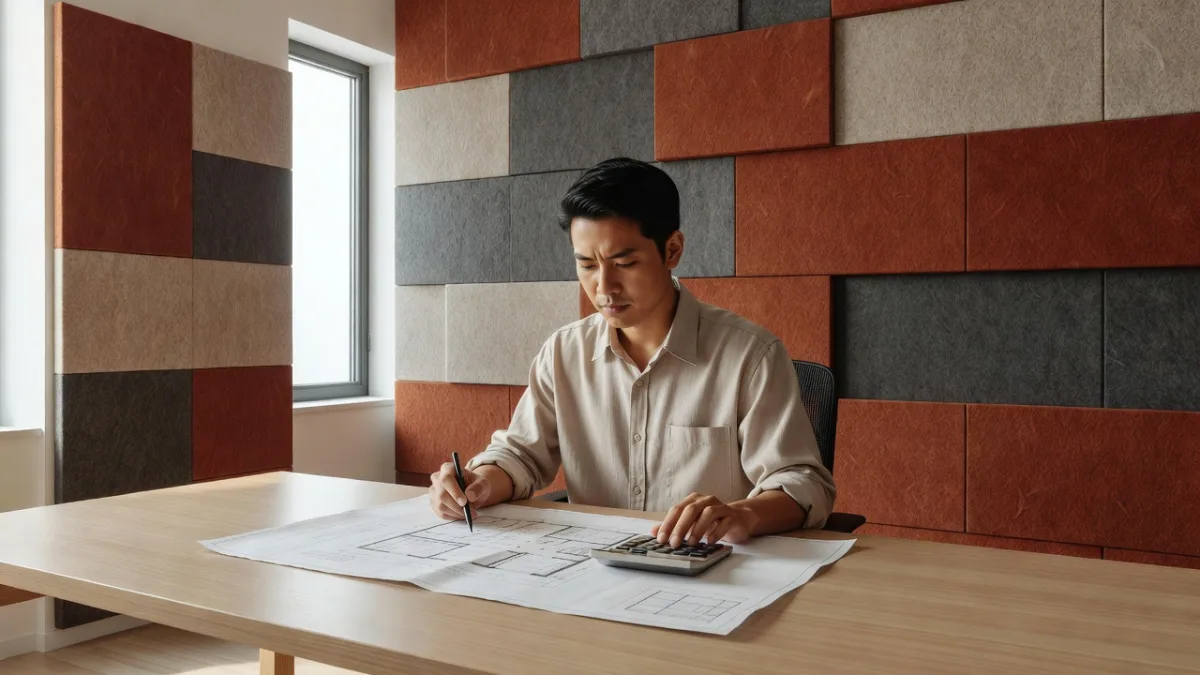
Calculating the number of acoustic panels rests on the Sabine formula: RT = 0.16 x V / A, where V is the volume of the room in m³ and A the equivalent absorption area in m². In other words, you simply compare the absorption you have with the one you need.
The approach takes five steps. Grab a tape measure, a calculator, and follow the order.
- Volume: multiply length x width x height. A room of 10 x 6 x 2.7 m gives 162 m³
- Current RT: estimate the starting reverberation time. Count 0.8 to 1 s for a classic furnished room, 1.2 to 1.6 s for hard and bare surfaces, up to 2 s for a tall glazed volume
- Target RT: set the goal by use. 0.5 to 0.6 s for a meeting room, 0.6 to 0.8 s for an open-plan office, 0.8 to 1 s for a convivial restaurant
- Missing area: calculate A = 0.16 x V / RT for the current state then for the target. The difference between the two is your absorption deficit in m²
- Conversion into panels: divide this deficit by the panel’s absorption coefficient. With an NRC of 0.85, a deficit of 34 m² needs 34 / 0.85 = 40 m² of panels
That is all. The accuracy of your result depends above all on the estimate of the current RT, and that is where experience plays a part. A doubt of 0.3 s on the starting point shifts the result by a few m², rarely more. So no panic if you have no sound level meter.
How many acoustic panels for a restaurant, an open-plan office or a meeting room?
A 120 m² restaurant needs about 42 m² of NRC 0.85 panels, a 200 m² open-plan office around 77 m², a 30 m² meeting room about 13 m². Here are the three complete calculations, the ones we redo every week on quote requests.
120 m² restaurant, 3 m height, that is 360 m³. Hard surfaces, glass and tiling: RT estimated at 1.6 s, that is an existing absorption of 0.16 x 360 / 1.6 = 36 m². To reach 0.8 s, you need 72 m². Deficit: 36 m², that is 36 / 0.85 = 42 m² of panels, to spread between the ceiling and the back wall.
200 m² open-plan office, 2.7 m height, that is 540 m³. RT estimated at 1.1 s with the furniture, that is 78 m² of existing absorption. The target of 0.6 s, consistent with the high-performance level of the NF S31-080 standard, needs 144 m². Deficit: 66 m², that is 77 m² of panels, primarily ceiling baffles above the workstations.
30 m² meeting room, 2.5 m height, that is 75 m³. RT estimated at 0.9 s, that is 13 m² of absorption. The target of 0.5 s, essential in video-conferencing, needs 24 m². Deficit: 11 m², that is 13 m² of wall panels on the two parallel walls.
| Room type | Floor area | Volume | NRC 0.85 panels | Priority location |
|---|---|---|---|---|
| Meeting room | 30 m² | 75 m³ | 12 to 14 m² | Parallel walls, ear height |
| Classroom | 60 m² | 168 m³ | 24 to 28 m² | Ceiling + back wall |
| Reception hall | 80 m² | 280 m³ | 22 to 26 m² | Ceiling + wall facing the entrance |
| Restaurant | 120 m² | 360 m³ | 40 to 45 m² | Ceiling above the tables |
| Open-plan office | 200 m² | 540 m³ | 75 to 80 m² | Ceiling baffles + partitions |
These orders of magnitude show how many acoustic panels to plan for in common configurations. The same restaurant with 4 m under the ceiling and a low glass canopy would tip toward the top of the range, because the volume climbs while the existing absorption does not.
What factors make the number of acoustic panels needed vary?
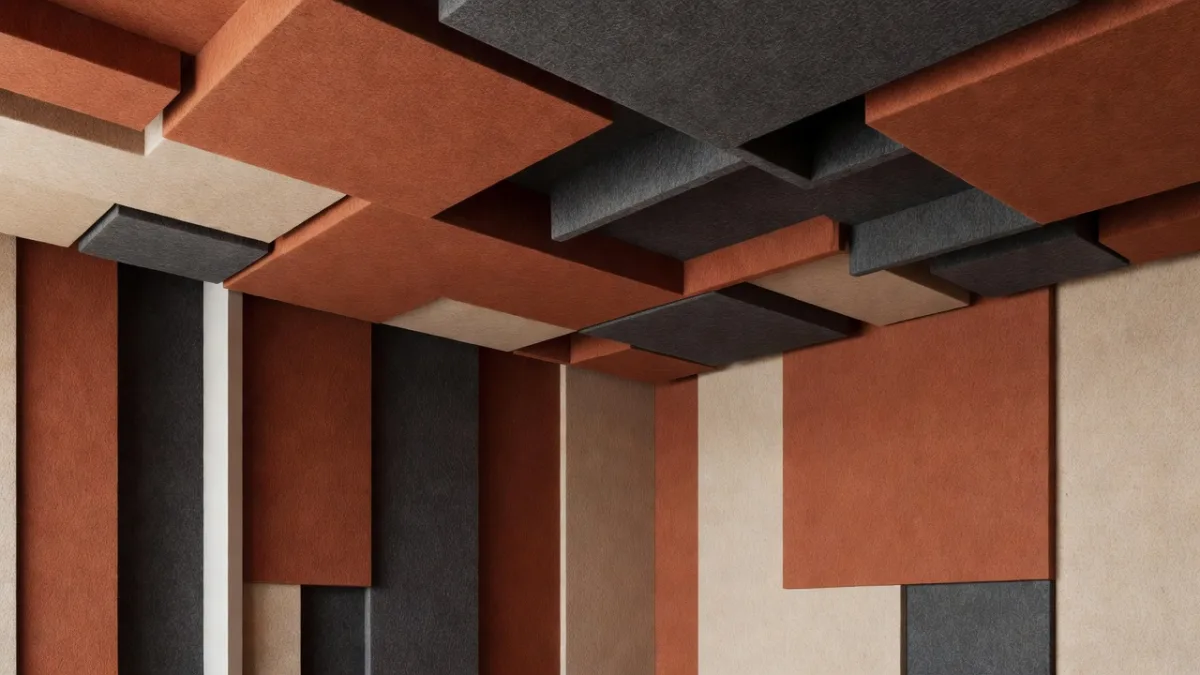
Three factors strongly change the panel need: ceiling height, the proportion of glazing and the density of furniture. Two rooms of the same floor area can call for twice as much treatment.
Height first. The volume goes directly into the Sabine formula, so moving from 2.5 m to 4 m under the ceiling increases the need by about 60% at equal floor area. This is the classic trap of industrial premises converted into offices or restaurants.
- Ceiling height: each extra metre swells the volume, so the absorption deficit. Beyond 3.5 m, suspended baffles are almost always called for
- Glazing: glass absorbs almost nothing and reflects everything. A 20 m² glazed surface is offset by 4 to 6 m² of extra panels facing it
- Furniture and textiles: sofas, carpet, thick curtains bring free absorption. A densely furnished room often starts at 0.8 s instead of 1.4 s
- Room shape: two bare parallel walls create flutter echoes that no statistical average describes, you must treat at least one
- Occupancy: people absorb too. A full restaurant sounds better than an empty one, but sizing for a full room is a mistake, you hear the problem most at half capacity
Our manufacturer’s advice: before settling on how many acoustic panels to order, always calculate on the room empty of guests but furnished. That is the realistic scenario, and it is the one that avoids nasty surprises at opening.
Why does placing your panels well beat over-covering?
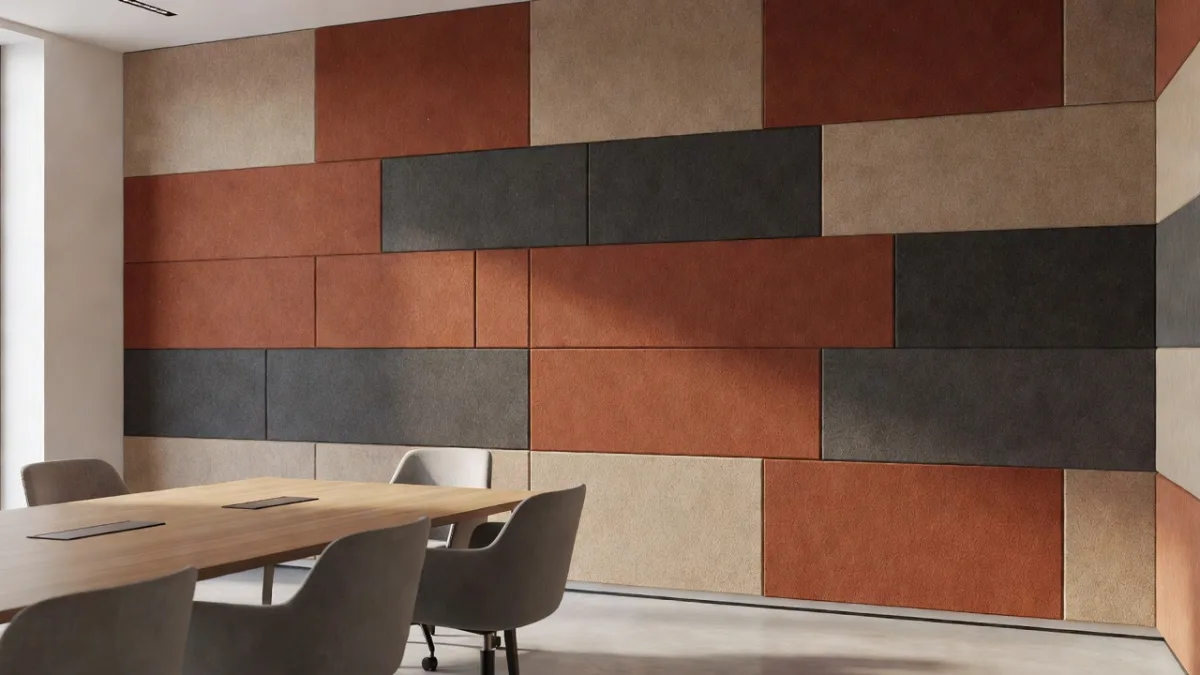
A well-placed panel absorbs the reflection at the moment it disturbs, whereas a poorly placed panel merely decorates. At equal budget, a considered layout over 18% of the surface beats a random placement over 28%, and we have verified it more than once.
At ACOUSTELIO, we see on our projects that the high-yield locations are always the same. The ceiling above speech zones, the walls at ear height between 1 m and 2 m, and the bare parallel surfaces that bounce sound back to each other.
- Ear height: between 1 m and 2 m off the floor, where the first reflections strike. A panel 30 cm below the ceiling on a 3 m wall works far less
- Distribution: it is better to scatter ten panels across three surfaces than to line them up on one. A staggered layout breaks more sound paths
- Facing surfaces: treat only one of two parallel walls, not necessarily both, and offset the panels to avoid mirror zones
- Source zones: in a restaurant, the ceiling above the tables. In an open-plan office, right over the phone stations and passage zones
Over-covering costs a lot for a marginal gain. Going from 30 to 40% coverage rarely improves the feel, whereas it dries out the room and inflates the bill by a third. Frankly, we prefer to sell fewer well-placed m²: the client measures the result, and comes back. The before-and-after photos of our projects show real layouts, with the surfaces fitted.
When do you need to go through a full acoustic study?
An acoustic study becomes useful when the room falls outside standard configurations: volume above 1,000 m³, a regulatory requirement or complex geometry. For a classic meeting room or restaurant, the Sabine calculation presented above is amply enough.
Let us be honest about the limits of the simplified method. Sabine assumes a diffuse sound field and distributed absorption, which describes some spaces poorly. When these assumptions break down, the estimate drifts, and there a professional with on-site measurement makes the difference.
- Large volumes: atriums, halls more than 5 m high, multi-purpose rooms. The room modes and long echoes call for modelling
- Regulatory obligations: the order of 25 April 2003 imposes precise RTs in educational and healthcare establishments, with justification to be produced
- Coupled rooms: mezzanines, rooms open onto one another, stairwells. Sound travels between volumes and skews the overall calculation
- Contractual result requirement: when a lease or a specification sets a figured RT, a before-and-after measurement protects everyone
Between the two, there is a middle path: the costed layout by the manufacturer. You send dimensions, photos and the room’s use, and we return a layout plan with the calculated m², within 48 h and free of charge at ACOUSTELIO. It is less thorough than an acoustician’s study, because there is no on-site measurement, but for 90% of commercial projects it is enough to size it right. The INRS also reminds us that acoustic treatment of premises is among the priority measures for reducing noise at work, ahead even of individual protection, as detailed in its dossier on noise.
Frequently asked questions about the number of acoustic panels
How many acoustic panels do you need for a 20 m² room?
Count on 7 to 9 m² of NRC 0.85 panels for a 20 m² room under a 2.5 m ceiling, that is a volume of 50 m³. The calculation: with a starting RT around 0.9 s, the existing absorption is worth about 9 m² of Sabine. To bring it down to 0.5 s, you need 16, so a deficit of 7 m² that you divide by 0.85. If the room is heavily furnished, the bottom of the range is enough. If it is bare with tiling, aim for the top, or even 10 m². This typically represents 6 to 8 panels of 120 x 120 cm, spread over two perpendicular walls at ear height.
Can you install too many acoustic panels in a room?
Yes, an over-treated room turns dead and unpleasant, with a blocked-ear sensation that many describe as oppressive. An RT that is too short, below 0.3 s in a living space or a restaurant, kills the sound atmosphere: conversations seem muffled and the space loses its conviviality. This is why the 15 to 30% coverage range is a useful safeguard. In a restaurant, you aim for 0.8 s, not the silence of a recording studio. Over-treatment also costs needlessly: the m² beyond the calculated deficit bring almost nothing. It is better to reinvest that budget in careful placement or a decorative print on the panels.
Should you treat the walls or the ceiling first?
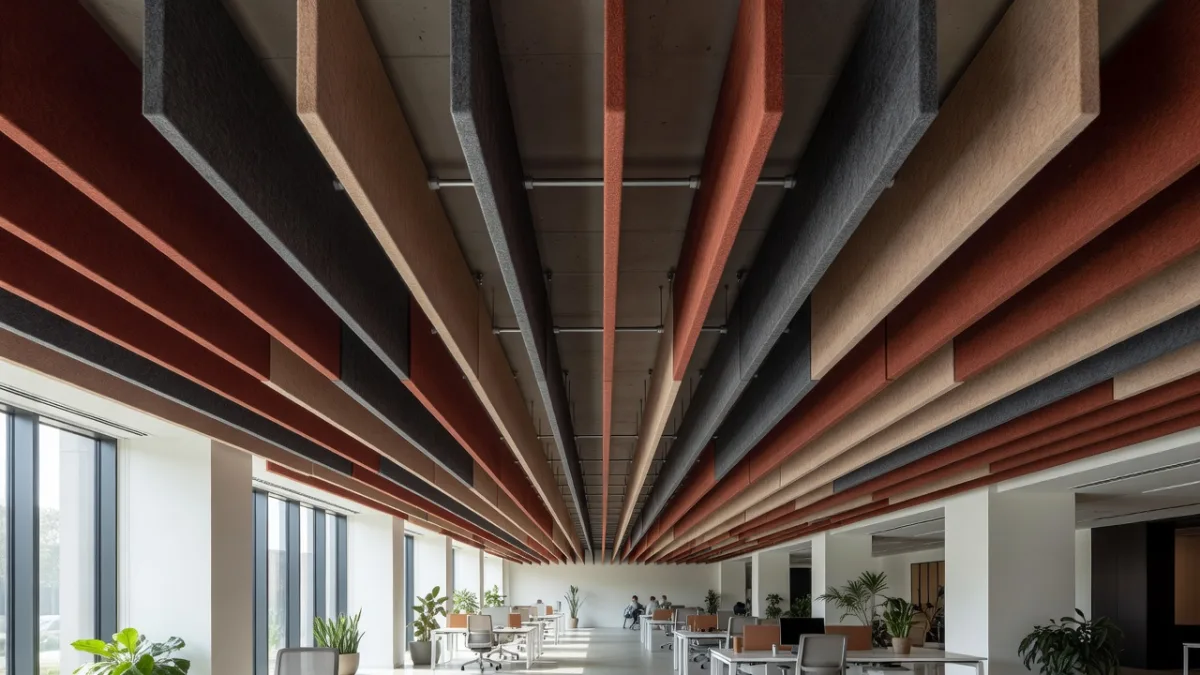
The ceiling first in large collective volumes, the walls first in small speech rooms. In a restaurant or an open-plan office, the ceiling offers the largest continuous free surface and sits directly above the noise sources, so ceiling baffles or panels work there at the best yield. In a 20 to 40 m² meeting room, the disturbing reflections travel mainly between parallel walls at ear height, and well-distributed wall panels settle the essentials. The best is often a mix: two thirds ceiling, one third walls in large spaces, and the reverse in small ones. The room’s real configuration decides case by case.
How do you estimate reverberation time without a measuring device?
A simple test gives a reliable order of magnitude: clap your hands in the empty room and listen to the tail of the sound. If the clap dies out sharply, you are under 0.6 s. If it leaves a brief but audible tail, count on 0.8 to 1.2 s. If the sound clearly floats, as in a car park or a church, you exceed 1.5 s. Then cross-check with the materials: tiling, concrete, glass and bare plasterboard push the RT up, carpet, curtains and upholstered furniture pull it down. To refine, smartphone apps measure RT60 with correct accuracy for a pre-sizing. The margin of error stays acceptable, since a gap of 0.3 s changes the final result by only a few m².
What panel surface do you need to halve perceived noise?
Halving the perceived reverberation level comes down to halving the reverberation time, which requires doubling the room’s total absorption area. If your room has 30 m² of natural absorption, you therefore need to add about 30 m² of Sabine, that is 35 m² of NRC 0.85 panels. On our projects, this halving matches the feedback most often reported by clients: it is the average 50% drop in reverberation that we measure after installation. Be careful though, this calculation concerns reverberation, not the noise emitted by the source. A noisy dishwasher will stay noisy, but its noise will no longer be amplified by the room.
Are acoustic panels enough against neighbour noise?
No, acoustic panels correct reverberation inside a room but do not stop noise from passing through a surface. These are two distinct physical problems: acoustic treatment addresses the reflection of sound on surfaces, soundproofing addresses its transmission through walls and floors. A PET felt panel of a few centimetres adds no significant mass to the surface, so it blocks neither the conversations of the next office nor the music of the flat above. For that, you need heavy linings with decoupling, another trade. On the other hand, by absorbing the reverberant field, the panels lower the overall sound level of the emitting room by 3 to 6 dB, which indirectly reduces what passes next door.
You now know the method: surface to cover, Sabine formula, conversion into m² of NRC 0.85 panels. What remains is to apply it to your room, with its heights, its glazing and its real use. Send us your dimensions and a few photos: we return a free costed layout and a tailored quote within 48 h, with the exact number of acoustic panels, their location and the expected result.