Reverberation time, or RT60, measures how long it takes for a room’s sound level to drop by 60 decibels after the source stops. It is calculated with the Sabine formula (RT = 0.16 × V/A) and corrected by adding absorbent surfaces to the walls or ceiling.
The subject goes beyond simple comfort: the Ademe and Conseil national du bruit study published in 2021 puts the social cost of noise in France at 147.1 billion euros a year, a significant share of it tied to workplaces and shared spaces.
ACOUSTELIO designs PET felt panels printed in your colours that absorb up to 85 % of noise (NRC 0,85), certified EN 13501-1 B-s1,d0 for public-access buildings, with a custom quote within 48 h.
Reverberation time is the reference metric for putting a number on a room’s resonance. A room that “rings”, conversations that blur together, a team exhausted by the end of service: behind these symptoms, there is almost always an RT60 that is too long.
At ACOUSTELIO, we correct this parameter on every project with our made-to-measure acoustic panels in PET felt, and we see an average 50 % less reverberation after treatment. This guide gives you the full method: definition, the Sabine formula explained simply, measurement protocols, target values by type of space and a costed action plan to bring down an RT that is too high.
What is reverberation time (RT60)?
Reverberation time is how long it takes for the sound level to fall by 60 decibels after the source stops. A drop of 60 dB represents a sound pressure divided by 1,000 and a sound energy divided by a million.
Sound never stops dead in a room. It bounces off the tiling, the windows, the plaster, and each reflection prolongs the sense of resonance. When these reflections die away in half a second, speech stays clear. When they linger beyond 1.5 second, syllables overlap, everyone raises their voice to be understood and the overall level climbs further. That is the vicious circle of the din.
- RT60: the decay duration for 60 dB, expressed in seconds, measured by frequency bands
- T30 and T20: measurements over 30 or 20 dB of decay, extrapolated to RT60 when background noise prevents capturing the full 60 dB
- Reverberant field: all the reflected sounds that add to the direct sound and blur listening
- Intelligibility: the ease of understanding speech, which drops as soon as the RT exceeds the target for the space
A point of vocabulary, because the confusion is common: reverberation is the physical phenomenon, RT60 is its measurement. And correcting this time is a matter of acoustic treatment, not soundproofing, which handles the transmission of noise between two spaces.
How does the Sabine formula work?
The Sabine formula estimates a room’s RT60 from two values only: its volume and its absorption capacity. It is written RT = 0.16 × V / A, with V the volume in m³ and A the equivalent absorption area in m².
Wallace Sabine established this relationship back in 1898, while trying to correct the disastrous acoustics of a Harvard lecture theatre. More than a century on, it remains the most widely used sizing tool, because it gives surprisingly reliable results for rooms of simple shape. The area A is calculated by adding each surface multiplied by its absorption coefficient: A = Σ (Si × αi). This coefficient ranges from 0 (fully reflective surface) to 1 (total absorption), and its standardised equivalent is detailed on our page dedicated to the NRC absorption coefficient.
A concrete example beats theory. Take a restaurant dining room of 15 × 10 × 3 m, so 450 m³:
- Tiled floor: 150 m² × α 0.02 = 3 m² of absorption, which is to say nothing
- Plaster ceiling: 150 m² × α 0.05 = 7.5 m² of absorption
- Painted walls: 150 m² × α 0.05 = 7.5 m² of absorption
- Total: A = 18 m², so RT = 0.16 × 450 / 18 = 4 seconds
Four seconds in a restaurant is unliveable. Add 40 m² of PET felt panels at NRC 0,85: the absorption area rises to 52 m² and the RT falls to 1.4 second. The calculation fits on the corner of a napkin, and it is exactly the one we run before every quote.
How do you measure the reverberation time of a space?
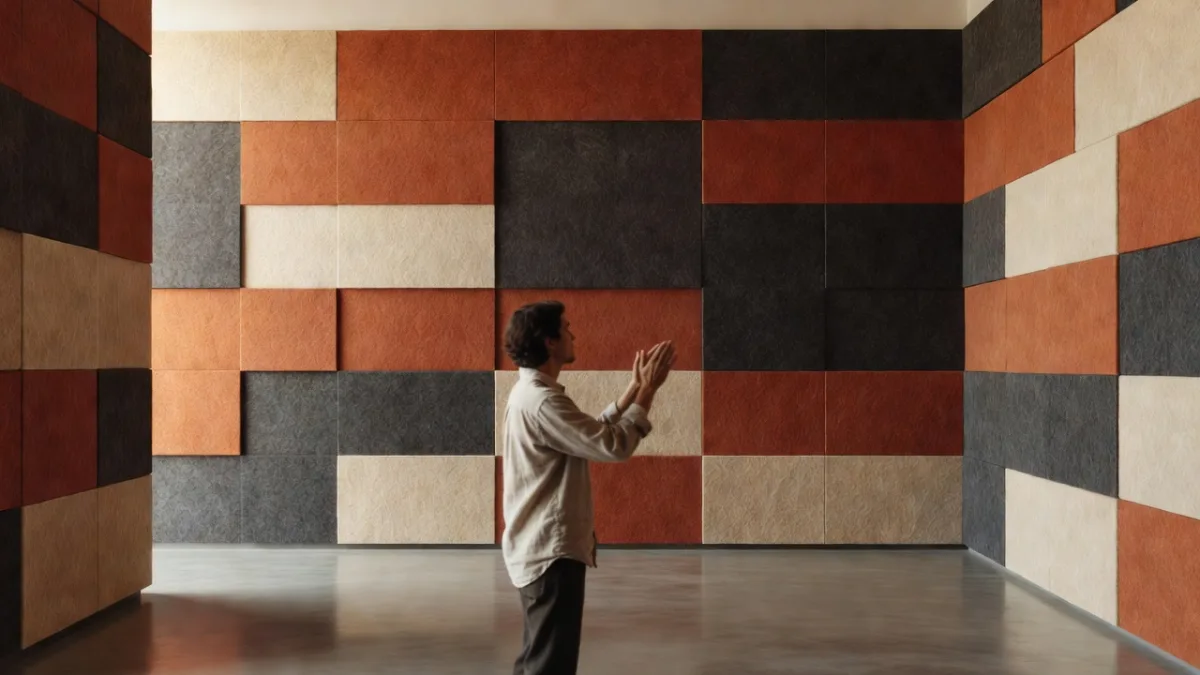
Three methods coexist to measure an RT60: the mobile app, the class 1 sound meter and the full acoustic study. The right choice depends on the stakes, not the budget.
The smartphone app works on a simple principle: you generate an impulse (a hand clap, a burst balloon) and the phone’s mic records the decay. Count on a margin of error of 20 to 30 %, because smartphone mics compress the signal and pick up the bass poorly. It is enough to get a rough idea. Not to prove anything.
- Mobile app: free, immediate, ideal for placing your space between “fine” and “problematic”
- Class 1 sound meter: standardised measurement to ISO 3382, with a calibrated omnidirectional source and readings by octave band, from 125 Hz to 4,000 Hz
- Acoustic consultancy: multipoint measurements, room modelling and sized recommendations, essential when contractual or regulatory compliance is at stake
In practice, standard ISO 3382 imposes precise conditions: source 1.5 m off the floor, mics at least 2 m apart, several measurement positions. In other words, a real protocol. At ACOUSTELIO, we systematically ask for the dimensions, the materials and photos of the space before quoting: the Sabine calculation, calibrated on this data, is enough in the vast majority of acoustic treatment projects. We reserve standardised measurement for the cases where a contractual target must be demonstrated.
What are the target reverberation time values by space?
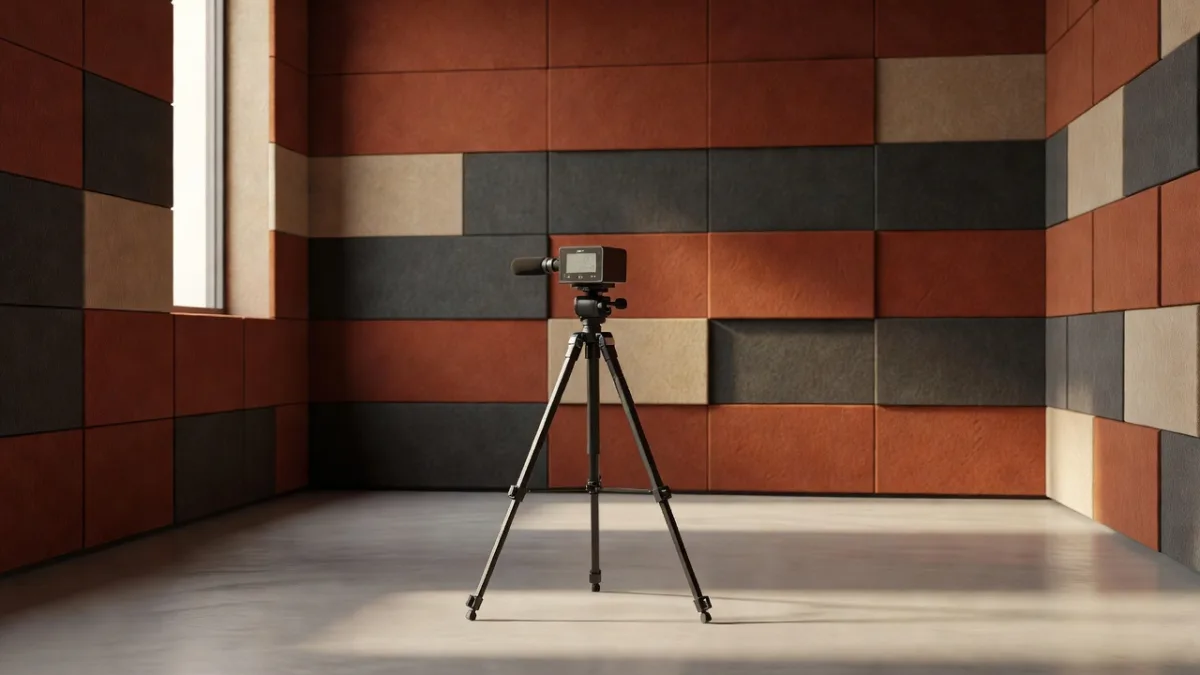
Each use has its RT60 target: around 0.4 to 0.6 s for an office, 0.4 to 0.8 s for a classroom, and less than 1.2 s for a restaurant. A concert hall, on the other hand, seeks 1.5 to 2 s because music needs that fullness.
There is therefore no universal “good” RT, but ranges by intended use of the space. The table below summarises the values we use to size our projects:
| Type of space | Target RT60 | Reference framework | Zones to treat |
|---|---|---|---|
| Classroom | 0.4 to 0.8 s | Decree of 25 April 2003 | Ceiling and back of room |
| Meeting room | 0.4 to 0.7 s | NF S31-080 | Facing walls and ceiling |
| Private office | 0.4 to 0.6 s | NF S31-080 | Walls |
| Open space | 0.4 to 0.6 s | NF S31-080 | Baffle ceiling and walls |
| Restaurant | 0.7 to 1.2 s (aim for 0.8 s) | Field recommendation | Ceiling and upper walls |
| School canteen | 0.8 s maximum | Decree of 25 April 2003 | Ceiling |
| Public building reception hall | 0.8 to 1.2 s | Field recommendation | Ceiling and walls |
These ranges call for two field remarks. First, they apply to an occupied space: an empty room always measures higher, because bodies and clothing absorb part of the sound. Second, aiming for the bottom of the range is not always relevant:
- Restaurant: we aim for 0.8 s rather than 0.7 s, because a room that is too dead kills the atmosphere and the sense of conviviality
- Open space: the low target is justified, and acoustic treatment is thought through with the team layout, as we detail on our office acoustics page
- Classroom: the range is regulatory, so non-negotiable in new build or heavy renovation
What do standard NF S31-080 and French regulations say?
In France, two texts frame the reverberation requirements in office and school premises: standard NF S31-080 for offices and the decree of 25 April 2003 for teaching establishments. The first is voluntary, the second is mandatory.
Standard NF S31-080 ranks each type of office space (private office, shared office, open space, meeting room, dining) into three performance levels: standard, high-performance and very high-performance. For an open space, the high-performance level roughly corresponds to an RT around 0.5 s, which assumes an absorbent ceiling and treated wall surfaces. On our office-floor projects, we find that most untreated open spaces sit between 0.9 and 1.3 s. The path is therefore real, but it is easily walked: treating 15 to 30 % of the wall and ceiling surfaces is usually enough.
For schools, the decree of 25 April 2003 imposes a mean RT (500 to 2,000 Hz) between 0.4 and 0.8 s in classrooms of less than 250 m³. And when the volume exceeds 250 m³, canteens included, the text requires an equivalent absorption area of at least half the floor surface. The INRS, for its part, recalls that noise at work degrades concentration and increases fatigue well below the thresholds of hearing danger. In public-access buildings, the constraint is doubled by a fire requirement: materials must be rated B-s1,d0, a point we detail on our public-building acoustics page.
- NF S31-080: a voluntary standard for offices, binding only if your brief or your certification (HQE, BREEAM) requires it
- Decree of 25 April 2003: mandatory regulation for teaching establishments, RT checkable on delivery
- EN 13501-1: European fire rating of materials, required in public-access buildings at level B-s1,d0
How do you lower a room’s reverberation time?
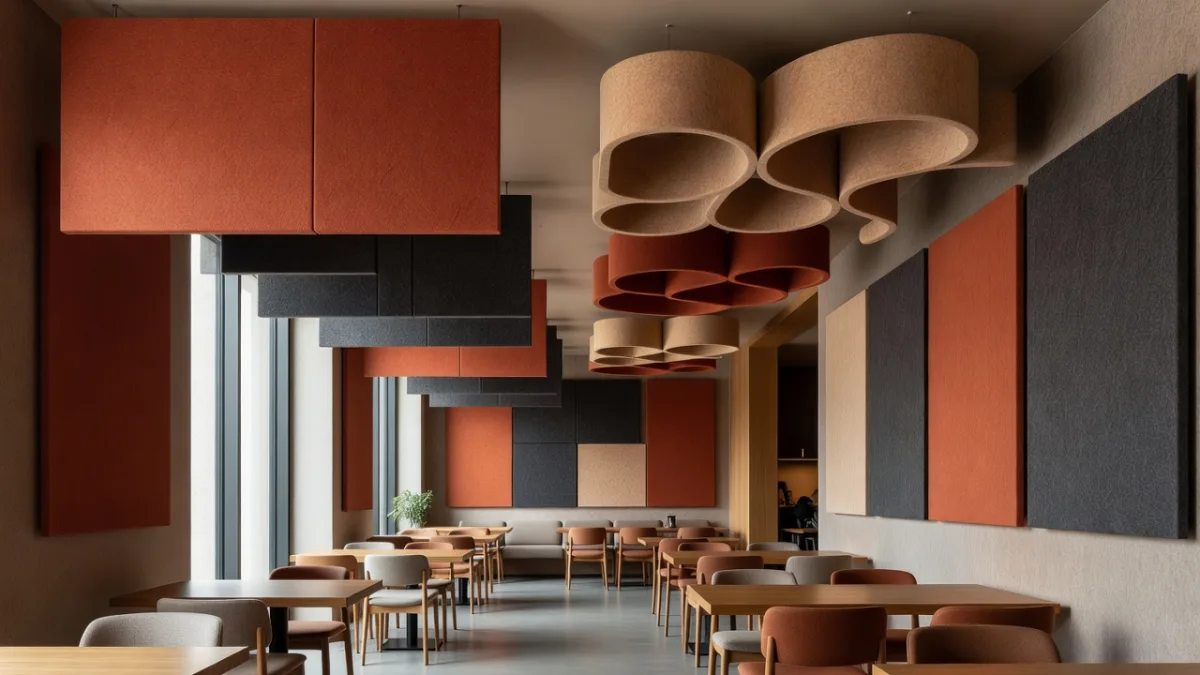
Lowering this time comes down to increasing the room’s absorption area, almost always by adding absorbent panels on the walls or the ceiling. The Sabine formula, used in reverse, tells you exactly how many square metres to install.
The approach fits in four steps. You estimate the current RT (calculation or measurement). You set the target from the table above. You calculate the missing absorption area: target A = 0.16 × V / target RT. And you distribute this surface where it works best, that is facing the reflective surfaces and as close as possible to the noise sources.
Take our 450 m³ restaurant that started at 4 seconds. To reach 0.8 s, you need about 90 m² of absorption area, so 85 m² of panels at NRC 0,85 on top of the existing 18 m². Related to the 300 m² of walls and ceiling, that represents 28 % of the surfaces: we land precisely on our field rule of 15 to 30 %. The result seen on our sites, across all types: 50 % less reverberation on average.
- Walls: PET felt panels installed with adhesive or clips, from 49 €/m², printable in your colours to turn the acoustic constraint into a support for decor
- Ceiling: acoustic baffles suspended on cables, from 59 €/m², the solution when the walls are glazed or already occupied
- Distribution: better to treat two perpendicular surfaces (a wall + the ceiling) than a single wall heavily
- Sizing: 15 to 30 % of the wall and ceiling surfaces is enough in the vast majority of spaces
Frankly, the ceiling is the most cost-effective zone in large volumes: it is clear, close to the sources and it works across the whole surface of the space. It is our first reflex in a canteen as in an open space.
What mistakes should you avoid when correcting reverberation?
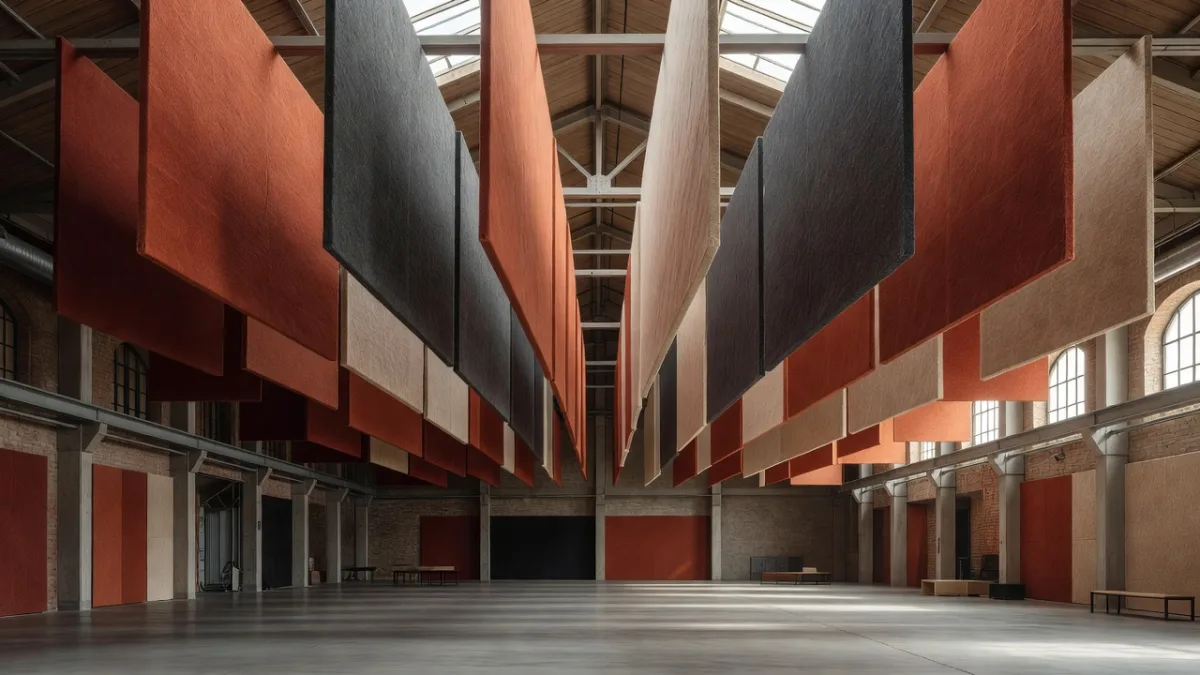
The first mistake is confusing acoustic treatment and soundproofing: absorbent panels reduce a room’s internal resonance, but they will never block the neighbour’s noise. The second is under-sizing the treatment to save a few square metres.
We regularly see spaces fitted with 5 % of absorbent surface, chosen on a hunch. The effect is inaudible, the client concludes that “the panels do not work”, and the budget is lost. The Sabine calculation avoids this waste in ten minutes. Here are the most common pitfalls:
- Under-sizing: below 10 to 15 % of treated surfaces, the drop in RT stays imperceptible to the ear
- Concentrating everything on a single wall: the reflections keep circulating between the untreated walls, so effectiveness collapses
- Aiming for an RT close to zero: an over-damped room becomes dead and unpleasant, especially in a place of conviviality
- Ignoring the low frequencies: a thin panel mainly absorbs the mids and highs; the bass demands thickness or an air cavity behind the panel
- Relying on an app for compliance: only an ISO 3382 measurement with a class 1 sound meter counts against a project owner
Let us be honest about the limits: RT60 does not say everything. Two rooms with the same RT can behave differently depending on the geometry and the distribution of the absorbers, and metrics such as the STI refine the analysis in complex cases. But in 2026, for 90 % of the restaurants, offices and classrooms we treat, the loop “Sabine, target, sizing” solves the problem without a heavy study.
Frequently asked questions about reverberation time
What is the right RT60 for a restaurant?
A comfortable restaurant sits between 0.7 and 1.2 second of reverberation, and we recommend aiming for 0.8 s to preserve both the conversations and the atmosphere. Below 0.7 s, the room becomes dead and loses its conviviality; beyond 1.2 s, the din sets in as soon as half the tables are occupied. Watch the trap of measuring an empty room: customers, clothing and occupied chairs absorb sound, so an empty room measured at 1.4 s can drop toward 1.1 s in service. The priority treatment covers the ceiling and the upper walls, clear zones close to the reverberant field.
What is the difference between RT60, T30 and T20?
RT60 is the theoretical reference: the duration of a 60 dB decay. T30 and T20 are practical measurements made over 30 or 20 dB of decay, then extrapolated mathematically to 60 dB. Why this manoeuvre? Because a full 60 dB decay demands a very powerful starting signal and a very low background noise, two conditions rarely met in an active space. Standard ISO 3382 frames these three metrics and specifies the minimum dynamics to respect. In a measurement report, a properly performed T30 is worth an RT60: acousticians use the terms almost interchangeably.
Can you measure RT60 with a mobile app?
Yes to get an order of magnitude, no to prove compliance. A smartphone app that analyses the decay after a hand clap or a burst balloon gives an estimate with a 20 to 30 % margin of error, enough to know whether your space sits at 0.8 or at 2.5 seconds. Phone mics, however, compress the signal, pick up the bass poorly and do not follow the ISO 3382 protocol (calibrated omnidirectional source, multiple positions, analysis by octave band). For a regulatory or contractual file, only a class 1 sound meter handled to the standard counts. To size a treatment, the Sabine calculation from the room’s dimensions is often more reliable than an app.
What surface of panels is needed to halve reverberation?
Halving the RT60 comes down to doubling the room’s equivalent absorption area, and that generally requires treating 15 to 30 % of the wall and ceiling surfaces. The exact surface depends on the volume of the room, its materials and the absorption coefficient of the chosen panels: with an NRC of 0,85, each square metre installed brings 0.85 m² of absorption, where an entry-level panel at NRC 0.5 brings almost half as much. In concrete terms, a very reverberant 450 m³ room is corrected with 80 to 90 m² of high-performing panels. At ACOUSTELIO, we carry out this sizing free of charge from your plans and photos, with a quote within 48 h.
Is meeting a reverberation time mandatory in France?
It depends on the type of space. In teaching establishments, yes: the decree of 25 April 2003 imposes an RT between 0.4 and 0.8 s in classrooms of less than 250 m³, and an absorption area of at least half the floor surface in large volumes such as canteens. In offices, standard NF S31-080 sets performance levels, but it is binding only if a brief or an environmental certification requires it. In public-access buildings, the strictest obligation covers the reaction to fire of materials (B-s1,d0 rating to EN 13501-1), a requirement our panels meet with a report supplied with every order.
Does correcting reverberation improve soundproofing?
No, and you should know it before investing. Acoustic treatment reduces resonance inside a room by absorbing the sound reflections; soundproofing blocks the transmission of noise between two spaces, which demands mass, decoupling and work on the walls themselves. PET felt panels will make your open space noticeably calmer and your conversations more intelligible, but they will not stop you hearing the meeting room next door through a lightweight partition. The two approaches actually complement each other very well: by absorbing the reverberant field, treatment lowers the overall sound level by 3 to 6 dB, which mechanically reduces the noise loading the partitions.
You now know the full mechanics: measure or calculate your RT60, compare it to the target values for your type of space, then size the absorbent surface with the Sabine formula. What remains is taking action. Send us the dimensions and a few photos of your space: we calculate your current RT60, the panel surface needed and you receive a custom quote within 48 h, proof approved before production and delivery in 10 to 15 working days.