The EN 13501-1 standard is the European framework that classifies the reaction to fire of construction products across seven euroclasses, from A1 (non-combustible) to F (not classified), completed by two indices: s1 to s3 for smoke and d0 to d2 for flaming droplets. In France, it replaces the old M classification for construction products.
Fire and rescue services respond to nearly 300,000 fires every year in France according to the Ministry of the Interior’s statistics, and it is the smoke, not the flames, that causes most of the deaths.
ACOUSTELIO manufactures acoustic panels in PET felt classified B-s1,d0 to the EN 13501-1 standard, the level required in public buildings, with a fire test report supplied on every order, NRC 0.85 absorption and a tailored quote within 48 h.
The EN 13501-1 standard determines whether your materials are accepted by the inspection office, because it defines the reaction-to-fire class of every product fitted on the walls, ceilings or floors of a building. At ACOUSTELIO, a manufacturer of made-to-measure acoustic panels in PET felt, this standard is part of daily life: every panel ships with its B-s1,d0 fire test report.
The trouble is that reading a rating like B-s1,d0 stays cryptic for most project owners. Seven letters, three smoke indices, three droplet indices, and an old M0-M4 equivalence still lingering in specifications. This guide covers everything in order, with the two tables missing from most articles on the subject.
What exactly does the EN 13501-1 standard define?
The EN 13501-1 standard defines the European reaction-to-fire classification of construction products, in other words their capacity to feed a fire or not. It therefore does not measure fire resistance, which concerns how long an element (door, floor, partition) keeps its barrier role: that falls to the EN 13501-2 standard and REI classifications.
In practice, a product goes through a series of standardised tests in an accredited laboratory, and it is the combination of results that gives the final euroclass. In France, the order of 21 November 2002 on the reaction to fire of construction and fit-out products made this system official to progressively replace the French M classification.
- SBI test (EN 13823): the product is exposed to a corner burner, measuring the rate of fire growth and smoke production
- Ignitability test (EN ISO 11925-2): a small flame is applied to the sample for 15 or 30 seconds
- Non-combustibility test (ISO 1182): reserved for classes A1 and A2, the material is heated to 750 °C in a furnace
- Calorific value (ISO 1716): measures the total energy the material can release when burning
Remember the fundamental distinction: reaction to fire describes how the material behaves as a fuel, fire resistance describes how a structural element holds up. A wall covering falls under the first, never the second.
How do you read the euroclasses A1 to F?
The euroclasses of the EN 13501-1 standard rank products across seven levels, from A1 for non-combustible materials to F for products that are untested or failed. The closer the letter is to A, the less the material contributes to the growth of a fire.
Floors follow the same logic with the “fl” index (for floorings): a floor covering will be classified Bfl-s1 for example, never B-s1,d0. This detail trips up many poorly written specifications, and we see it come through regularly.
| Euroclass | Fire behaviour | Example materials |
|---|---|---|
| A1 | Non-combustible, no contribution | Stone, concrete, bare rock wool, glass |
| A2 | Extremely limited contribution | Plasterboard, faced mineral wool |
| B | Combustible, very low contribution | Fire-retardant PET felt, treated wood, rigid PVC |
| C | Combustible, limited contribution | Certain treated particle boards |
| D | Medium contribution | Solid wood, untreated OSB |
| E | High contribution | Expanded polystyrene, untreated textiles |
| F | Untested or not classifiable | Product with no reaction-to-fire test |
An honest word on the limits: the euroclass describes the product under precise test conditions, not your real job site. The same felt can earn a different rating depending on whether it is bonded full-face onto plasterboard or fitted with an air gap. The mounting method is part of the classification, and that is a point too many product sheets keep quiet about.
What do the indices s1, s2, s3 and d0, d1, d2 mean?
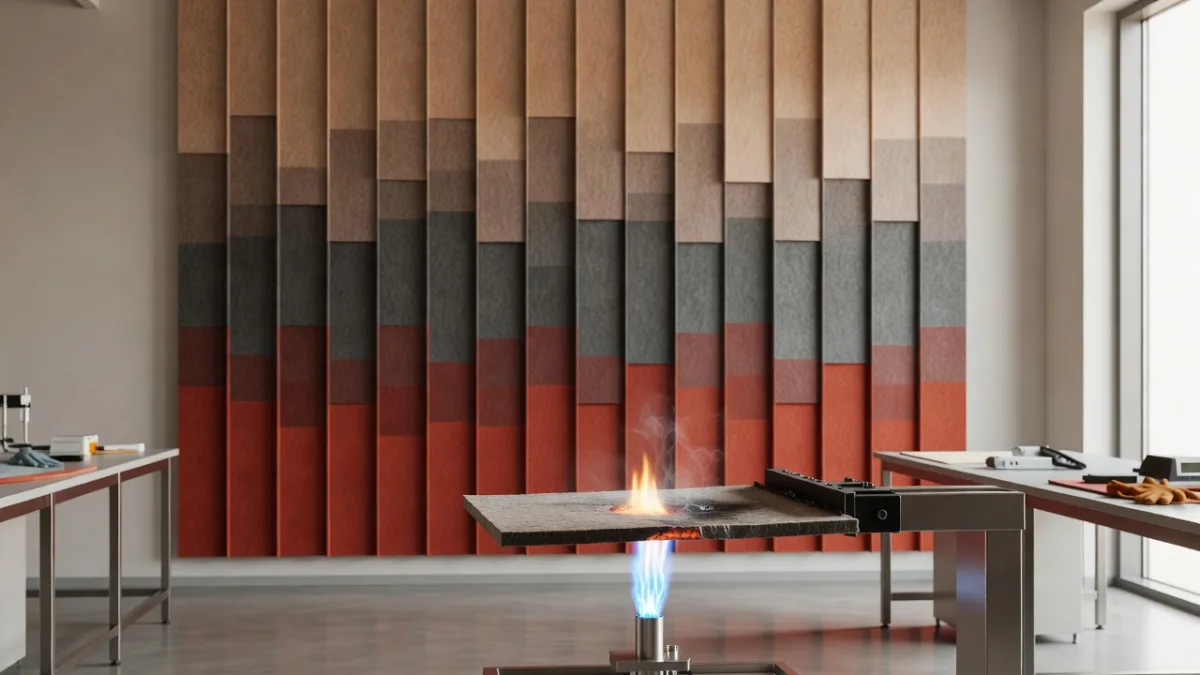
The s and d indices of the EN 13501-1 standard complete the main letter: s measures smoke production and d the fall of flaming droplets or debris. These two criteria did not exist in the old M classification, and that is exactly what makes the European system more protective.
Why do these indices matter so much? Because in a real fire, smoke kills before the flame. It suffocates, it blinds, and it blocks evacuation within minutes. A ceiling that drips flaming, meanwhile, spreads fire to the floor and makes it impossible for occupants to pass.
- s1: low quantity and speed of smoke release, the best level
- s2: smoke release of medium quantity and speed
- s3: heavy smoke release, no limitation requirement met
- d0: no flaming droplets or debris during the test
- d1: droplets whose flaming does not persist beyond 10 seconds
- d2: neither d0 nor d1, the product drips and the drops burn
Our position is clear: at equal euroclass, always demand s1 and d0. A B-s3,d1 and a B-s1,d0 share the same letter, but their behaviour in a real situation is nothing alike, especially on the ceiling of a room open to the public.
What is the correspondence between euroclasses and the old M classification?
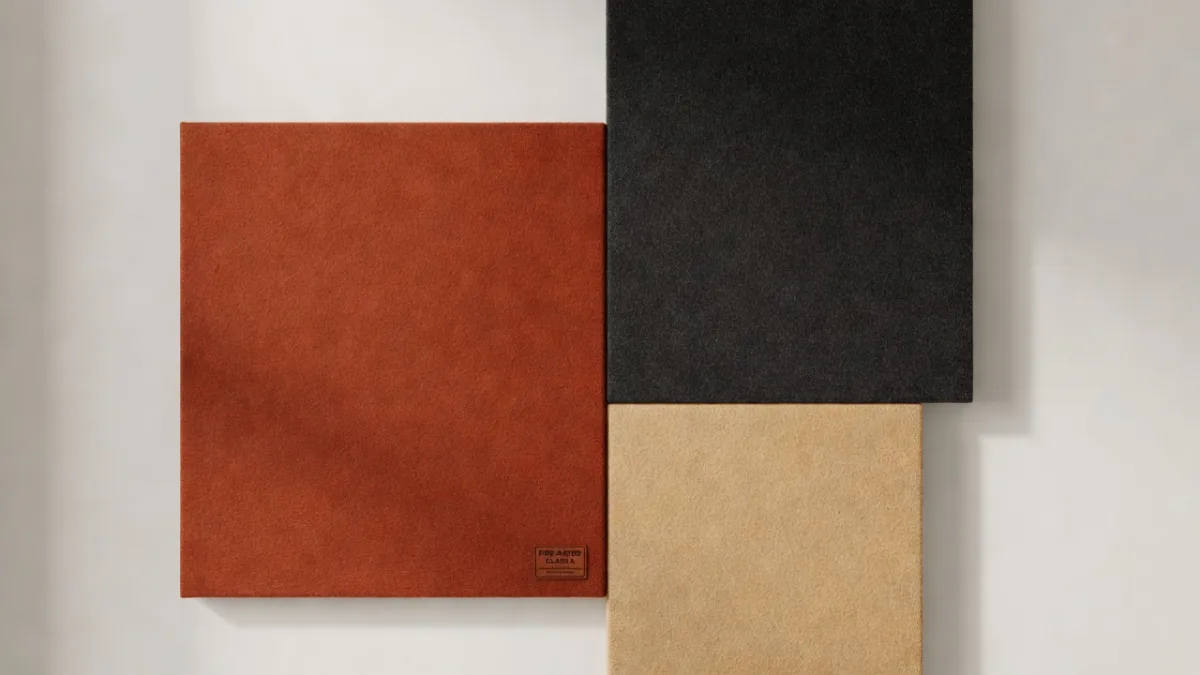
The correspondence between euroclasses and the M classification is set by annex 4 of the order of 21 November 2002: B-s3,d1 or better is equivalent to M1, C-s3,d1 or better to M2, D-s3,d1 or better to M3. This table works in one direction only: a euroclass lets you justify an M requirement, never the reverse.
You will keep coming across specifications that call for “M1” even though construction products have been classified in euroclasses for more than twenty years. It is not a blocker, but you have to know how to translate it. The table below makes the conversion in the permitted direction.
| Euroclass (EN 13501-1) | M classification equivalent | Practical reading |
|---|---|---|
| A1 | Non-combustible | No contribution to fire |
| A2-s1,d0 | M0 | Near non-combustible, minimal smoke |
| A2 (others) and B, with d0 or d1 | M1 | Combustible but non-flammable |
| C, with d0 or d1 | M2 | Hard to ignite |
| D, with d0 or d1 | M3 | Moderately flammable |
| All classes except E-d2 and F | M4 | Easily flammable |
| E-d2 and F | Not classified | Rejected wherever a requirement exists |
So if your specification requires M1 for a wall covering, a B-s1,d0 product meets the requirement with margin to spare. On the other hand, an old “M1” test report drawn up under the NF P92-5XX standards is no longer enough for a construction product: the inspection office will ask for classification to the EN 13501-1 standard.
What reaction-to-fire requirements apply by type of public building and room?
In public buildings, the safety regulation imposes different reaction-to-fire levels depending on the function of the surface: ceilings must reach M1 (that is B-s3,d0 as a minimum euroclass), vertical walls M2, and floors M4. These requirements appear in the AM articles of the fire safety regulation, and they tighten in certain cases.
When a room presents a particular risk, the requirement steps up a notch. Enclosed stairwells, hotel sleeping quarters, atriums, high-rise buildings: M0 or A2-s1,d0 becomes the reference. At ACOUSTELIO, we see on our projects that the inspection office systematically checks three zones: circulation routes, dining-room ceilings and spaces holding more than 50 people.
- Ceilings and suspended ceilings: M1 generally required, that is a euroclass B with d0 or d1
- Vertical walls: M2 minimum, but most specifiers align on M1 for safety
- Floors: M4, that is Dfl-s2 minimum in the European floor classification
- High-risk rooms and protected escape routes: reinforced requirements, often M0 or A2-s1,d0
- Floating or suspended elements: treated as ceilings, the typical case of acoustic baffles
Restaurant, open-plan office open to the public, hotel, school: each configuration has its subtleties, and the final say always rests with the safety commission. Our dedicated page on acoustics in public buildings details the use cases by type of establishment, with the levels to aim for so you pass inspection without reworking the job.
How do you read a fire test report without getting it wrong?
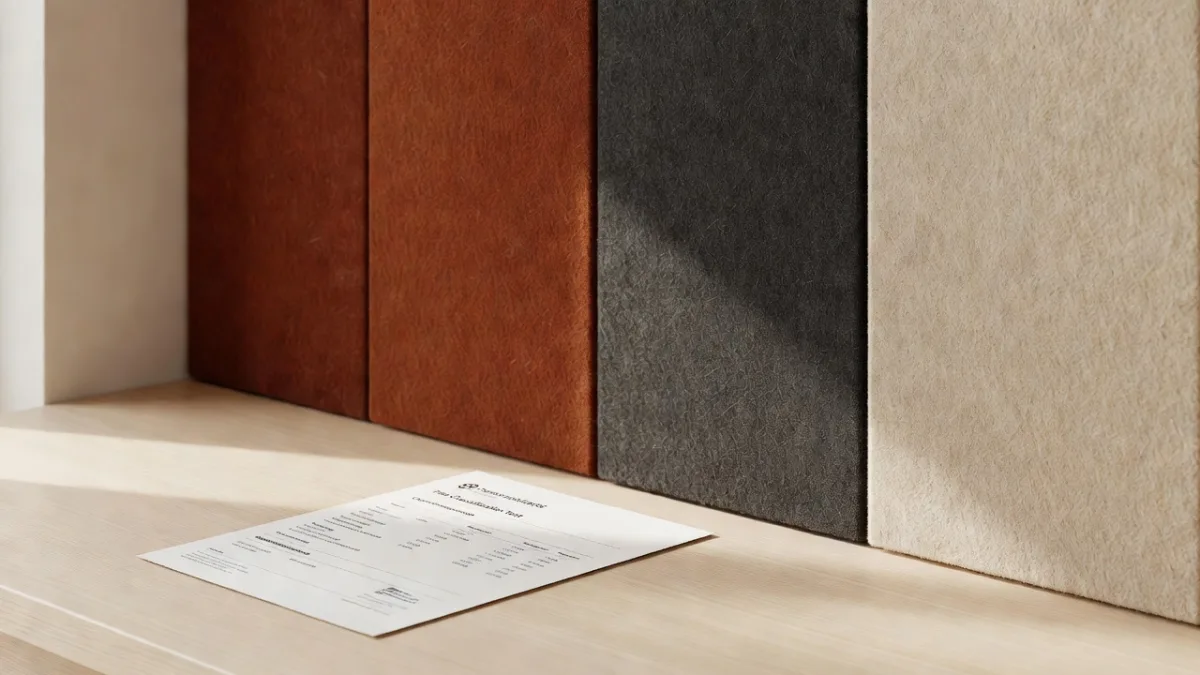
A fire test report is the official document issued by an accredited laboratory (CSTB, LNE, Efectis or European equivalent) that certifies the euroclass of a product to the EN 13501-1 standard. Without this document, a technical sheet claiming “B-s1,d0” has no contractual value in front of an inspection office.
And this is where many projects go off the rails. At ACOUSTELIO, we see on our projects that the request for the test report almost always arrives at the end-of-works file stage, when it is too late to change product. Ask for it before ordering, not after installation.
- Product identification: exact reference, thickness, surface mass, tested colours
- Mounting conditions: test substrate (plasterboard, air gap, full-face bonding), which defines the direct field of application
- Classification obtained: the line of the B-s1,d0 type, with the associated test reports
- Period of validity: five years in French practice, an expired report must be renewed
- Issuing laboratory: check its accreditation, an in-house manufacturer report does not replace a test report
The classic trap: a valid report, but drawn up on a mounting different from yours. A felt tested bonded full-face is not covered if it is fitted as a suspended island. Our EN 13501 fire classification page presents the test report of our panels and its field of application, supplied with every order.
Why is B-s1,d0 the level expected for your walls and ceilings?
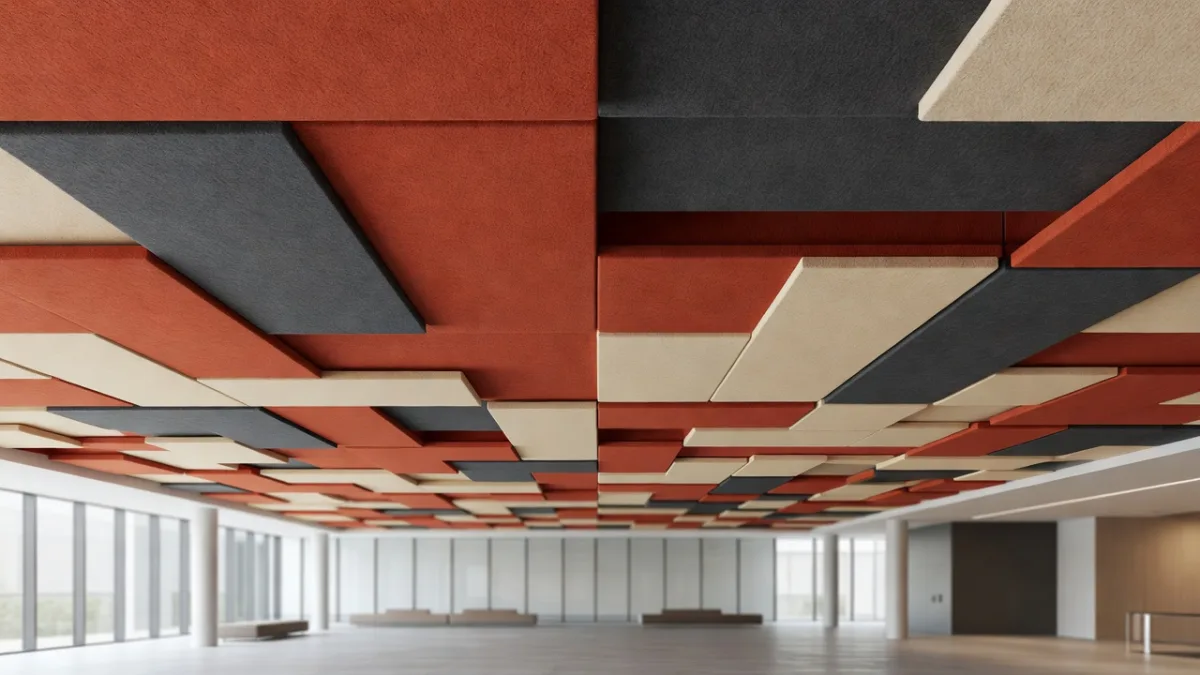
The B-s1,d0 classification has become the de facto standard for wall coverings and ceilings in public buildings because it is equivalent to M1 while guaranteeing the best level on smoke and droplets. A B-s1,d0 product therefore covers the ceiling requirement (M1) and the wall requirement (M2) with margin to spare, in the vast majority of rooms.
Frankly, aiming lower makes no economic sense. The price gap between a C-s2,d0 panel and a B-s1,d0 is small, but the latter passes everywhere while the former forces you to check room by room. The result: one product, one test report, a simpler safety file.
The PET felt used by ACOUSTELIO reaches this level thanks to fire-retardant treatment in the mass, without losing its absorption qualities (NRC 0.85, up to 85% of noise absorbed). In 2026, this is what specifiers expect from a material that combines acoustic treatment and compliance: a PET felt with recycled content, light, certified, and documented. Our acoustic wall panels are delivered with the matching test report, in France as across the EU and the UK within 10 to 15 working days.
One limit to keep in mind, though: B-s1,d0 does not mean non-combustible. If your project requires M0 or A2-s1,d0 (certain technical rooms, high-rise buildings, protected stairwells), PET felt is not the right answer and you need to switch to mineral materials. A serious supplier will tell you this before selling you anything.
Frequently asked questions about the EN 13501-1 standard
Is the EN 13501-1 standard mandatory in France?
Yes for construction products: the order of 21 November 2002 requires classification to the EN 13501-1 standard as soon as a reaction-to-fire requirement applies, notably in public buildings. Fit-out materials (curtains, furniture, temporary decor) remain classified to the French NF P92-5XX standards, so in M categories. In practice, a wall covering or an acoustic ceiling fixed to the building falls under the euroclasses, while a decorative hanging still falls under M1. When there is doubt over the line between construction and fit-out, it is the inspection office or the safety commission that decides, and it is better to ask the question ahead of the works.
What is the difference between EN 13501-1 and EN 13501-2?
The EN 13501-1 standard classifies reaction to fire, that is a product’s capacity to feed the fire, while EN 13501-2 classifies fire resistance, that is how long a construction element keeps its barrier function. The first produces euroclasses (A1 to F with s and d indices), the second REI classifications expressed in minutes, such as REI 120 for a two-hour fire-rated floor. An acoustic wall panel is concerned only by reaction to fire: it plays no compartmentation role. Confusing the two leads to absurd requirements in specifications, like asking for a “fire-rated panel” where you should read B-s1,d0.
How does a B-s1,d0 classification compare with the old M1?
A B-s1,d0 classification is equivalent in regulation to M1, with superior performance on two points the M classification did not measure: smoke and flaming droplets. The correspondence table of the order of 21 November 2002 admits all euroclass B into M1 whatever the smoke index, provided the product is d0 or d1. A B-s1,d0 therefore sits at the top of the M1 range: very low contribution to fire, minimal smoke, no flaming drop. This is why specifiers ask for it on the ceilings and walls of public buildings, where the evacuation of occupants depends directly on the visibility and breathability of the air.
Does a fire test report have a period of validity?
Yes, a reaction-to-fire test report is valid for five years in French practice, renewable by the laboratory on the basis of the same product or additional tests. An expired report is not automatically invalid technically, but an inspection office is entitled to reject it, and some do not hold back. Check the direct field of application too: the report covers a precise product (thickness, density, colour) fitted according to a precise mounting. If the manufacturer has changed its formulation or if your mounting method differs from the test, the document no longer protects you. At ACOUSTELIO, the test report supplied with every order matches the panel actually delivered.
Which euroclass should you require for acoustic panels in a public building?
B-s1,d0 is the level to require for acoustic wall or ceiling panels in a public building. This classification covers the M1 requirement for ceilings and the M2 requirement for vertical walls, with the best smoke index and zero flaming droplet. For suspended baffles, reason as you would for a ceiling, since the product sits above the occupants. Beware of low-price offers claiming a mere class E or a “fire-retardant treatment” with no test report: they will be rejected at the first inspection. And in rooms with an M0 requirement, such as certain protected stairwells or technical rooms, no PET felt is suitable, whatever the brand.
Is the M classification still used in 2026?
Yes, the M classification survives in 2026 on two fronts: fit-out materials, still governed by the NF P92-5XX standards, and the drafting habits of specifications, which keep mentioning M0 or M1 out of reflex. For construction products, the EN 13501-1 standard is authoritative and the conversion works in one direction only: a euroclass justifies an M requirement, never the reverse. An old M1 report with no associated euroclass therefore cannot validate a new wall covering. If your specifier still works in M classification, hand them the correspondence table of the order of 21 November 2002: it closes the discussion in two minutes.
Preparing a project in a public building and want acoustic panels that pass inspection first time? ACOUSTELIO delivers PET felt panels classified B-s1,d0, fire test report included, NRC 0.85 absorption, across the EU and the UK in 10 to 15 working days. Request your tailored quote: reply within 48 h, proof approved before production.