French workplace noise regulations set three thresholds: 80 dB(A), which requires the employer to provide hearing protection, 85 dB(A), which makes wearing it compulsory and imposes a noise reduction plan, and 87 dB(A), a limit that must never be exceeded. These values appear in articles R. 4431-1 and following of the French Labour Code.
According to the Ifop survey run for the JNA association, 56 % of French workers say they are bothered by noise in their workplace, and ADEME puts the social cost of occupational noise at 21 billion euros a year.
ACOUSTELIO designs PET felt acoustic panels certified EN 13501-1 (B-s1,d0) with an NRC 0,85 absorption coefficient, and sends you a custom quote within 48 h to treat your business premises.
Workplace noise falls under the Labour Code from 80 dB(A), but the discomfort starts well before that. A workshop at 88 dB(A) exposes the employer to sanctions. An open-plan office at 62 dB, on the other hand, breaches no regulation. And yet it wears out your teams, erodes concentration and fuels turnover.
This guide covers both sides of the subject: the regulatory thresholds and their obligations, then the “legal” noise that still costs a fortune. ACOUSTELIO, manufacturer of made-to-measure acoustic panels for offices, restaurants and public-access buildings, supports employers on that second front: the one where the law stays silent, but where your staff, for their part, suffer.
What do workplace noise regulations say in 2026?
French workplace noise regulations rest on articles R. 4431-1 to R. 4437-4 of the Labour Code, derived from decree no. 2006-892 transposing European directive 2003/10/EC. They define three daily exposure thresholds that trigger increasing obligations for the employer: 80, 85 and 87 dB(A).
Exposure is measured on two parameters. First the LEX,8h, that is, the noise dose received over an 8-hour day, expressed in dB(A). Then the peak level (LpC), which captures short, violent noises such as a metallic impact, expressed in dB(C). Each parameter has its own thresholds, and exceeding just one is enough to trigger the obligations.
- Lower exposure action value (80 dB(A) or 135 dB(C)): the first prevention action level
- Upper exposure action value (85 dB(A) or 137 dB(C)): corrective actions become compulsory
- Exposure limit value (87 dB(A) or 140 dB(C)): never to be exceeded, hearing protection included in the calculation
- Risk assessment document (DUERP): the noise risk assessment must appear in it whatever the measured level
One point often misleads employers: the decibel scale is logarithmic. Going from 82 to 85 dB(A) is not 4 % more noise, it is a doubling of the sound energy received by the ear. The table below sums up the thresholds in force in 2026 and what they trigger in practice.
| Threshold (LEX,8h) | Peak level | Obligation triggered |
|---|---|---|
| Below 80 dB(A) | Below 135 dB(C) | Risk assessment in the DUERP, reduction to a minimum |
| 80 dB(A): lower action value | 135 dB(C) | Hearing protection made available, information and training, audiometric testing on request |
| 85 dB(A): upper action value | 137 dB(C) | Wearing of protection enforced, zone signage, noise reduction programme |
| 87 dB(A): exposure limit | 140 dB(C) | Immediate measures: this threshold must never be exceeded, protection included |
What are the employer’s obligations at 80, 85 and 87 dB(A)?
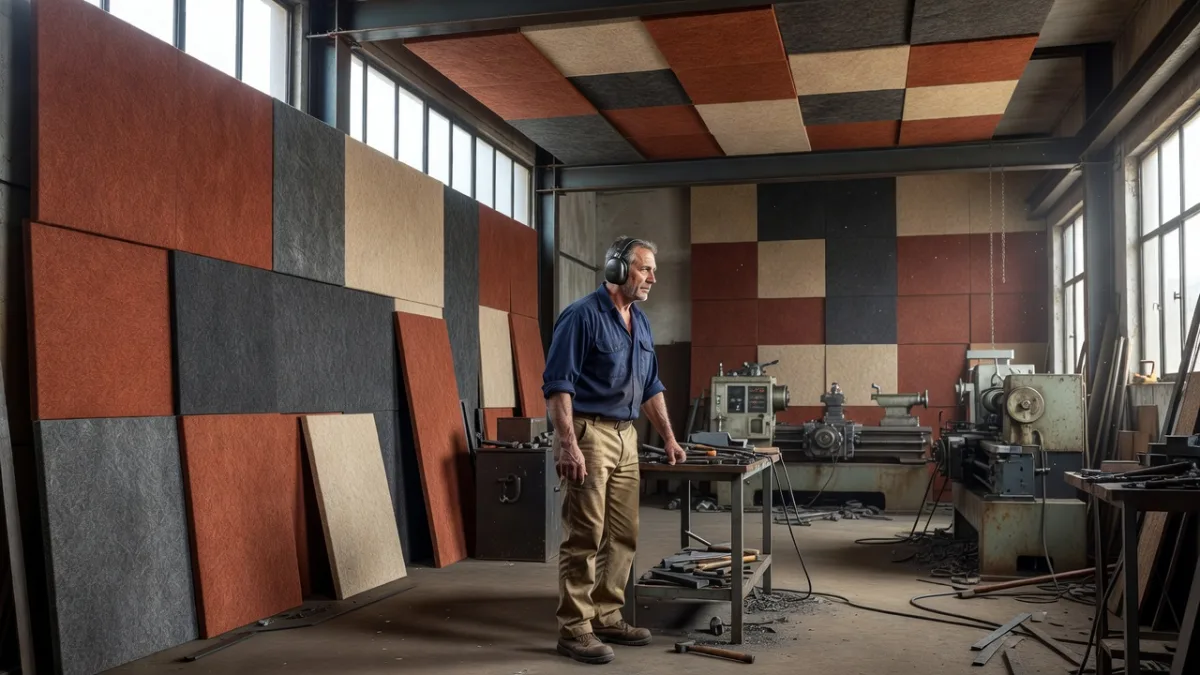
Each threshold crossed adds obligations to those of the previous one. At 80 dB(A), the employer makes protection available; at 85 dB(A), it enforces wearing it and corrects the situation; at 87 dB(A), it must act immediately because that level is prohibited.
From a daily average of 80 dB(A), you must provide individual hearing protectors (earplugs, ear defenders), train your employees on the risks and give them access to a preventive audiometric test if they request one. This is the first step, often reached in a workshop, a commercial kitchen or on a packaging line.
At 85 dB(A), the tone changes. Making protection available is no longer enough: actually wearing it becomes compulsory and you must enforce it. Added to that are signage for noisy zones, restricted access to them and above all a written programme of technical and organisational measures to reduce exposure. Acoustic treatment of the room, machine enclosures, job rotation: the Labour Code demands actions, not intentions.
- Measurement: assessment according to the NF EN ISO 9612 standard, with a calibrated sound level meter, by a competent operator
- New premises: article R. 4213-5 requires soundproofing from the design stage in rooms where exposure will exceed 85 dB(A)
- Medical follow-up: information and prevention visit, preventive audiometry above the lower action value
- Collective measures first: collective protection (room treatment, reduction at source) legally takes priority over PPE
The hierarchy matters. Article L. 4121-2 requires fighting the risk at its source before handing out earplugs. An employer who settles for PPE without ever treating the room is therefore applying the law backwards.
Why does workplace noise wear people down even below the legal thresholds?
Workplace noise damages health and productivity well below 80 dB(A). An open-plan office sits between 55 and 65 dB: no regulation forces anyone to act, yet 56 % of workers say they are bothered by noise at work according to the 2025 Ifop-JNA survey.
This is the real blind spot in the regulations, and frankly the most costly one for office-based businesses. At 60 dB, nobody goes deaf. On the other hand, the cognitive load explodes: colleagues’ conversations, phones, video calls all piling on top of each other. The brain filters constantly, so it tires. The same Ifop-JNA survey finds that work quality is reportedly degraded for 72 % of employees bothered by noise.
The macro figures are dizzying. ADEME and the Conseil national du bruit put the social cost of noise in France at 155.7 billion euros a year, of which around 21 billion for the workplace alone. The productivity loss linked to poor concentration represents the equivalent of 270,000 full-time jobs lost every year.
- Fatigue and irritability: cited by 60 % of surveyed employees as the first effect of noise
- Concentration: each sound interruption costs several minutes of refocusing on a complex task
- Turnover: a noisy environment weighs on departures, rarely measured but very real
- Psychosocial risks: chronic noise is recognised as a workplace stress factor by the INRS
At ACOUSTELIO, we see on our projects that the complaint almost never comes from the raw sound level, but from reverberation: a hard room that throws every voice back amplifies the discomfort. For concrete solutions specific to open floors, our guide on open-plan office noise details the treatments that work.
What is the NF S31-080 standard worth for your offices?

The NF S31-080 standard is the French benchmark for acoustic comfort in offices. It classifies each type of space (individual office, shared office, open plan, meeting room) according to three performance levels: standard, high performance and very high performance.
Unlike the Labour Code, this standard is voluntary. No fine if you ignore it. But that is precisely what makes it useful: it sets a quantified target where the law says nothing. For a “high performance” open-plan office, for example, it aims for an ambient sound level L50 between 40 and 45 dB(A) and a spatial sound decay greater than 3 dB per doubling of distance. In other words, a colleague’s voice must fade quickly as you move away from them.
- Individual offices: the standard sets insulation targets between rooms, from 35 to 45 dB depending on the confidentiality required
- Open-plan offices: ambient level, spatial decay and reverberation time are the three indicators tracked
- Reverberation: an overly long RT makes speech unintelligible and raises the overall level, our article on reverberation time explains how to measure it
- Contractual use: more and more project owners require it in commercial renovation programmes
Our position is clear: aim for the “high performance” level of NF S31-080 in any office refit, even without any obligation. The extra cost is low when the treatment is planned upstream, and it is a tangible argument for your recruitment as well as your wellbeing-at-work policy.
What are the legal risks of doing nothing about noise?
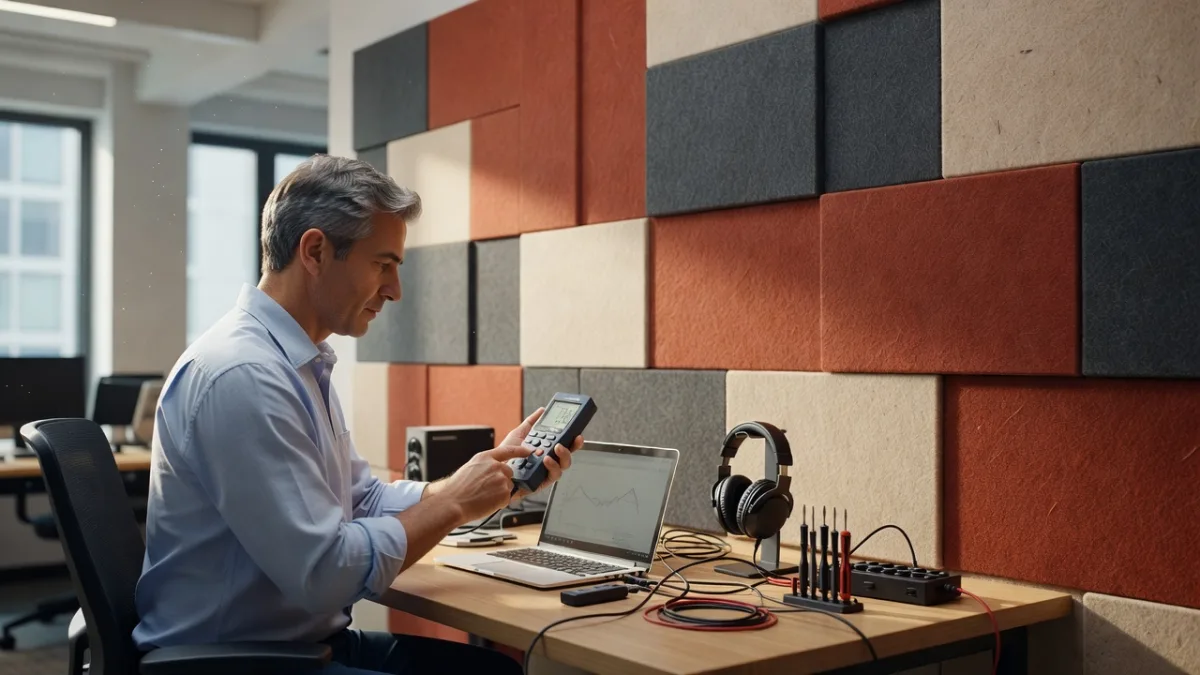
An employer who neglects noise faces three levels of risk: sanctions from the labour inspectorate, recognition of an occupational disease and gross negligence (faute inexcusable). Occupational deafness appears in table 42 of the French occupational disease schedules and can emerge years after exposure.
The duty of care under article L. 4121-1 covers both physical and mental health. In practice, if an employee develops deafness and shows that you knew about the risk without acting (no measurement, no protection, no room treatment), gross negligence can be established. The result: an increased annuity paid to the victim and compensation for all of their losses, at your expense.
And “non-hazardous” noise? It comes in through another door: psychosocial risks. A chronic sound environment that generates stress and exhaustion must appear in the DUERP under psychosocial risks. Employees have already invoked it in employment tribunal disputes over degraded working conditions. Case law remains cautious on this ground, but waiting for litigation before acting is the worst possible strategy.
- Occupational disease table 42: recognition of occupational deafness, with exposure traceability spanning decades
- Gross negligence: established when the employer was, or should have been, aware of the danger without taking measures
- DUERP: the absence of a noise risk assessment is a breach in itself, verifiable by the labour inspectorate
- Psychosocial risks: chronic noise, even moderate, must be treated as a documented stress factor
Documentation protects you as much as it protects your teams. Dated measurements, a written action plan, invoices for acoustic treatment: in a dispute, these documents make the difference between a diligent employer and a convicted one.
How do you treat workplace noise in 4 steps?
An action plan against workplace noise always follows the same order: measure, prioritise, reduce at source, then treat the room. This sequence mirrors the legal prevention hierarchy and avoids spending in the wrong place.
Step 1, measure. Have a sound map drawn up: sound level meter or dosimetry in industrial areas, measurement of the ambient level and reverberation time in office environments. Without figures, there are no priorities and no proof of diligence.
Step 2, prioritise. Cross-reference measured levels, the number of exposed staff and exposure duration. A machine at 92 dB(A) used 6 hours a day comes before a meeting room that echoes. Record everything in the DUERP with a timetable.
Step 3, treat at source. Quieter machines at purchase, enclosures, maintenance of noisy equipment, usage rules in open-plan offices (dedicated rooms for video calls, quiet zones). This is the legal priority and often the most cost-effective measure.
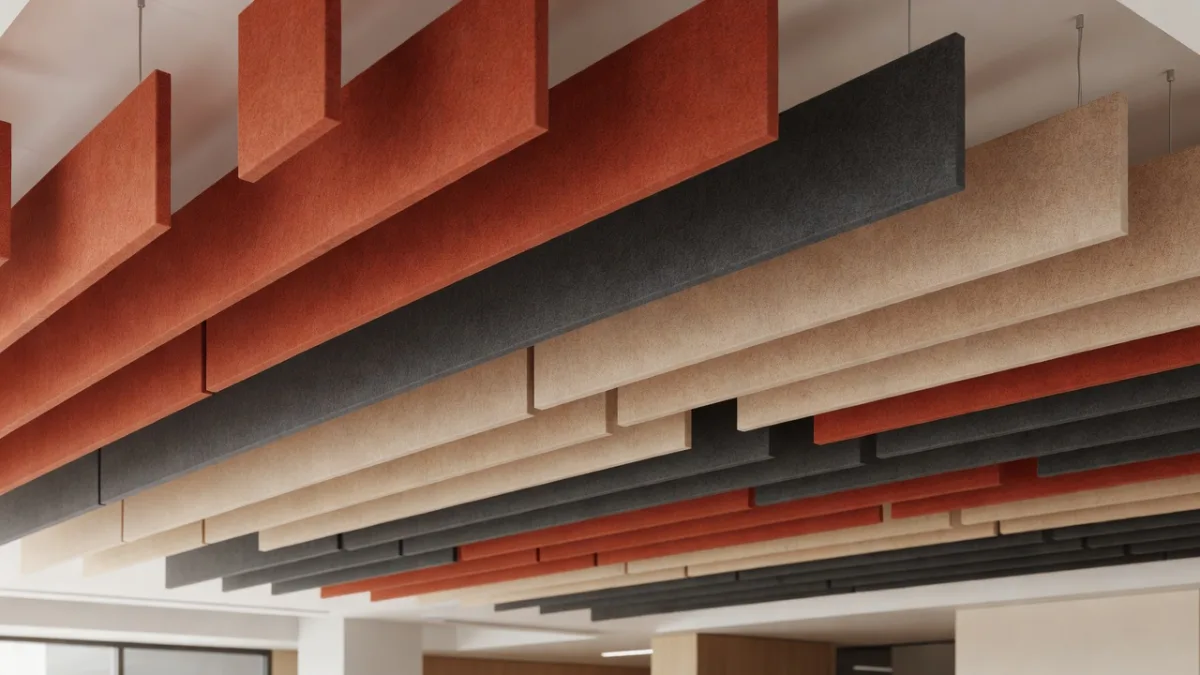
Step 4, treat the room. When the source cannot be turned down, you absorb. Wall panels and ceiling baffles in PET felt reduce the reverberation that amplifies every noise. At ACOUSTELIO, we see an average 50 % drop in reverberation on our projects, and treating 15 to 30 % of the wall or ceiling surface is usually enough.
- Initial measurement: essential to prove the improvement and give priorities an objective basis
- Collective protection first: treating the room benefits everyone, without depending on individual discipline
- NRC 0,85 absorption: our panels trap up to 85 % of the sound energy that hits them
- Public-building compliance: B-s1,d0 fire rating required in public-access buildings, test report supplied
For an office floor, our dedicated office acoustics page details typical configurations by surface area and use. The full regulatory benchmarks remain available on the website of the INRS.
Frequently asked questions about workplace noise
What are the noise thresholds not to be exceeded at work?
The French Labour Code sets three daily exposure thresholds: 80 dB(A), 85 dB(A) and 87 dB(A). At 80 dB(A), the employer must make hearing protection available and train employees. At 85 dB(A), wearing the protection becomes compulsory and a noise reduction programme must be launched. The 87 dB(A) threshold is an absolute limit value: it must never be exceeded, this time taking into account the attenuation of the protectors worn. Equivalent thresholds exist for short, intense noises: 135, 137 and 140 dB(C) in peak level. Exceeding a single parameter is enough to trigger the corresponding obligations.
Is open-plan office noise covered by the law?
No, not directly: an open-plan office between 55 and 65 dB remains well below the first regulatory threshold of 80 dB(A). No specific acoustic treatment obligation therefore applies at that level. The employer nevertheless remains bound by the general duty of care (article L. 4121-1), which covers physical and mental health, and chronic noise must appear in the DUERP as a psychosocial risk factor when it generates fatigue and stress. The NF S31-080 standard, which is voluntary, then serves as the benchmark: it recommends an ambient level of 40 to 45 dB(A) for a high-performance open-plan office. That is the target we advise aiming for in renovations.
What is the 87 dB(A) exposure limit value?
The exposure limit value is the absolute ceiling set by article R. 4431-2 of the French Labour Code: 87 dB(A) averaged over 8 hours or 140 dB(C) at peak. Its particularity lies in how it is calculated: unlike the 80 and 85 dB(A) thresholds measured at the unprotected ear, the limit value takes into account the actual attenuation provided by the hearing protectors worn. If the level reaching the ear still exceeds 87 dB(A), the employer must act immediately: identify the causes, reduce noise at source, change protectors or shorten exposure. Continuing operations beyond the limit value engages the employer’s liability, including criminal liability in the event of subsequent deafness.
Can an employer be convicted over workplace noise?
Yes, on several grounds. Occupational deafness is recognised in table 42 of the French occupational disease schedules: an affected employee can obtain compensation even years after exposure. If the employer knew about the danger without taking measures (no measurement, no protection, no reduction plan), gross negligence can be established, with an increased annuity and compensation for all losses. The labour inspectorate can also sanction non-compliance with the threshold-related obligations. Finally, moderate but chronic noise can fuel litigation based on psychosocial risks and degraded working conditions. A documented prevention file remains the best legal protection.
What is the difference between dB(A) and dB(C)?
Both dB(A) and dB(C) measure sound pressure, but with a different filter. A-weighting reproduces the human ear’s sensitivity at everyday levels: it is used to assess average exposure over the day (LEX,8h), the kind that wears down hearing over time. C-weighting, which is almost linear, better captures low frequencies and very short peaks: it is used to measure the peak level, such as a press impact or a detonation, capable of damaging the inner ear in a few milliseconds. That is why workplace noise regulations set thresholds on both scales: 80, 85 and 87 dB(A) on one side, 135, 137 and 140 dB(C) on the other.
How much does bringing premises into acoustic compliance cost?
For the acoustic treatment side, count on from 49 €/m² for wall panels and 59 €/m² for ceiling baffles and panels at ACOUSTELIO. The good news is that there is no need to cover the whole room: treating 15 to 30 % of the wall or ceiling surface is usually enough for a clear result, with an average 50 % drop in reverberation recorded on our projects. A 100 m² open-plan office can therefore often be treated for a budget in the region of 1,500 to 3,000 euros, installed or fitted by your own teams. Every project starts with a custom quote within 48 h, with a proof approved before production and delivery in 10 to 15 working days.
You now know your obligations and, above all, what noise costs you even when the law demands nothing. Measure, record the risk in the DUERP, then treat the source and the room. To price the acoustic treatment of your premises with B-s1,d0 certified PET felt panels, request your custom quote: response within 48 h, layout plan included.