Acoustic foam absorbs high frequencies correctly from 40 mm thickness upwards, but it stays weak in the low end, and most consumer-grade polyurethane foams catch fire easily. In a professional space open to the public, regulations require a material rated B-s1,d0, which rules out standard foam.
According to the test reports published by manufacturers, a thin 20 mm foam plateaus around 0.30 absorption below 500 Hz, while it exceeds 0.90 above 2,000 Hz: effectiveness varies threefold depending on frequency.
ACOUSTELIO manufactures PET felt acoustic panels rated B-s1,d0 to EN 13501-1, with a laboratory-measured NRC of 0,85, a fire test report supplied with every order and a custom quote within 48 h.
Acoustic foam promises a lot for a few dozen euros: less echo, a clearer voice, a studio feel. And it is partly true. But between what the product sheets claim and what a test report measures, the gap is real. At ACOUSTELIO, manufacturer of made-to-measure acoustic panels in PET felt, we receive requests every week from professionals disappointed by their foam tiles. This article sorts fact from fiction, figures in hand.
Our position fits in two sentences. For a home studio or a vocal booth, foam remains a decent, cheap tool. For a restaurant, an open-plan office or a hotel, however, standard polyurethane foam stacks up three flaws: partial absorption, rapid ageing and, above all, fire behaviour incompatible with the requirements of buildings open to the public. That is not a sales pitch, it is factual, and we are going to demonstrate it point by point.
What is acoustic foam actually for?
Acoustic foam absorbs part of the sound energy that strikes its surface and therefore reduces reverberation inside a room. It does not block noise: it only stops sound from bouncing off the wall it covers.
The physics is simple. The sound wave penetrates the material’s open-cell structure, the air vibrates in the microscopic pores, and friction converts acoustic energy into heat. The result: fewer reflections, less echo, a room that sounds deader. But no less sound gets through the wall for all that.
- Absorption: the ability to dissipate sound within the room, measured by the αw coefficient or the NRC
- Insulation: the ability to block sound between two spaces, which relies on the mass and airtightness of the walls
- αw coefficient: a value from 0 to 1, measured in the laboratory to the ISO 354 standard, frequency by frequency
- NRC: the average absorption across the 250 to 2,000 Hz range, easier to read when comparing two products
That distinction rules out half of all foam purchases from the start. Because if your problem comes from the neighbours, the street or the room next door, no foam will fix it. You need mass, decoupling, a proper insulation job. Foam treats the echo in the room where it is installed. Full stop.
When does acoustic foam remain a good choice?
Acoustic foam remains relevant for small private spaces where budget comes first and nobody receives the public. A home studio, a streaming booth or a machine enclosure gain a real benefit for a cost of 10 to 50 euros per m² according to market data.
Let us be honest: to treat the first reflections around a microphone, a 50 mm foam does the job. It is light, it glues up in an hour, and it absorbs the voice frequencies above 1,000 Hz well. That is exactly what a podcaster or an amateur musician is after when starting out.
- Home studio: treating the lateral reflection points and the ceiling, completed by bass traps in the corners
- Vocal booth: speech sits mostly between 500 and 4,000 Hz, a range where thick foam performs well
- Technical enclosures: cutting the noise of a machine or a server inside a closed housing, away from areas open to the public
- Testing before investing: confirming that a problem really comes from reverberation before committing a serious budget
So yes, foam has its place. At home. The trouble starts when that DIY logic is carried over into a venue that welcomes customers, employees or pupils, because the rules of the game change completely.
Why does foam disappoint in the mids and lows?
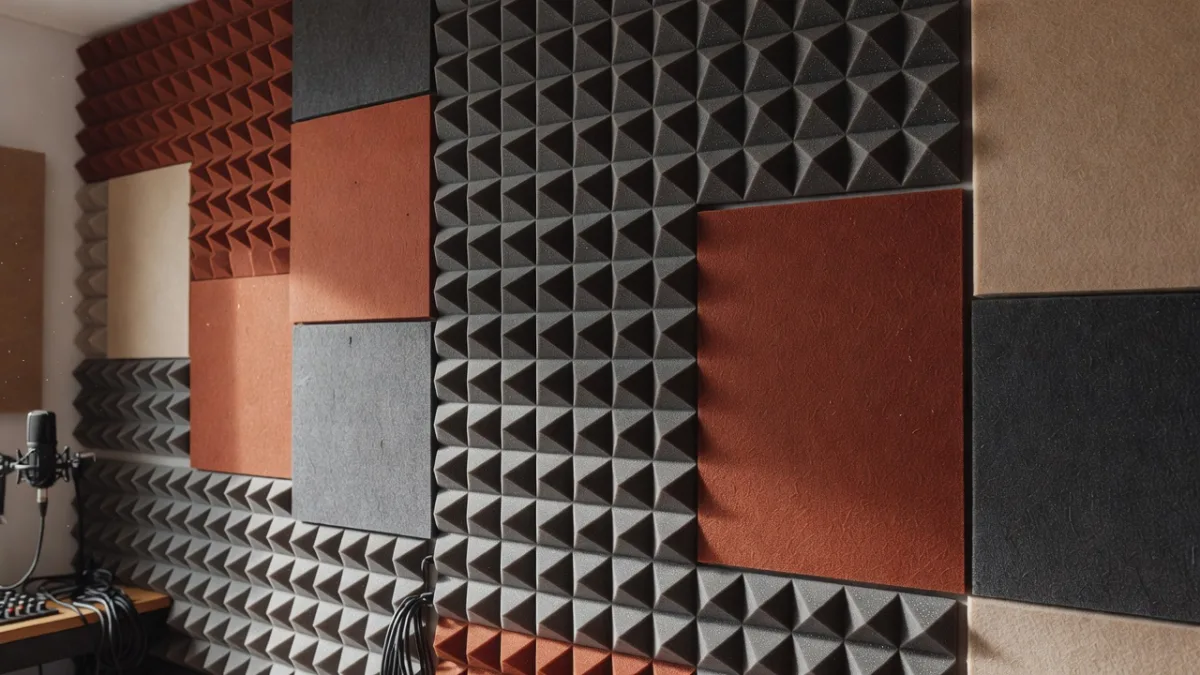
A thin foam absorbs almost nothing below 500 Hz, because low-frequency waves are physically too long to be dissipated in 20 or 30 mm of material. The decorative tiles sold online, often barely 20 mm thick, therefore treat only a fraction of the spectrum.
In concrete terms, a 100 Hz wave is about 3.4 metres long. Hoping to trap it in 2 cm of polyurethane is wishful thinking. Acoustic consultancies agree on a minimum of 40 to 50 mm to cover the human voice, and on more than 100 mm to start working on the low frequencies. Yet the majority of entry-level pyramid tile kits stay below that threshold.
- Below 250 Hz: near-zero absorption for thin foams, you need bulky bass traps
- 500 to 1,000 Hz: average results, highly dependent on the product’s actual thickness and density
- Above 2,000 Hz: good absorption, often above 0.90, and that is the flattering figure sellers put forward
- Treated surface: ten 30 × 30 cm tiles cover 0.9 m², a drop in the ocean in an 80 m² restaurant
At ACOUSTELIO, we see it on our projects: the disappointment almost always comes from there. A client stuck up a few thin tiles, the din did not budge, and they conclude that acoustic treatment does not work. It works. Just not with 1 m² of 20 mm foam.
Is acoustic foam flammable?
Yes, standard polyurethane acoustic foam is a flammable material that ignites within seconds and spreads flaming droplets. Its combustion also releases smoke loaded with carbon monoxide and hydrogen cyanide, a gas identified by the INRS as extremely toxic.
This is the real subject of this article, and it gets far too little coverage. Polyurethane is a cellular organic material: a lot of air, a lot of contact surface, a chemistry that burns fast. Firefighters know the phenomenon well, and several dramatic fires in public venues around the world have involved foams installed as wall coverings.
- Ignition speed: an untreated polyurethane tile catches fire on contact with a simple naked flame
- Flaming droplets: foam melts as it burns and spreads fire to the floor, which the classification records as d1 or d2
- Toxic smoke: combustion releases hydrogen cyanide and carbon monoxide, the leading causes of death in fires
- No rating: in 2026, most decorative foams sold online show no test report at all, or at best a class E
In other words, the risk is not theoretical. Unrated foam glued over 20 m² of wall is a considerable fire load placed at head height. At home, that is your choice. In a venue open to the public, it is prohibited, and here is why.
What do fire regulations say for professional spaces?
In French buildings open to the public (ERP), the safety code requires wall coverings rated at least M2, equivalent to C-s3,d0, and ceilings rated M1, equivalent to B-s1,d0. An unrated or class E polyurethane foam therefore has no legal place on the walls of such a building.
The reference text is the French order of 25 June 1980, which governs fire safety in public-access buildings. And the safety commission does not settle for a promise: it demands the test report for the material actually installed. No report, no compliance. We covered how the euroclasses work in our article on the EN 13501-1 standard, which grades every material from A1 to F according to its fire behaviour.
- B-s1,d0: very low combustibility, limited smoke, no flaming droplets, the level required for ERP ceilings
- C-s3,d0: the minimum threshold accepted for vertical walls in most areas open to the public
- Class E: the material withstands a small flame for a few seconds, a common level for consumer foams
- Unrated: no testing carried out, the material is deemed class F and therefore unusable in a public building
Our position is deliberate: in a professional space open to the public, standard foam is a poor choice, and that verdict comes from the regulations, not from marketing. That is why all our panels ship with their official test report, as explained on our EN 13501-1 fire rating page.
Polyurethane foam, melamine foam or PET felt: which to choose?
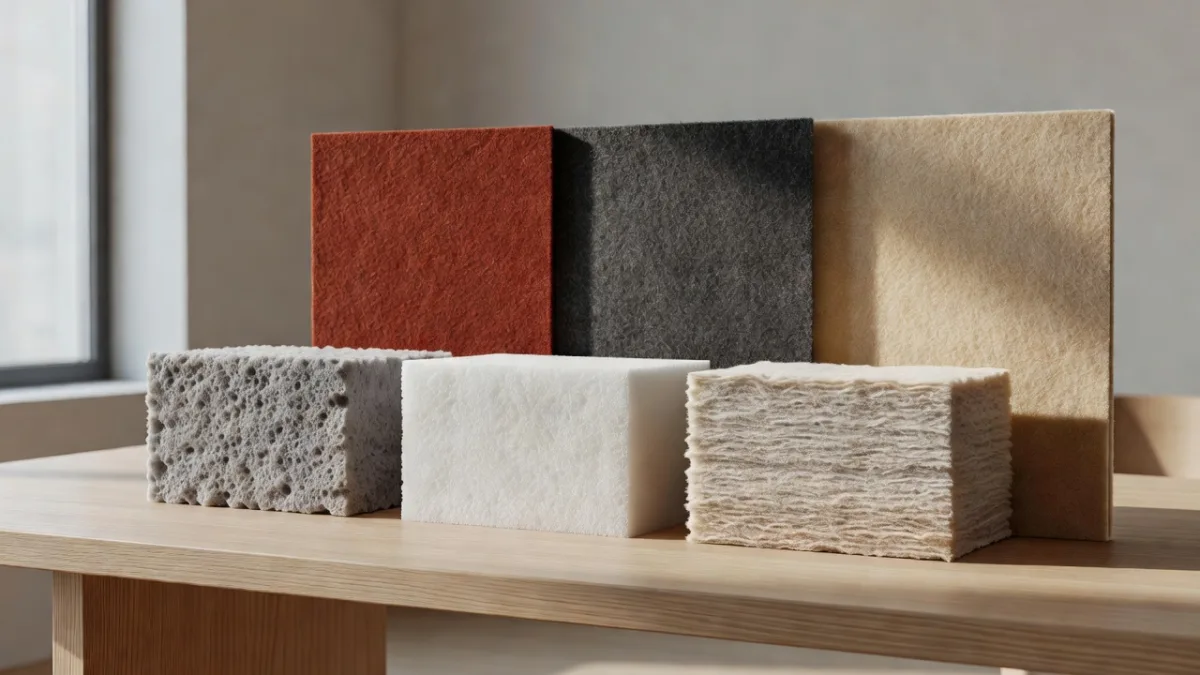
The choice between polyurethane, melamine and PET felt depends on the venue, the budget and the regulatory obligations. Polyurethane wins on price, melamine on fire performance in technical environments, and PET felt on the balance of performance, safety and aesthetics in spaces open to the public.
Melamine foam deserves an honest word, by the way: it is a good material, often rated M1, widely used in industry. Its limits lie elsewhere, because it remains crumbly, sensitive to knocks and visually poor. The table below sums up what we observe in the field and in the datasheets.
| Criterion | Polyurethane foam | Melamine foam | PET felt |
|---|---|---|---|
| Absorption | Good in the highs, weak below 500 Hz | Good in the mids and highs | Measured NRC 0,85, broadband |
| Fire rating | Often unrated or class E | M1 possible depending on the product | Certified B-s1,d0, report supplied |
| Durability | Yellows and crumbles in 3 to 5 years | Stable but crumbly under impact | Stable for over 10 years, cleanable |
| Aesthetics | Anthracite grey reliefs, studio look | Off-white, plain, marks easily | Colours, custom cuts and HD printing |
| Best use | Home studio, vocal booth, enclosures | Plant rooms, industry | Offices, restaurants, hotels, public buildings |
The reading is clear: each material has its zone of relevance, but only one ticks measured performance, fire compliance and visual finish all at once for a venue open to the public. We have published a full comparison of acoustic PET felt against the other materials for those who want to dig deeper.
How does acoustic foam age over time?
A polyurethane foam exposed to light yellows within a few months, then turns brittle and crumbles to the touch after three to five years. This ageing is chemical, and therefore inevitable: UV and oxygen degrade the very structure of the material.
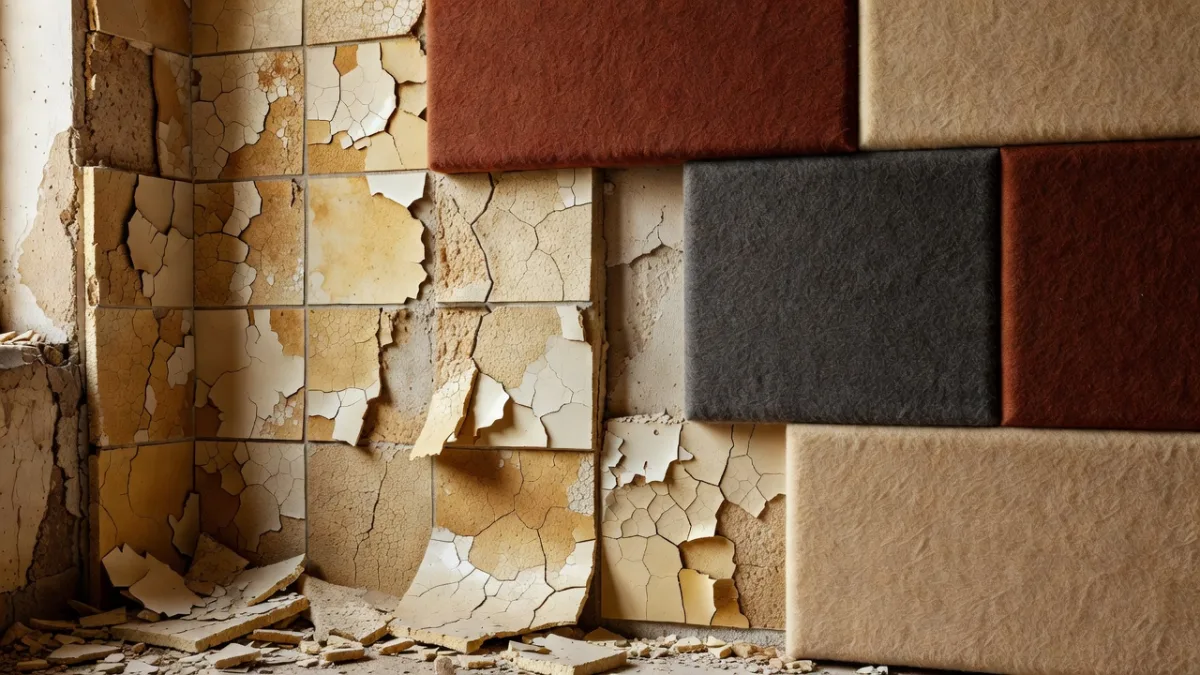
At ACOUSTELIO, we see the same scenario on every refurbishment project when the old tiles come down: orange, dusty tiles that leave crumbs on the floor and glue marks impossible to hide on the wall. The client saved 300 euros at purchase, and pays for the repaint five years later.
- Yellowing: polyurethane oxidation shifts from grey to yellow then orange, even without direct sunlight
- Crumbling: the material loses its elasticity and disintegrates at the slightest contact, especially on the ridges of the reliefs
- Soiling: the cells trap dust and grease, and foam cannot be cleaned with a sponge or a vacuum without damage
- Brand image: in a restaurant or a hotel lobby, yellowed tiles send an immediate signal of neglect
PET felt ages differently, and it is measurable: fibre dyed through the mass, a dense surface that dusts off, no chemical migration. Panels we installed ten years ago have not shifted in colour. That, too, is the real cost of a material.
Which alternative should you choose for your use case?
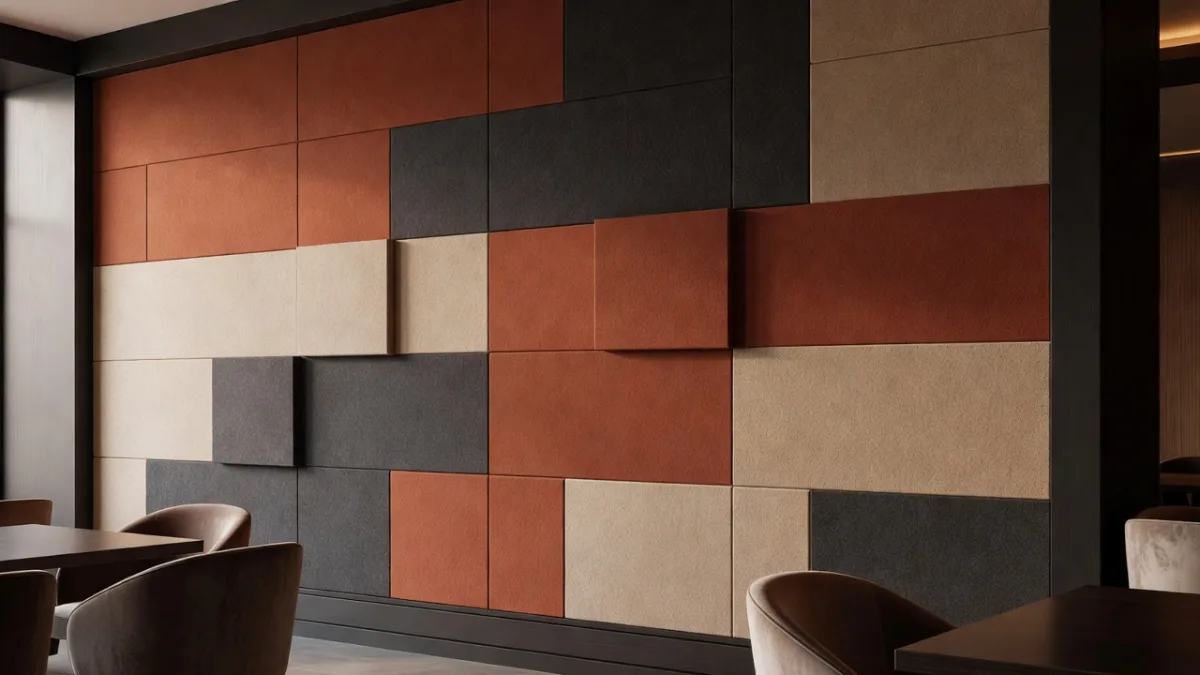
The right absorber depends on the venue: PET felt for spaces open to the public, framed mineral wool for demanding studios, perforated wood for high-end meeting rooms. Foam, for its part, stays confined to private and technical uses.
For a professional space, our field recommendation comes down to one simple rule: treating 15 to 30 % of the wall or ceiling surface is usually enough, and our projects end with reverberation cut in half on average. Our PET felt wall panels start at 49 €/m², printable in your colours, which turns the acoustic constraint into a decorative asset.
- PET felt: NRC 0,85, rated B-s1,d0, light and cut to measure, the logical choice for restaurants, offices, hotels and public buildings
- Framed mineral wool: excellent broadband absorption behind a stretched fabric, but heavier installation and a facing is mandatory
- Perforated wood: high-end architectural finish and good absorption with an integrated backing veil, for markedly higher budgets
- Polyurethane foam: keep it for the home studio, the vocal booth and machine enclosures, away from areas open to the public
When a client asks us whether their foam can stay in place, our answer hinges on a single question: who enters this room? A private individual at home does as they please. A professional who receives the public does not, and the safety commission will remind them.
Frequently asked questions about acoustic foam
Does acoustic foam block the neighbours’ noise?
No, acoustic foam does not block noise coming from another dwelling or from the street. It absorbs the sound reflections inside the room where it is installed, which reduces echo and reverberation, but it adds almost no mass to the wall. Yet it is mass and airtightness that slow the transmission of sound between two spaces. To attenuate neighbourhood noise, you need a mass-spring-mass insulating lining, high-performance windows or a floor treatment. Gluing foam tiles onto a party wall costs money and changes almost nothing: it is the most common buying mistake we come across.
Is foam dangerous for your health?
An intact polyurethane foam presents no notable danger at room temperature, the serious risk appears in a fire. Its combustion releases carbon monoxide and hydrogen cyanide, gases responsible for the majority of fire deaths according to prevention bodies such as the INRS. An ageing foam also raises a secondary concern: as it crumbles, it releases particles and dust into the air, unpleasant in a poorly ventilated room. Finally, some cheap imported foams give off solvent odours for several weeks. In short, the real danger is not everyday use but fire behaviour, and that is precisely what the euroclasses allow you to assess before buying.
Can foam be installed in a restaurant or a public building?
No, unless the product comes with a test report attesting a compliant fire rating, which is rare for standard foam. The safety code for buildings open to the public generally requires coverings rated M2, equivalent to C-s3,d0, on vertical walls and M1, equivalent to B-s1,d0, on ceilings. An unrated polyurethane foam is deemed class F and therefore cannot be installed in areas open to the public. The safety commission asks for the test report during its inspections, and non-compliance can lead to an unfavourable opinion on continued operation. For a restaurant, a PET felt panel rated B-s1,d0 with the report supplied settles the question.
What thickness should you choose for an audible result?
Count on 40 to 50 mm minimum to treat the human voice, and more than 100 mm to act on the low frequencies. The thin 20 mm tiles sold in kits only absorb effectively above 2,000 Hz: they soften sibilants but leave the din untouched. Thickness is not the only factor, because the material’s density and the total treated surface matter just as much. Ten 30 cm tiles cover less than 1 m², a surface far too small to change the acoustics of a 30 m² room. The rule we apply on our projects: aim for 15 to 30 % of the wall or ceiling surface with a genuinely absorbent material.
Why does foam yellow over time?
Polyurethane yellows because UV rays and oxygen progressively break down its chemical bonds, a phenomenon called photo-oxidation. The process starts within the first few months, even without direct sun exposure, and it is irreversible: no cleaning restores a yellowed foam to its original colour. The degradation does not stop at aesthetics, because the material also loses its elasticity, turns brittle and ends up crumbling to the touch. On our refurbishment projects, we regularly take down tiles installed five years earlier: they are orange, friable and leave glue residue on the walls. A through-dyed material such as PET felt does not undergo this mechanism.
Acoustic foam or PET felt panel: which to choose?
Choose acoustic foam for private use on a small budget, and PET felt as soon as a professional space is involved. Foam wins on immediate purchase price, around 10 to 50 €/m², but it loses on everything else: absorption limited to the highs at low thicknesses, problematic fire behaviour, rapid yellowing and crumbling. PET felt posts a measured NRC of 0,85, the B-s1,d0 rating required in public buildings, a service life of over ten years and real design freedom with custom cuts and high-definition printing. Weighed against service life and regulatory risk, the maths tilts firmly toward felt for a restaurant, an office or a hotel.
Still hesitating between keeping your foam or switching to a compliant, durable solution? Send us the dimensions and a few photos of your space: we will return a custom quote within 48 h, with the number of panels needed, the B-s1,d0 fire test report and a simulation of the expected acoustic result.