Classroom acoustics in France are governed by the decree of 25 April 2003: reverberation time must stay between 0.4 and 0.8 seconds in a teaching room of less than 250 m³. Beyond that, instructions become hard to understand and the teacher strains their voice all day long.
According to surveys by INSERM and MGEN, 55 % of teachers report voice disorders, and these dysphonias account for nearly 20 % of their sick leave, against 4 % in other professions.
ACOUSTELIO manufactures PET felt acoustic panels certified B-s1,d0 to EN 13501-1, with an NRC absorption coefficient of 0,85, a fire test report supplied with every order and a custom quote within 48 h to bring your classrooms back within the regulatory values.
Classroom acoustics are not a matter of comfort: they are a direct factor in learning and an occupational health issue for teachers. A classroom that echoes degrades speech intelligibility, drives up the noise level and wears out voices. The good news: the problem can be fixed quickly, without heavy work, with made-to-measure acoustic panels in PET felt mounted on the walls or suspended from the ceiling.
This guide is written for school heads, facility managers and the technical departments of local authorities. You will find the exact regulatory values of the French decree of 25 April 2003, a simple diagnostic method, the fire constraints specific to school buildings open to the public and a realistic budget per classroom. At ACOUSTELIO, we see an average 50 % reduction in reverberation after treatment on our projects: that is the level of result to aim for.
Why do classroom acoustics weigh so heavily on learning?
Noise in a classroom directly degrades comprehension: for a child to grasp an instruction, the reference voice must exceed the ambient noise by at least 15 dB. Yet the WHO recommends background noise below 35 dB(A) in an unoccupied classroom, when real measurements often sit between 45 and 55 dB(A).
In practice, in an overly reverberant classroom, syllables overlap. The pupil at the back hears a wall of sound, not a sentence. They compensate with a constant listening effort, so they tire, so they disengage. And the teacher speaks louder to rise above the hubbub, which pushes the level up further: this is the Lombard effect, a spiral everyone knows without naming it.
- Intelligibility: a signal-to-noise ratio of at least +15 dB is needed for a child to understand speech without effort
- Concentration: prolonged listening effort exhausts attention, especially in children under 8 and in pupils with hearing loss or learning in a second language
- Lombard effect: everyone raises their voice to be heard, and the overall level mechanically climbs by several decibels
- Teachers’ voices: 55 % report vocal disorders and 13 % a moderate to severe vocal handicap according to MGEN
- Absenteeism: dysphonias account for nearly 20 % of teachers’ sick leave, against 4 % among other workers
Voice disorders are still not recognised as an occupational disease in France, unlike in Finland or Poland. As a result, the human cost stays invisible in budgets, even though it is paid for in substitute teachers and speech therapy sessions.
What do the acoustic regulations say for schools?
Acoustic regulations for French schools rest on the decree of 25 April 2003 on noise limitation in educational buildings. This text requires a reverberation time of between 0.4 and 0.8 seconds in classrooms of less than 250 m³, measured with the room furnished and unoccupied.
The text, available on Légifrance, covers nursery and primary schools, middle schools, high schools, specialist schools and higher education. Watch out for a nuance many websites overlook: it only applies to new buildings and to extensions whose permit was filed after the end of 2003. A school built in the 1970s is not legally bound by it, yet that is precisely where classrooms echo the most. In every case, reverberation time remains the first indicator to measure.
- Article 5: reverberation times by room type, averaged over the 500, 1,000 and 2,000 Hz octave bands
- Article 6: in corridors, halls of less than 250 m³ and covered playgrounds, the absorption area must cover at least 50 % of the floor area
- Article 4: equipment noise limited to 33 or 38 dB(A) in libraries, medical rooms and music rooms
- Canteens: dining halls are explicitly covered, with a ceiling of 1.2 s above 250 m³
| Type of school room | Volume | Requirement (decree of 25 April 2003) |
|---|---|---|
| Classroom, study room, practical activities | ≤ 250 m³ | Tr between 0.4 and 0.8 s |
| Teaching room, music room | > 250 m³ | Tr between 0.6 and 1.2 s |
| Dining hall, refectory | ≤ 250 m³ | Tr between 0.4 and 0.8 s |
| Dining hall | > 250 m³ | Tr of 1.2 s maximum |
| Rest, exercise or play room (nursery school) | All volumes | Tr between 0.4 and 0.8 s |
| Corridors, halls, covered playgrounds | < 250 m³ and covered playgrounds | Absorption ≥ 50 % of floor area |
Keep the logic of the text in mind: the larger the volume and the more collective the use, the more absorbent surface you need to stay within the limits.
How do you diagnose a classroom that echoes?
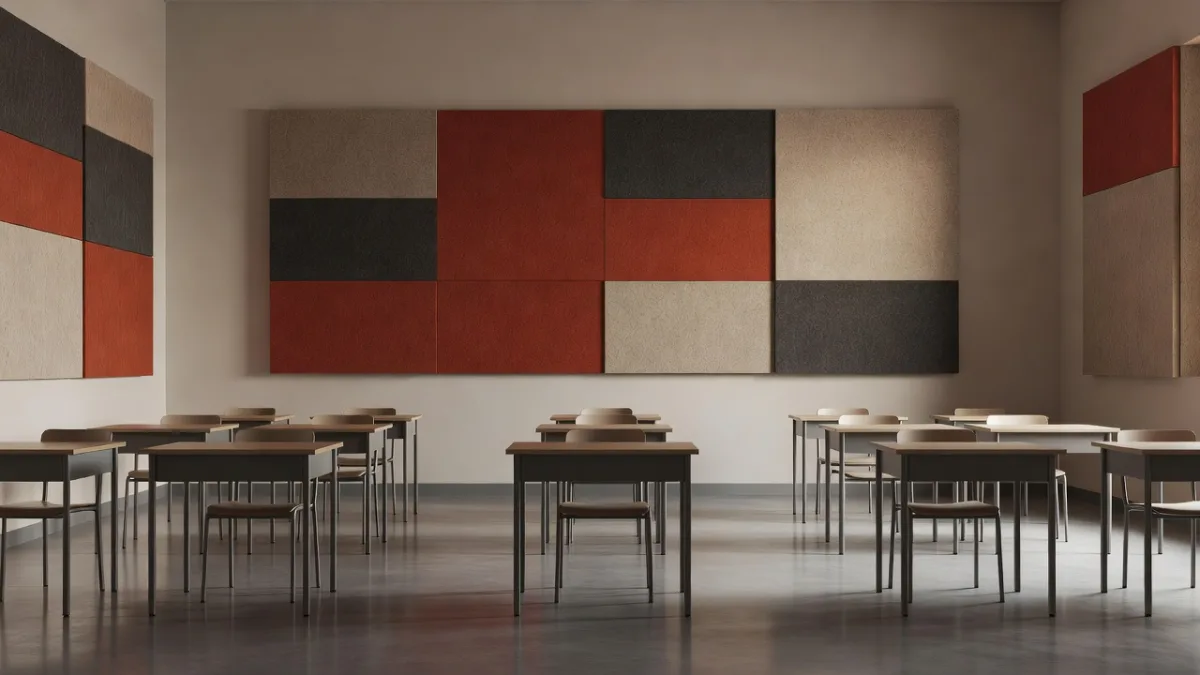
The acoustic diagnosis of a classroom starts with a simple test: a sharp hand clap in the empty room. If the sound clearly lingers for more than half a second, the classroom is probably outside the target values of 0.4 to 0.8 seconds.
This empirical test does not replace a standardised measurement carried out by an acoustician to NF S 31-057, but it is more than enough to raise the alarm. The signals on the ground, meanwhile, do not lie. When a teacher ends the week voiceless, when the pupils at the back ask for everything to be repeated three times, when the noise level climbs on its own as soon as a group works independently, the verdict is already in. Frankly, in a tiled classroom with bare walls and a painted concrete ceiling, the measurement almost always confirms what the ear already knows.
- Hand clap test: a clap whose echo lingers signals excessive reverberation, to be confirmed by measurement
- Hard surfaces: tiling, glazing, concrete and painted plaster reflect sound instead of absorbing it
- Smartphone sound meter: readings above 70 dB(A) during normal activity should raise concern, even if they remain indicative
- Human symptoms: broken voices on Friday, repeated instructions, unusual pupil fatigue at the end of the day
- Standardised measurement: only a Tr measurement to NF S 31-057 counts for the purposes of the decree
Our practitioner’s advice: photograph the room, note its dimensions and list the wall materials. Those three pieces of information are enough for a serious manufacturer to size a treatment and quote for it, without waiting for a full study.
Which acoustic solutions can be installed in a school open to the public?
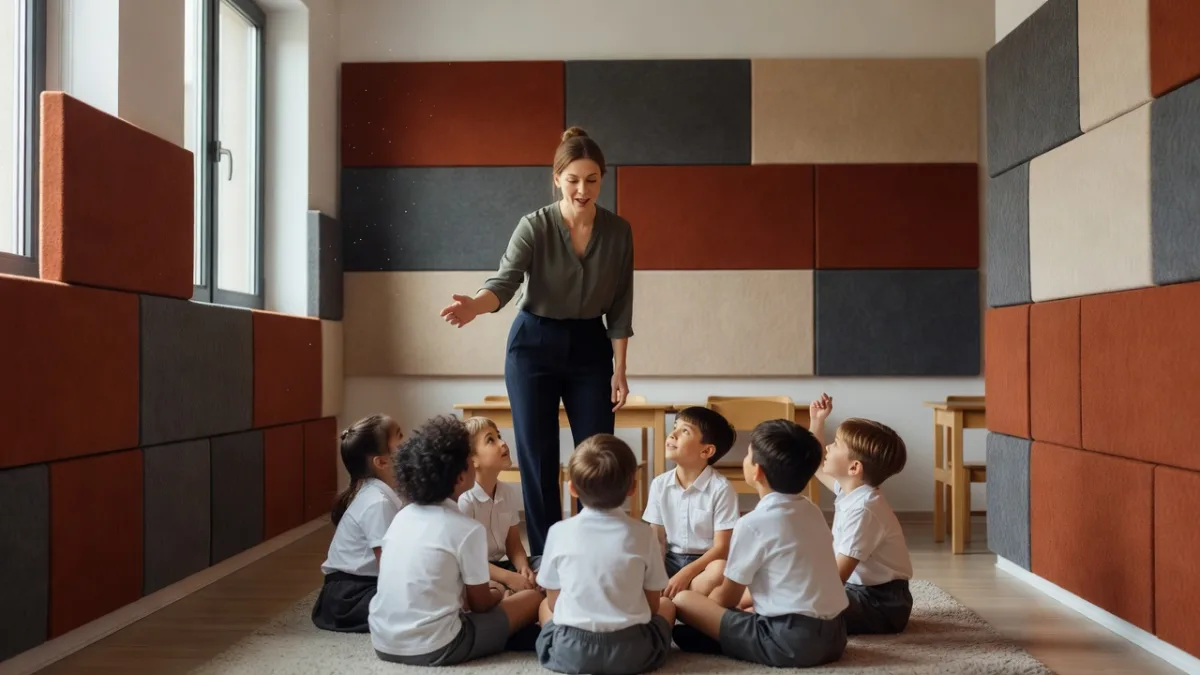
In a French school, classed as a public-access building, acoustic correction materials must carry a B-s1,d0 fire rating to EN 13501-1. It is the number one checkpoint for inspection bodies and safety commissions: an unrated panel, however effective, has no place in a school.
A school is a type R public-access building, and that changes everything in product selection. The decorative foams sold online regularly end up removed after the safety commission’s visit, because they have no usable fire test report. High-density PET felt, on the other hand, ticks every box: high absorption, B-s1,d0 rating, light weight and resistance to the knocks of everyday school life. Our range dedicated to public-access buildings was designed exactly for this framework, and we explain how the Euroclasses work in our guide to the EN 13501-1 standard.
- B-s1,d0: the level required in public-access buildings, meaning a very low combustibility material, with low smoke emission and no flaming droplets
- Fire test report: demand the test report for the product actually delivered, not a generic range certificate
- NRC 0,85: our panels absorb up to 85 % of incident sound energy, a value measured in the laboratory
- Robustness: PET felt takes chair knocks and can be cleaned, unlike foams and stretched fabrics
- Hygiene: no irritating fibres and no off-gassing, a real issue in rooms occupied by children
Every ACOUSTELIO order ships with its fire classification report, and our B-s1,d0 fire rating warranty covers you in black and white before the safety commission. It is a document the inspection body will ask for, so you may as well have it before installation rather than after.
Ceiling or walls: where should panels go in a classroom?
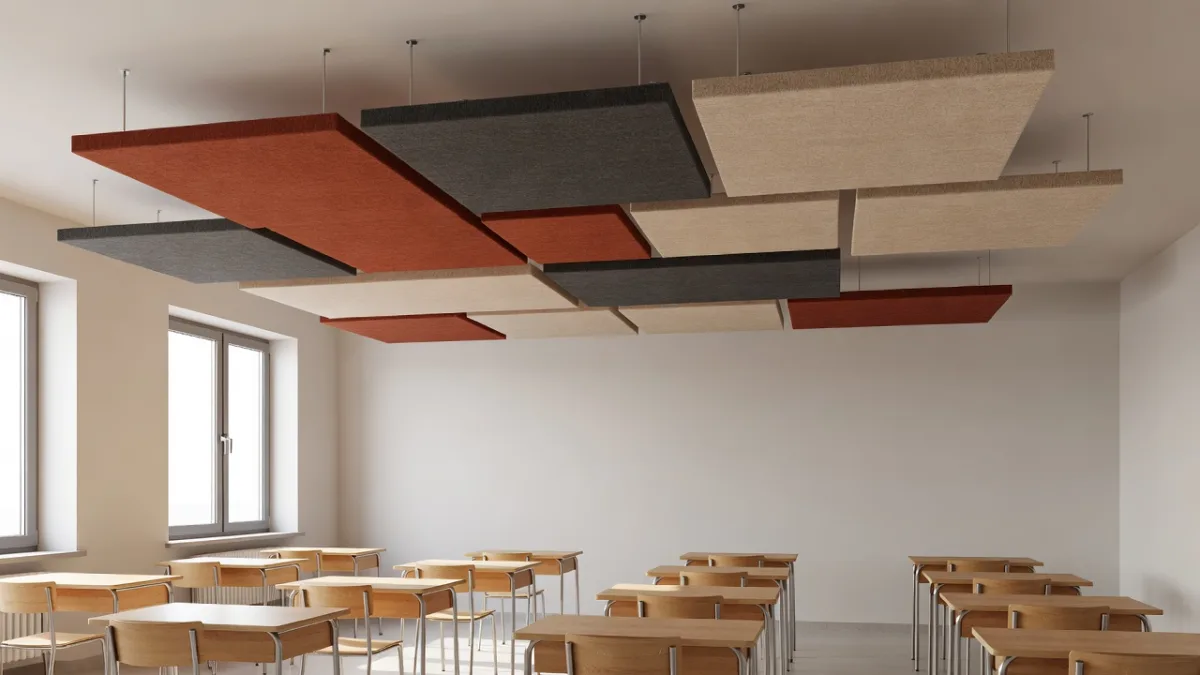
In a classroom, the ceiling is the most effective surface to treat, because it is completely clear and receives sound from the whole room. Walls come as a complement, especially the back wall and the upper side walls, above the displays.
Why this hierarchy? Because classroom walls are already taken: boards, teaching displays, windows, radiators. Rarely more than 30 % of wall surface is genuinely available. The ceiling, by contrast, offers 50 to 60 m² in one piece. Suspended baffles or cable-hung rafts work on both faces there, so for the same surface area they absorb more. At ACOUSTELIO, our school projects show that a mixed treatment, ceiling first then the back of the classroom, reaches the 0.4 to 0.8 s target in almost every case.
- Ceiling: baffles or rafts suspended on cables, double-sided absorption, no footprint on teaching walls
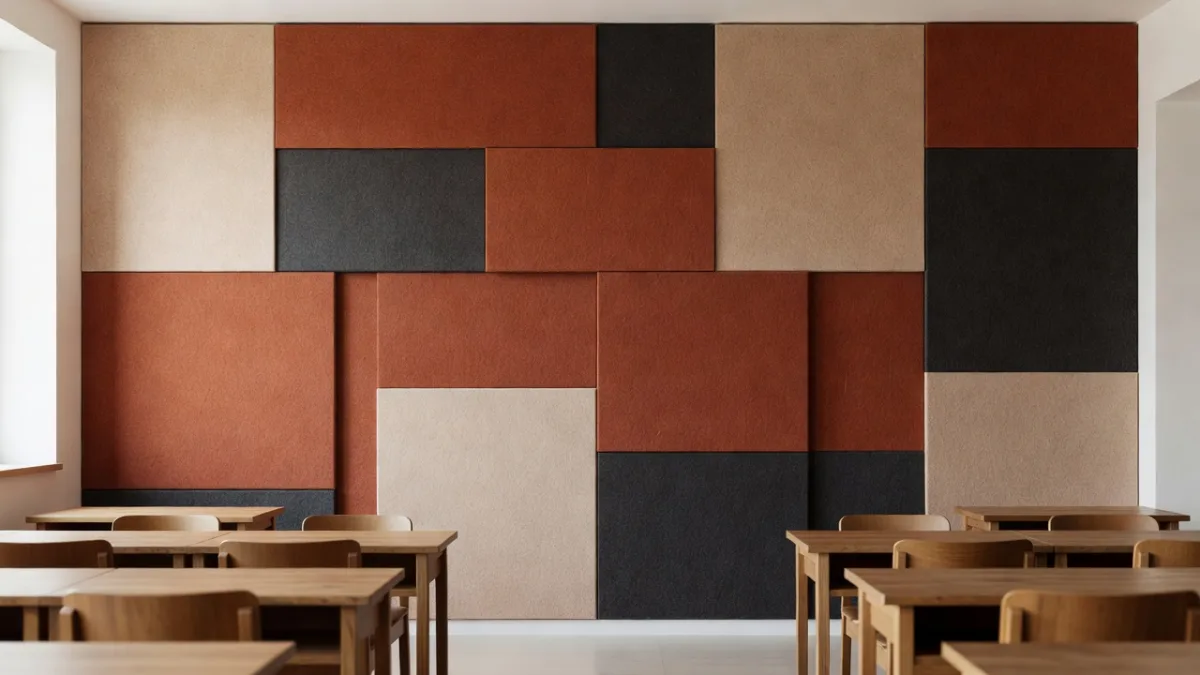
- Back wall: glued or clipped panels, they cut the direct echo sent back toward the teacher
- Sizing rule: treating 15 to 30 % of the wall and ceiling surface is usually enough to reach the target values
- Mounting height: above 1.80 m, panels stay out of reach of knocks and curious fingers
- Fast installation: adhesive, clips or suspension, a classroom is treated in half a day without closing the school
An honest word of warning: if your problem comes from corridor noise or the class next door, acoustic correction will not solve it. That is a sound insulation issue, so a matter of partitions and doors, not absorbent panels. The two are often confused, and it is better to know before you spend.
What budget should you plan per classroom?
Treating a standard classroom costs between 1,200 and 2,700 € in materials, based on 25 to 45 m² of panels. Our wall panels start at 49 €/m² and ceiling and baffle solutions at 59 €/m².
Take a typical classroom of 60 m² of floor area under a 2.70 m ceiling, roughly 160 m³. The 15 to 30 % treated-surface rule gives 25 to 45 m² of panels, to be split between the ceiling and the back of the classroom. In 2026, it is one of the best cost-to-impact projects in a school building: no demolition, no asbestos removal triggered, no repainting, and a result you can hear the day after installation. Compare it with refurbishing a floor or replacing the windows, and the maths is quickly done.
- Materials: 1,200 to 2,700 € per classroom depending on the treated surface and the wall/ceiling mix
- Installation: allow half a day for two staff, achievable in-house by the technical department thanks to adhesive, clip or cable fixing
- Canteen: budget 2 to 4 times that of a classroom, but it is the noisiest room in the school and the most rewarding to treat
- Lead times: custom quote within 48 h, proof approved before production, DDP delivery in 10 to 15 working days
- Result: 50 % less reverberation on average across our projects, with a conform-or-remake guarantee
One point of method: always price from the real dimensions of each room, not from a school-wide ratio. Two classrooms identical on plan can behave differently depending on their glazing and floor coverings.
How can local authorities finance acoustic treatment?
Financing the acoustic treatment of schools falls to the local authority that owns the buildings: in France, the municipality for nursery and primary schools, the department for middle schools, the region for high schools. This work fits within the maintenance and improvement budgets for school buildings.
For municipalities, two state grants regularly support this type of operation: the DETR, the rural infrastructure grant, and the DSIL, the local investment support grant. Improvements to the school environment are eligible, and a well-prepared acoustic file, with pre-work measurements and a quantified target, goes through all the more smoothly. What is more, the amount per classroom stays below the thresholds for formal tender procedures, which allows a direct order or a simple comparative quote.
- Municipality: responsible for primary education, it can mobilise DETR, DSIL and its capital budget
- Department and region: middle and high schools have multi-year renovation programmes where acoustics fit naturally
- Pooling: treating 4 or 5 classrooms in a single order cuts the unit cost and delivery charges
- A solid file: a Tr measurement before and after the work justifies the spend to elected officials and state services
- Phasing: start with the canteen and the worst classrooms, then spread the rest over 2 or 3 budget years
Our experience with local authorities shows that an acoustic project moves faster when it is carried jointly by the school leadership and the technical department. One documents the daily disturbance, the other carries the budget file: that partnership unlocks decisions that had been stalled for years.
Frequently asked questions about classroom acoustics
What reverberation time should you aim for in a classroom?
Aim for a reverberation time of between 0.4 and 0.8 seconds, the range required by the French decree of 25 April 2003 for teaching rooms of less than 250 m³. In practice, the bottom of the range is preferable: at around 0.4 to 0.5 s, speech stays clear all the way to the back of the classroom, including for pupils with hearing loss or learning in a second language. The value is measured with the room furnished and unoccupied, averaged over the 500, 1,000 and 2,000 Hz octave bands. An untreated classroom, with a hard floor and bare walls, commonly exceeds 1 second, more than double the target.
Does the decree of 25 April 2003 apply to older schools?
No, the decree is only legally binding on new buildings and on extensions whose building permit was filed after the end of 2003. A school built in the 1960s or 1970s therefore has no regulatory obligation of acoustic compliance. But this legal gap protects neither pupils nor teachers: it is precisely these buildings, with their hard surfaces and large glazed areas, that echo the most. The decree’s values remain the technical benchmark to aim for in any renovation, and they are the argument school leaderships use to support their request for work with the local authority.
What is the difference between acoustic correction and sound insulation in a school?
Acoustic correction reduces reverberation inside a room using absorbent materials, while sound insulation blocks noise transmission between two rooms. PET felt panels will make your classroom calmer and speech more intelligible, but they will not stop you hearing the class next door through a lightweight partition. Insulation is a matter of building structure: partition mass, door quality, treatment of ducts. Before investing, identify the source of the disturbance. If the problem comes from inside the room, correction is enough. If it comes from next door, you will need building work.
Are acoustic panels allowed in a school open to the public?
Yes, provided you use materials rated B-s1,d0 to EN 13501-1, the fire reaction level required for linings in public-access buildings. This rating guarantees a very low combustibility material, with low smoke production and no flaming droplets. The safety commission may ask for the test report of the product installed: keep it in the building’s safety register. ACOUSTELIO panels in PET felt are certified B-s1,d0 and delivered with their fire test report with every order, which secures both the commission’s visit and the inspection body’s checks.
How much does acoustic treatment cost for a classroom?
Count on between 1,200 and 2,700 € in materials for a standard 60 m² classroom, based on 25 to 45 m² of panels split between the ceiling and the walls. ACOUSTELIO wall panels start at 49 €/m² and ceiling solutions at 59 €/m². Installation, by adhesive, clips or cable suspension, takes half a day and remains within reach of municipal technical staff, which avoids an external labour cost. For a canteen, multiply the budget by 2 to 4 depending on the volume. A custom quote based on your dimensions is produced within 48 h.
Can the panels be installed during term time?
Yes, installing acoustic panels generates no significant dust or odour, and a classroom is treated in half a day. Many schools still take advantage of half-term breaks to work without timetable constraints, especially when several rooms are treated in a row. Fixing by adhesive or clips on the walls and cable suspension from the ceiling requires no heavy tooling. After the proof is approved, DDP delivery takes 10 to 15 working days, duties included: an order placed in early June is therefore installed before the new school year, which remains the schedule school leaderships prefer.
A classroom that echoes can be fixed in a few weeks, from taking the dimensions to installation. Send us your room measurements and photos: we will return a custom quote within 48 h, with the B-s1,d0 fire test report and sizing aligned with the values of the decree of 25 April 2003.