The decibel scale measures sound intensity from 0 dB, the threshold of hearing, to 140 dB, the threshold of immediate damage. It is logarithmic: adding 3 dB doubles the sound energy, adding 10 dB doubles the perceived loudness. Hearing risk starts at 80 dB(A) under prolonged exposure.
Noise is expensive, and not only for your ears: the 2021 ADEME-CNB study puts the social cost of noise in France at 147.1 billion euros a year, of which some twenty billion for the workplace alone.
ACOUSTELIO designs PET felt acoustic panels certified NRC 0,85 and rated B-s1,d0 under EN 13501-1, with a custom quote within 48 h to bring your professional spaces back below the comfort thresholds.
The decibel scale ranks every noise, from the recording studio to the jet engine, on a logarithmic graduation where each 10 dB step multiplies the sound energy by 10. In concrete terms, an open-plan office at 65 dB contains 100 times more acoustic energy than a quiet office at 45 dB. That is why a few extra decibels change everything.
At ACOUSTELIO, a manufacturer of made-to-measure acoustic panels in PET felt, we work with this scale every day to size treatments for restaurants, offices and hotels. This guide gives you the exact benchmarks: the logic of the decibel, the difference between dB and dB(A), a complete chart from 0 to 140 dB, the regulatory thresholds and the real gain an acoustic treatment delivers.
What is a decibel and how do you read a logarithmic scale?
The decibel expresses a ratio between a measured sound pressure and a reference pressure, that of the faintest sound audible to a young human ear. The scale is logarithmic because our ear is too: it handles pressures that vary by a factor of 1 to 10 million, and a linear graduation would be unreadable.
Three orders of magnitude are all you need to understand everything. Remember them, they come up in every acoustic discussion:
- +3 dB: the sound energy doubles. Two dishwashers at 55 dB each produce 58 dB, not 110
- +10 dB: the energy is multiplied by 10, but the ear perceives a sound twice as loud
- +20 dB: the energy is multiplied by 100, the sensation by about 4
- A gap of 10 dB or more between two sources: the louder noise completely masks the quieter one
This strange arithmetic has an enormous practical consequence. Halving the number of noise sources in a room only gains you 3 dB. Gaining 10 dB through absorbent treatment, on the other hand, cuts the perceived loudness in half. A handful of figures, and a great deal of comfort.
What is the difference between dB and dB(A)?
The dB(A) is a decibel weighted to match the sensitivity of the human ear, which hears extreme lows and highs poorly. All regulatory values, from labour law to concert standards, are therefore expressed in dB(A) rather than raw dB.
An example says more than a definition. A boiler room emits 85 dB, a large share of it in low frequencies around 50 Hz; the ear only perceives part of it, and the weighted sound meter may read 78 dB(A). Conversely, for conversation noise, the dB and dB(A) values stay close because the human voice occupies the mid frequencies, exactly where the ear is most sensitive.
- dB: the raw physical measurement of sound pressure, all frequencies combined
- dB(A): the measurement corrected by the A filter, representative of what the ear actually perceives
- dB(C): the weighting used for very loud impulsive noises, such as peaks in industrial environments
In the rest of this article, as in most professional documents, the sound scale values are given in dB(A) whenever perceived noise is at stake. When you read a measurement report or a machine datasheet, always check which weighting is used: a 7 dB gap between dB and dB(A) can change a conclusion.
Where do everyday noises sit on the decibel scale?
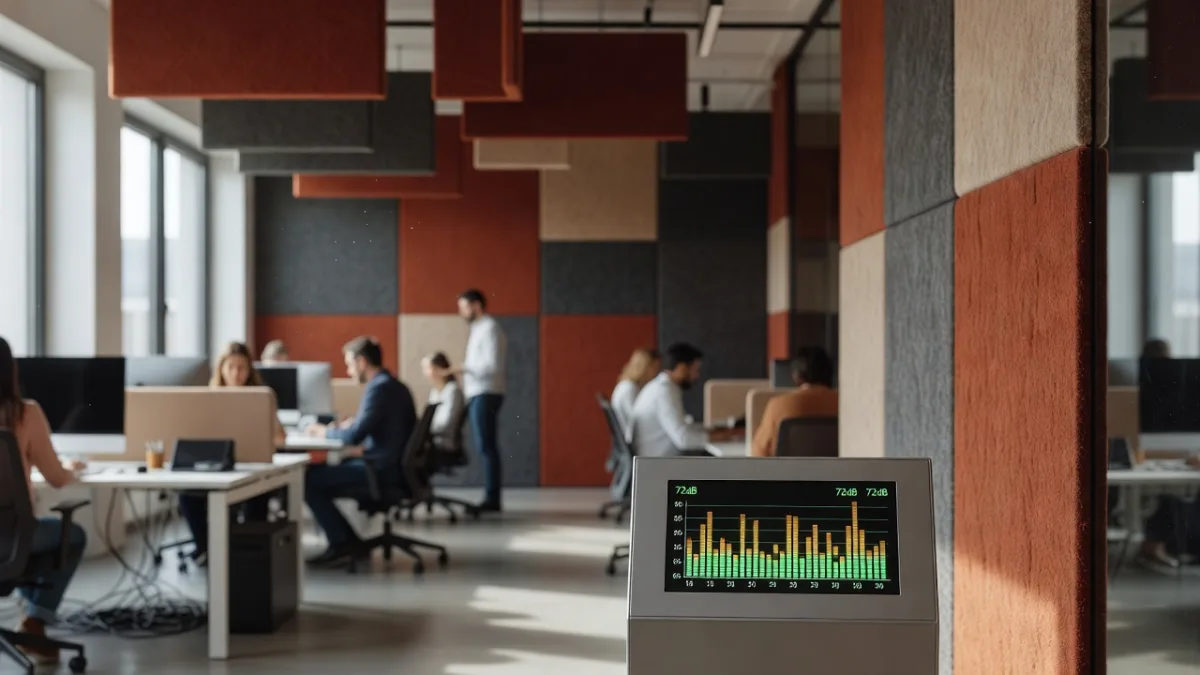
The decibel scale runs from 0 dB, an almost unattainable absolute silence, to 140 dB, where a single exposure can destroy hearing. Everyday life plays out between 30 and 90 dB, and the professional spaces we treat concentrate between 45 and 85 dB(A).
The chart below pairs domestic and professional examples for each step. It is the reference we use at ACOUSTELIO during the diagnostic phase, because a client understands “your room is at the level of a busy street” better than an abstract value.
| Level | Everyday example | Professional space example | Perception and risk |
|---|---|---|---|
| 0 dB | Threshold of hearing | Laboratory anechoic chamber | Absolute silence |
| 20 dB | Soft whisper | Recording studio | Very quiet |
| 30 dB | Quiet bedroom at night | Empty meeting room | Calm, conducive to sleep |
| 40 dB | Refrigerator, light rain | Library, hotel room | Comfortable for concentration |
| 45 dB | Quiet dishwasher | Calm private office | Target for knowledge work |
| 55 dB | Washing machine | Restaurant at a third of capacity | Lively yet comfortable atmosphere |
| 60-65 dB | Normal conversation at 1 m | Open-plan office in activity | Cognitive fatigue over the day |
| 70 dB | Vacuum cleaner, busy street | Restless classroom | Clear discomfort, raised voices |
| 75-85 dB | Heavy road traffic | Full restaurant, noisy canteen | Difficult conversation, Lombard effect |
| 80 dB | Alarm clock close to the ear | Light workshop | Risk threshold at 8 h exposure |
| 90 dB | Lawn mower | Industrial press | Dangerous without protection |
| 100 dB | Jackhammer at 10 m | Concert, nightclub | Damage possible within minutes |
| 110 dB | Car horn at 1 m | Concert near the speakers | Close to pain, frequent tinnitus |
| 120 dB | Alarm siren nearby | Engine test bench | Pain threshold |
| 130-140 dB | Aircraft taking off at 100 m | Airport runway, gunfire | Immediate and irreversible damage |
Two benchmarks in this chart deserve emphasis. First, a full restaurant reaches 75 to 85 dB(A), the level of heavy road traffic: your customers are dining on the edge of an acoustic motorway. Second, the gap between a quiet office at 45 dB and an open-plan office at 65 dB represents 100 times more sound energy. The raw figures look close, the perceived reality is nothing alike.
What are the risk thresholds and regulatory limits?
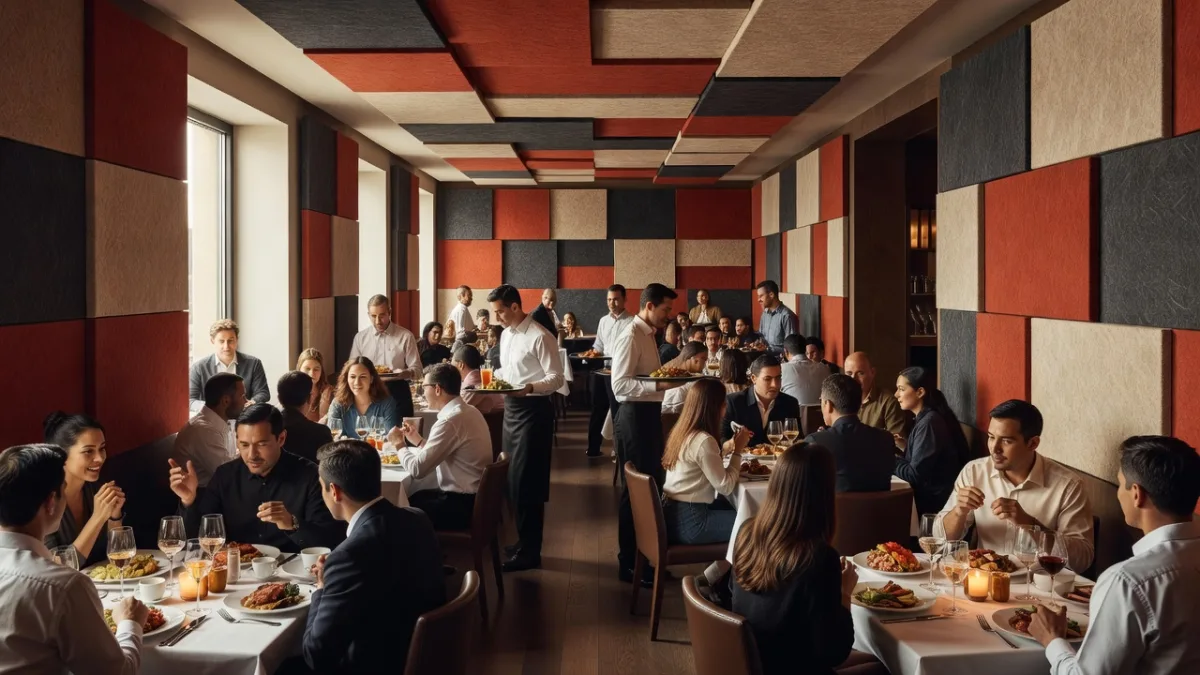
Hearing risk starts at 80 dB(A) for an 8-hour daily exposure, and every additional 3 dB halves the tolerable exposure time. At 86 dB(A), two hours are enough to reach the same noise dose as a full day at 80. Pain, for its part, arrives around 120 dB.
In France, the labour code sets three action levels every employer must know, detailed by the INRS in its occupational noise dossier:
- 80 dB(A) over 8 h: first action level, hearing protectors made available and staff informed
- 85 dB(A) over 8 h: hearing protection mandatory, zone signage and a noise reduction programme
- 87 dB(A) over 8 h: absolute limit value, hearing protection included, never to be exceeded
- 102 dB(A) over 15 min: the regulatory ceiling for venues playing amplified music since the 2017 decree
- 35 dB background noise: the WHO recommendation for classrooms and learning spaces
One point of caution, because we get the question often: a noisy restaurant or open-plan office rarely exceeds the legal thresholds of the labour code, which were designed for industry. But no infringement does not mean no problem. According to an Ifop survey for the French National Hearing Day, more than one working person in two reports being bothered by noise at work, with fatigue, stress and loss of concentration as a result. Comfort is decided well below the danger thresholds.
Where do your professional spaces sit on the sound scale?
A comfortable commercial space sits between 40 and 55 dB(A) of ambient noise, a degraded one between 65 and 85 dB(A). At ACOUSTELIO, our projects show that most untreated premises fall into the second category, however much care went into the decor.
The cause is almost always the same: hard surfaces (concrete, glass, painted plaster) that reflect sound instead of absorbing it. Noise bounces, accumulates, and everyone raises their voice to cover their neighbour. This is the Lombard effect, the spiral that turns a full room into a din: the level climbs by 3 dB, voices rise 3 dB to compensate, and so on.
- Private office: aim for 40 to 45 dB(A), the threshold beyond which cognitive load rises measurably
- Open-plan office: 60 to 65 dB(A) in real activity, a level that wears teams down over time, as we detail in our guide to open-plan office noise
- Restaurant in service: 75 to 85 dB(A) without treatment, enough to shorten meals and drive customers away, a scenario decoded in our article on solutions for a noisy restaurant
- Hotel and lobby: 50 to 60 dB(A) acceptable during the day, much less in the evening
The dB(A) level, however, only tells half the story. How long sound persists in the room, measured by the reverberation time, determines whether the same speech level stays intelligible or turns into cacophony. Two rooms at 65 dB(A) can deliver radically different experiences.
How many decibels do you gain with acoustic treatment?
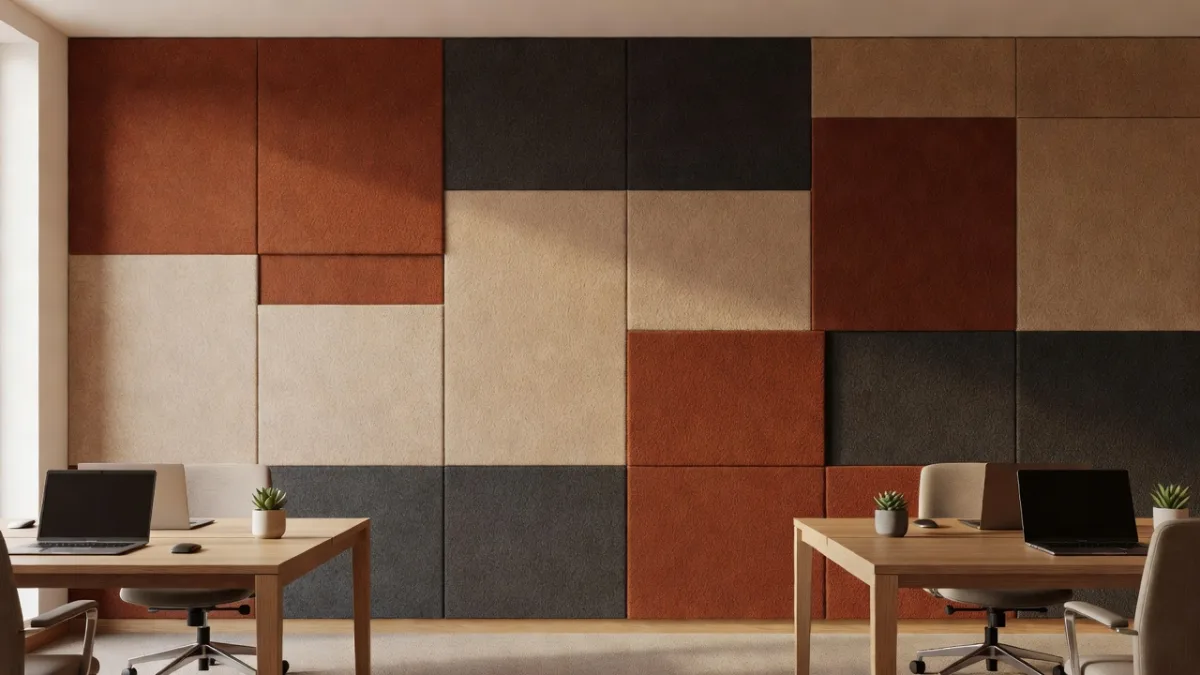
Treatment with absorbent panels reduces the ambient noise of a reverberant space by 3 to 6 dB(A) on average, and by up to 8 to 10 dB(A) in very hard rooms treated generously. Remember the logarithmic scale: 3 dB less already means half the sound energy removed; 10 dB less means the perceived loudness cut in half.
Let us be honest about the limits, because some vendors promise the impossible: absorption acts on the reverberant field, not on the direct noise at the source. A wall panel will never silence the person speaking one metre away from you. What it does is eliminate the build-up of reflections, break the Lombard effect and bring the overall level of the room back down. On our projects, ACOUSTELIO measures an average 50 % drop in reverberation after installation, which changes perception well beyond the measured decibels.
- -3 dB(A): the typical gain from partial treatment, sound energy halved, a noticeably calmer room
- -5 to -6 dB(A): properly sized wall plus ceiling treatment, conversations intelligible again table by table
- -8 to -10 dB(A): very reverberant cases treated in depth, perceived loudness cut in half
- Field rule: covering 15 to 30 % of the wall and ceiling surface is usually enough for a clear gain
With an NRC coefficient of 0,85, our PET felt panels absorb up to 85 % of the sound energy that hits them. For a restaurant, our team combines printed wall panels and suspended ceiling baffles: the full approach is detailed on our restaurant acoustics page. And because a treatment should be calculated rather than guessed, every project starts with a study of your room, not with a catalogue.
How do you measure the sound level of your premises?
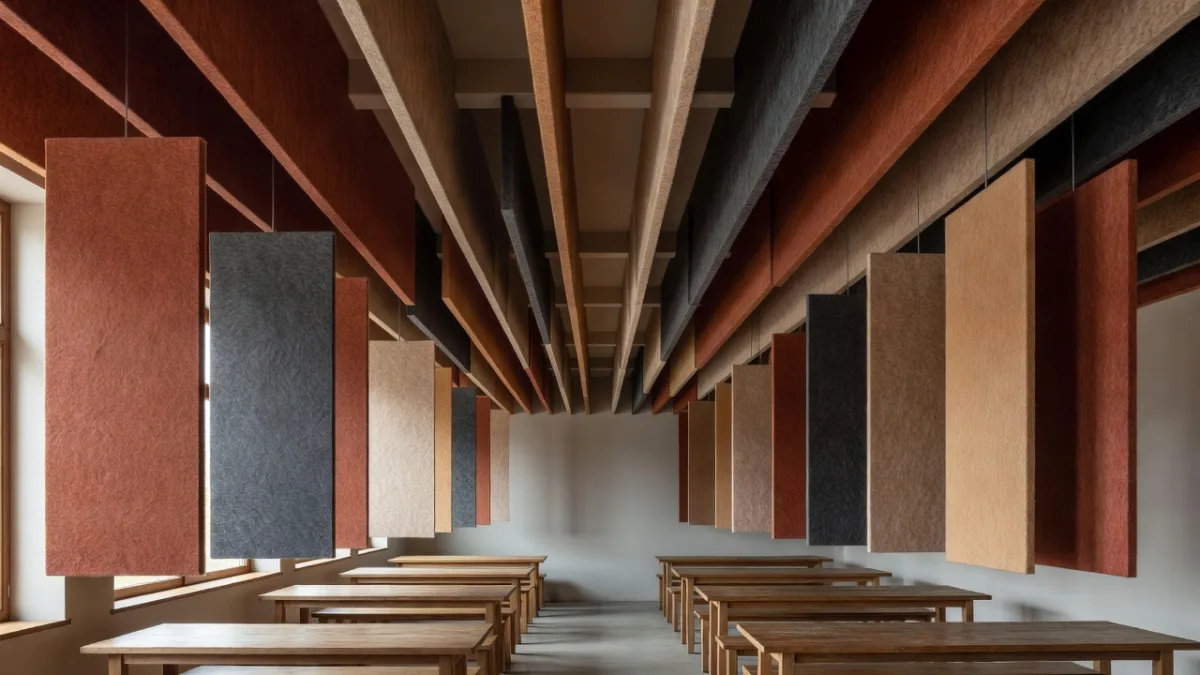
A smartphone sound meter app gives an estimate accurate to within 2 or 3 dB, largely sufficient for a first diagnosis. Purists will howl, but frankly: to find out whether your room runs at 60 or 80 dB(A), the free NIOSH SLM app or an equivalent does the job. A certified measurement with a class 1 sound meter only becomes necessary for a regulatory file.
A few simple rules make your measurement usable and comparable from one session to the next. We ask our clients for these readings before every study, and in 2026 half the quotes we produce are based on smartphone measurements taken by the client themselves:
- Timing: measure in real conditions, a restaurant is measured on a packed Friday evening, not a Tuesday at 3 pm
- Position: at ear height, at least 1 m from walls and direct noise sources
- Duration: record the average level (Leq) over 10 to 15 minutes, not an instantaneous value
- Weighting: set the app to dB(A), the value comparable to the thresholds in this article
- Context: note the occupancy rate and the equipment running, otherwise the value means nothing
Add a test that needs no tools at all: clap your hands in the centre of the empty room. If the clap lingers for more than a second, your premises are too reverberant and the sound level will climb mechanically as soon as they fill up. That test, plus the dB(A) measurement, plus the room dimensions: that is all we need to price a treatment.
Frequently asked questions about the decibel scale
How many decibels is a normal conversation?
A normal conversation sits between 55 and 65 dB at one metre’s distance. The level varies with context: a calm discussion in a quiet office runs around 55 dB, while an exchange in an already noisy environment quickly climbs to 65 or 70 dB because of the Lombard effect, the reflex that pushes people to raise their voice to cover the ambient noise. This is precisely why a full restaurant reaches 75 to 85 dB: dozens of simultaneous conversations add up and amplify one another. Bringing the background noise down a few decibels is often enough to break that spiral and relax the whole room.
Why do 3 extra decibels double the sound energy?
Because the decibel scale is logarithmic in base 10: every 10 dB added multiplies the acoustic energy by 10, so every 3 dB added multiplies it by roughly 2 (10 to the power of 0.3). The ear, however, does not keep pace: it takes 10 dB more for a sound to seem twice as loud. This double reading explains many misunderstandings. A 3 dB gain sounds modest to the ear even though it halves the sound energy, and therefore the noise dose received by your eardrums. In hearing risk prevention, those 3 dB matter enormously: they double the exposure time tolerable at the same level of safety.
At how many decibels does noise become dangerous?
Danger starts at 80 dB(A) for a prolonged exposure of 8 hours a day, according to the French labour code values relayed by the INRS. The higher the level, the shorter the tolerable duration: around 2 hours at 86 dB(A), a few minutes at 100 dB(A). The pain threshold sits around 120 dB, and immediate, irreversible damage occurs beyond 130 dB. Be careful though: harm depends on the total dose, that is, the combination of level and duration. An occasional concert at 100 dB damages hearing less than a whole year spent 8 hours a day in a workshop at 85 dB(A) without protection.
What is the difference between decibels and hertz?
The decibel measures the intensity of a sound, the hertz measures its frequency, in other words its pitch. A low sound at 100 Hz and a high sound at 5,000 Hz can show the same dB level while being perceived very differently, because the human ear is more sensitive to the mid frequencies, between 500 and 4,000 Hz, those of speech. It is this uneven sensitivity that the A weighting of the dB(A) corrects. Both quantities matter in acoustic correction: a high-performing absorbent panel must treat the frequencies of the human voice first, which is exactly what a dense PET felt does with its NRC of 0,85 measured across the full useful spectrum.
How many decibels does an acoustic panel cut?
A properly sized treatment with absorbent panels reduces ambient noise by 3 to 6 dB(A) on average, and by up to 10 dB(A) in very reverberant spaces. It sounds like little on paper, but 3 dB less means half the sound energy gone, and 10 dB less cuts the perceived loudness in half. The panel acts on the reverberant field: it removes the reflections that build up on hard surfaces, not the noise emitted directly at the source. At ACOUSTELIO, we measure an average 50 % drop in reverberation after installation, simply by covering 15 to 30 % of the wall and ceiling surface.
What sound level should you aim for in an office or a restaurant?
Aim for 40 to 45 dB(A) for an office dedicated to focused work, 55 to 60 dB(A) for an open-plan office in activity and 65 to 70 dB(A) maximum for a restaurant in full service. These targets remain ambitious: an untreated open-plan office runs closer to 65 dB(A) and a full restaurant often exceeds 80 dB(A). The gap is closed with absorbent treatment of the walls and ceiling, smart zoning of noisy activities and furniture that breaks up reflections. The exact level depends on your room, its geometry and its materials: that is the purpose of the study we run before every costing, with a custom quote within 48 h.
You now know the decibel scale, its thresholds and what a well-sized treatment can really gain for your spaces. What remains is finding out where your room sits and how many square metres of panels would bring it back to the right level: send us its dimensions and a few photos via our online quote request, and our team replies within 48 h with a costed recommendation and a proof approved before production.