Soundproofing a room covers two very different realities: blocking a noise that travels through the walls (sound insulation, heavy structural work) or removing the resonance inside the room (acoustic treatment, absorbent panels installed in half a day). Three questions are enough to make the right diagnosis, and that diagnosis makes the budget vary by a factor of 10.
The stakes go beyond simple comfort: according to the study by ADEME and the Conseil national du bruit published in 2021, the social cost of noise reaches 155.7 billion euros a year in France, a large share of it linked to poorly treated work and living spaces.
ACOUSTELIO manufactures made-to-measure acoustic panels in PET felt (NRC 0,85 absorption, B-s1,d0 fire rating required in public-access buildings) and answers with a custom quote within 48 h, backed by figures from real projects.
Before spending a single euro, make the diagnosis: do you want to block a noise coming in or going out, or silence a room that echoes? These are two different jobs, with techniques and budgets that have nothing in common. And in the field, roughly 8 enquiries out of 10 are actually about resonance, not transmission.
At ACOUSTELIO, manufacturer of made-to-measure acoustic panels in printed PET felt, we receive “soundproofing” enquiries every week that are nothing of the sort. That is why this guide starts with the diagnosis, moves on to the real solutions in both families, then compares the budgets. Honestly, with no detours, including when the right answer is not our product.
What does soundproofing a room really mean?
Soundproofing a room refers to two distinct interventions: stopping sound from passing through the walls, or stopping sound from bouncing off the interior surfaces. The first is called sound insulation, the second acoustic treatment, and they involve neither the same materials nor the same trades.
The confusion is expensive. Because the word “soundproofing” is ambiguous, homeowners glue foam to their walls hoping to stop hearing their neighbours, and restaurant owners consider lining work when their dining room simply needs absorption. The health stakes are real: the study by ADEME and the Conseil national du bruit puts the social cost of noise at 155.7 billion euros a year, and the WHO ranks noise as the second-largest environmental risk factor in Europe, just behind air pollution.
- Sound insulation: blocking the transmission of sound between two spaces, with mass, airtightness and decoupling. Structural work.
- Acoustic treatment: reducing reverberation inside a single space with absorbent materials. Light installation, no building work.
- Soundproofing: the everyday term that covers both, and which therefore needs clarifying before any purchase.
For the full theory and the measurement indices of each family, our dedicated article on acoustic treatment details the distinction. Here, we move on to action.
What is your problem: noise passing through or a room that echoes?
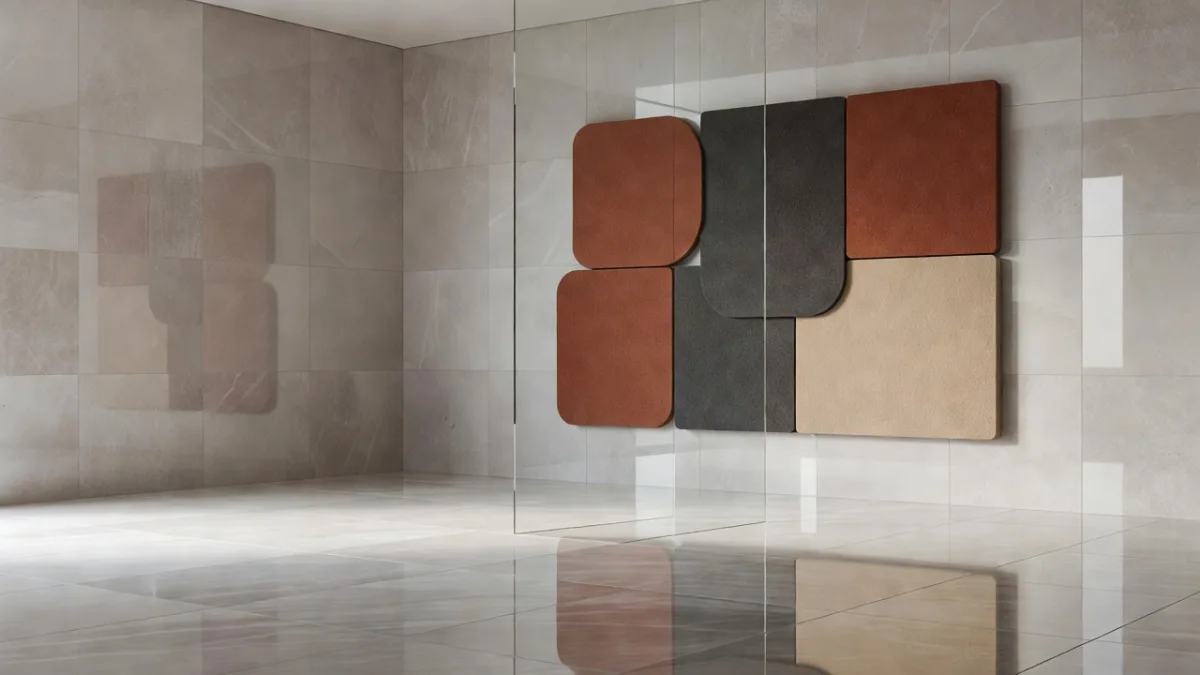
Three questions are enough to diagnose a noise problem in 90 % of cases. The right reflex is to identify the source of the noise before looking for a product, because each family of solution is ineffective outside its own territory.
- Question 1, where does the noise come from?: if it originates outside the room (street, neighbours, floor above), it is a transmission problem, so insulation. If it originates inside (voices, cutlery, machines), it is a resonance problem.
- Question 2, what does the clap test say?: clap your hands in the centre of the empty room. A clap that “lingers” for a second or more signals excessive reverberation, so a need for treatment.
- Question 3, is the noise a problem inside or outside?: if others can hear you (music, home studio), only insulation works. No absorbent panel will keep sound inside a room.
In practical terms, the table below cross-references the symptoms we hear most often with the probable cause, the appropriate solution and the indicative budget observed in 2026.
| Symptom | Probable cause | Appropriate solution | Indicative budget |
|---|---|---|---|
| You can hear the street, the neighbours, the TV next door | Lightweight walls, air leaks (door, shutter boxes, ducts) | Mass-spring-mass wall lining, acoustic doors and windows | 60 to 120 €/m² installed |
| Your music or conversations leak out of the room | Airborne transmission through the walls and the door | Solid door with seals, lining on party walls | 300 to 1,500 € per door, lining extra |
| Din, echo, tiring voices inside the room | Reverberation off hard surfaces (plaster, glazing, tiling) | NRC 0,85 absorbent panels on 15 to 30 % of the surfaces | From 49 €/m² of panels |
| Footsteps or object noise from the floor above | Structure-borne transmission through the building frame | Resilient underlay on the emitting side, decoupled ceiling | 80 to 150 €/m² on the ceiling |
How do you block a noise coming in or going out?
Blocking a noise requires working on the building’s structure according to three physical principles: mass, airtightness and decoupling. No product glued onto a surface replaces these three levers, and that is why genuine sound insulation is expensive.
Physics is stubborn. The mass law dictates that you need to roughly double the weight of a wall to gain 6 dB of attenuation. And airtightness is unforgiving: a few millimetres of gap under a door are enough to ruin a wall lining worth several thousand euros, because sound passes through the slightest air leak like water through a hole in a hull.
- Mass: wall lining with high-density plasterboard over mineral wool, count on 60 to 120 €/m² installed by a tradesperson.
- Airtightness: solid door with perimeter seals (300 to 1,500 €), windows with asymmetric laminated glazing (400 to 900 € each), treatment of shutter boxes and ducts.
- Decoupling: independent framing, anti-vibration hangers, even a “box within a box” for a studio, often beyond 400 €/m² all in.
Let us be transparent: ACOUSTELIO does not sell sound insulation, and we prefer to say so straight away. If your problem is noise passing through, the right first call is an acoustician or a specialist drywaller, not an absorbent panel. On the other hand, if your room echoes, the rest of this guide concerns you directly.
How do you treat a room that echoes too much?
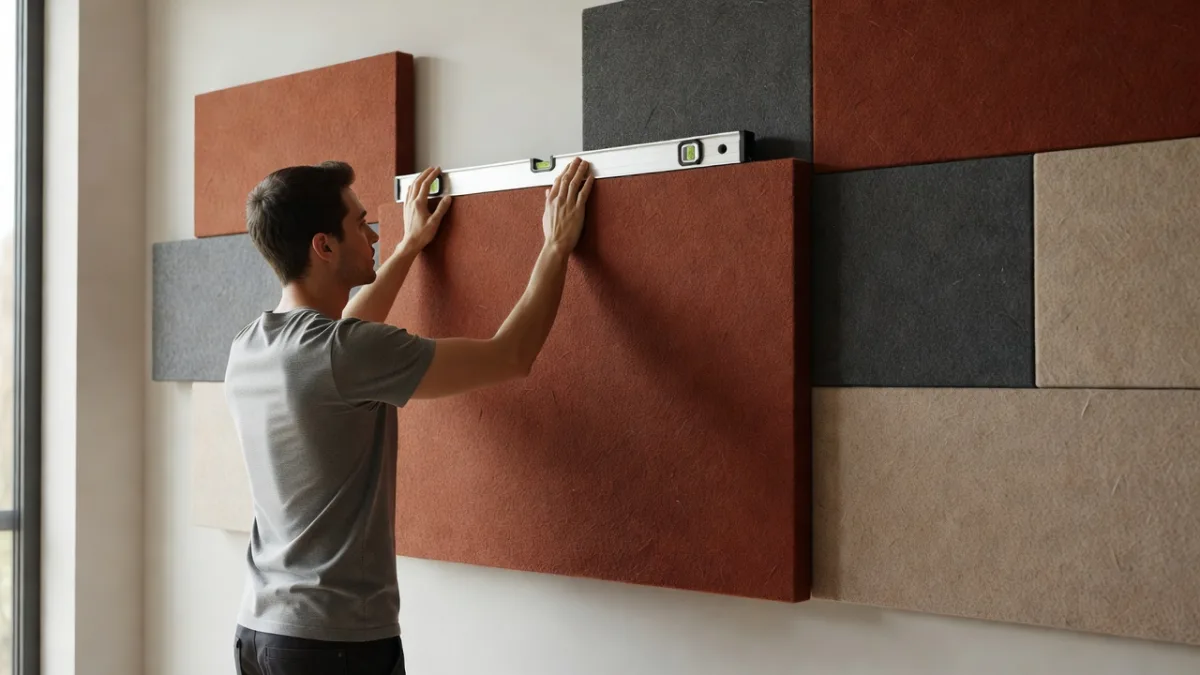
A room that echoes is treated with absorbent materials installed on 15 to 30 % of the wall or ceiling surface. Measured result on our sites: roughly 50 % less reverberation on average, for an installation that fits into half a day.
This is the majority scenario, by far. A noisy restaurant dining room, a tiring open space, a meeting room where video calls become painful: in all these cases, the noise originates inside and bounces off the plaster, the glazing and the tiling. At ACOUSTELIO, our projects show that bringing the reverberation time from 1.5 s down to around 0.7 s completely changes how the space is perceived, without touching the structure. The full mechanism is explained in our guide to reducing reverberation.
- Material: CE-certified PET felt with NRC 0,85 absorption, up to 85 % of incident noise absorbed, B-s1,d0 fire rating required in public-access buildings.
- Surface: the field rule of 15 to 30 % of the wall and ceiling surface is enough in most spaces, no need to line the whole room.
- Placement: facing walls and the ceiling above the noisy zones first, at ear height for wall panels.
- Installation: adhesive or clips on the wall, cables on the ceiling, no tradesperson or permit, with our conform-or-remake guarantee.
To size your project precisely, our calculation method is detailed in the article on how many acoustic panels to plan per room.
Which false solutions do not work?
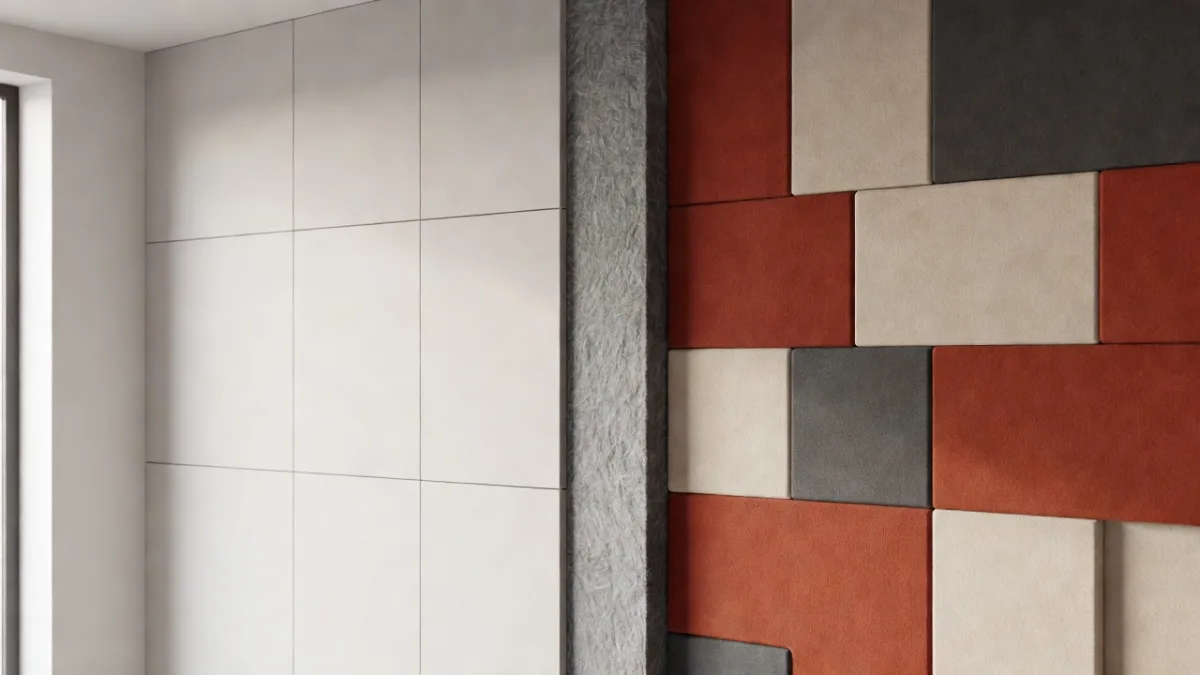
Egg cartons, thin foam and curtains alone will not soundproof a room, neither in the insulation sense nor, for the most part, in the treatment sense. These false fixes persist because they are cheap, but they combine measurable ineffectiveness with a fire risk.
Frankly, 3 cm pyramid foam glued to a bedroom wall: we still see it every month in the photos disappointed customers send us. It has never stopped a sound from crossing a partition. Here is the blacklist, with no sugar-coating.
- Egg cartons: near-zero mass, negligible absorption, flammable cardboard. It is a studio urban legend, not a solution.
- Cheap thin foam: 2 to 3 cm of polyurethane absorbs only part of the high frequencies and blocks nothing. Often with no fire rating, so effectively banned in public-access buildings.
- Curtains alone: a heavy curtain scrapes a few decibels off the high frequencies, nothing on the lows or on transmission. Useful as a top-up, never as the main treatment.
- “Anti-noise” paint or wallpaper: a few millimetres of thickness cannot contradict the mass law. The effect is marketing before it is acoustic.
- Insulated rug: it dampens footstep noise within the room, but treats neither the walls nor the ceiling, where most of the sound reflects.
The test is simple: always ask for a measured absorption coefficient (NRC or sabine alpha) and a fire test report. When the seller has neither, walk away.
What budget should you plan to soundproof a room?
The budget to soundproof a room ranges from a few hundred euros for acoustic treatment to more than 10,000 € for full sound insulation. The gap does not come from supplier margins but from the nature of the work: light installation on one side, structural building work on the other.
Take a room of 20 m² of floor area, in 2026. For treatment, the 15 to 30 % rule gives 8 to 15 m² of panels to install: from 49 €/m² for wall panels and 59 €/m² for ceiling panels and baffles, the project starts at around 500 to 900 € of materials, with installation done in-house in half a day. For insulation, lining the party walls, a solid door and an acoustic window quickly push the bill to between 5,000 and 15,000 €, excluding finishes. So, before signing anything, double-check your diagnosis: choosing the wrong family of solution means losing the entire spend.
- Acoustic treatment: 500 to 2,000 € for most rooms, a perceptible result from day one, roughly 50 % less reverberation observed on our projects.
- Light sound insulation: 1,500 to 5,000 € for a door, a window and one lined wall, real but partial gains.
- Full sound insulation: 5,000 to 15,000 € and above, the only valid choice for a home studio or a heavily exposed party wall.
At ACOUSTELIO, our projects show that a custom quote within 48 h, with a proof approved before production and DDP delivery in 10 to 15 working days, locks in a firm budget before any commitment. No nasty surprises at the end of the job, because there is no building job.
Frequently asked questions about soundproofing a room
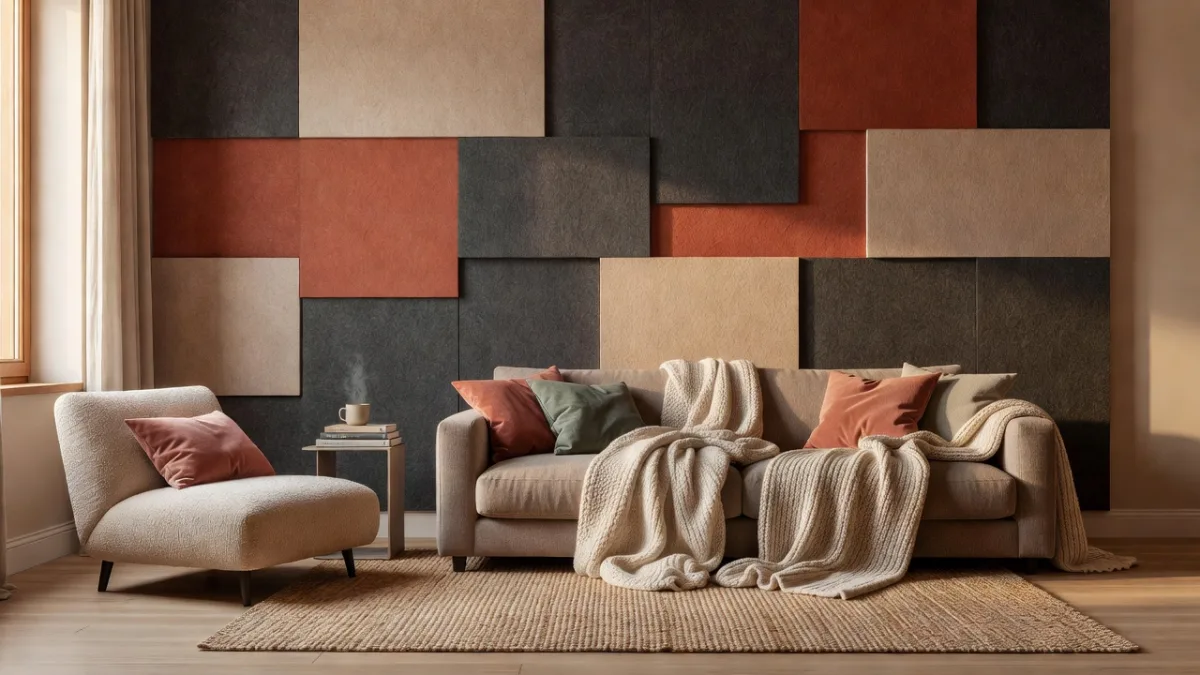
Can you soundproof a room without major work?
Yes, provided your problem is resonance and not noise transmission. A room that hums, where voices blur together and tire everyone out, is treated with absorbent panels fitted with adhesive, clips or cables, without touching the structure. Count on half a day of installation to cover 15 to 30 % of the surfaces and a reverberation reduced by roughly 50 % on average. On the other hand, if the noise comes from the neighbours, the street or the floor above, no lightweight solution will keep its promises: you will need mass, airtightness and decoupling, so building work. The three-question diagnosis in this guide saves you from paying for the wrong solution.
How much does it cost to soundproof a room in 2026?
Between 500 € and more than 15,000 € depending on the family of solution, and it really is the diagnosis that sets the price. For acoustic treatment, a 20 m² room is treated from 500 to 900 € of panels (49 €/m² on the wall, 59 €/m² for ceiling panels and baffles at ACOUSTELIO), with light installation handled on your side. For sound insulation, a wall lining costs 60 to 120 €/m² installed, an acoustic window 400 to 900 €, a solid door 300 to 1,500 €, and a complete project routinely exceeds 10,000 €. Ask for a quote itemised line by line: a lump sum with no detail often hides a vague service.
Do acoustic panels block the neighbours’ noise?
No, and any seller who claims otherwise is misleading you. An absorbent PET felt panel captures the sound energy bouncing around inside your room: it reduces echo, din and listening fatigue, measured by its NRC coefficient. But it weighs only a few kilograms per square metre, whereas blocking transmission requires mass and airtightness across the entire wall. The neighbours’ noise will therefore pass through the partition, panels or not. Our position is clear: for transmission, consult an acoustician or a drywaller. And for everything that echoes in your space, panels remain the most effective tool per square metre treated.
Are egg cartons or thin foam effective?
No, neither for blocking a noise nor for seriously treating a room’s acoustics. Egg cartons have neither mass nor controlled porosity: laboratory measurements credit them with negligible absorption, a long way from a certified material. Thin foam of 2 to 3 cm absorbs part of the high frequencies but lets the mids and lows pass and bounce, exactly where the energy of the human voice is concentrated. Add a genuine risk: unrated cardboard and polyurethane ignite easily, which makes them unusable in a public-access building where the B-s1,d0 rating is required. A certified NRC 0,85 PET felt does the job, with a fire test report supplied.
How many panels does it take to stop the resonance?
The rule observed in the field is to cover 15 to 30 % of the wall and ceiling surface, which is enough in the vast majority of rooms. For a room of 20 m² of floor area with a 2.5 m ceiling, that generally means 8 to 15 m² of panels, spread across the facing walls and above the noisiest zones. Highly reverberant spaces, with tiling, glazing and a high ceiling, sit at the top of the range. There is no point, however, in lining the entire room: beyond 30 %, each additional square metre delivers less and less. Our article on the number of acoustic panels details the calculation step by step according to your use.
What is the difference between soundproofing, sound insulation and acoustic treatment?
Soundproofing is the everyday word, sound insulation and acoustic treatment are the two techniques it covers. Sound insulation stops sound from crossing a wall between two spaces: it relies on mass, airtightness and decoupling, and involves structural work. Acoustic treatment reduces reverberation inside a single space using absorbent materials, fitted onto surfaces without building work. So when you say “I want to soundproof this room”, start by clarifying: noise passing through, or a room that echoes? The answer determines the technique, the professional to call and a budget that varies by a factor of 10.
Your room echoes, your restaurant drowns out conversations, your open space wears out your teams? Send us the dimensions and a few photos: we return a custom quote within 48 h, with a panel layout plan, a proof approved before production and delivery in 10 to 15 working days. And if your problem is a matter of sound insulation, we will tell you honestly from the very first exchange.