The sound absorption coefficient measures the share of sound energy a material absorbs instead of sending it back into the room. It ranges from 0 (total reflection, like raw concrete) to 1 (complete absorption). Depending on the calculation method, it is called Sabine alpha (αs), weighted alpha (αw) or NRC.
Noise costs dearly, and not only to the ears: ADEME and the Conseil national du bruit put its social cost at 147.1 billion euros a year in France (2021 study), a large share of it tied to workplaces that are too reverberant.
ACOUSTELIO manufactures acoustic panels in PET felt posting an NRC of 0,85 (up to 85 % of noise absorbed, measured in the laboratory), certified B-s1,d0 to EN 13501-1, with a custom quote within 48 h.
The sound absorption coefficient answers a simple question: when a sound wave hits a surface, what proportion of its energy disappears? A raw concrete wall absorbs barely 2 % of the sound it receives. A high-performing PET felt panel absorbs up to 85 % of it. Between the two, every material has its signature.
At ACOUSTELIO, a manufacturer of made-to-measure acoustic panels in PET felt, we handle these coefficients every day to size our clients’ projects. So it is worth explaining them without jargon: exact definition, standardised measurement method, the difference between αw and NRC, classes A to E and above all a full chart of the coefficients material by material. Everything the technical sheets never take the time to clarify.
What is the sound absorption coefficient?
The sound absorption coefficient, written alpha (α), expresses the ratio between the sound energy absorbed by a surface and the sound energy it receives. A value of 0,85 means that 85 % of the incident energy does not return to the room as echo or reverberation.
When a sound wave meets a wall, three things happen at the same time. Part of the energy is reflected back into the room, part is absorbed (converted into heat by friction in the material), and a last part passes through the wall. The α coefficient only concerns the first two. That is why it characterises the acoustic treatment of a space, never its soundproofing.
- α = 0: total reflection, no absorption. No real material reaches it, but tiling and smooth concrete come close
- α = 1: complete absorption, the equivalent of an open window through which sound escapes without return
- Frequency dependence: the same material absorbs low (125 Hz), mid (500 to 1,000 Hz) and high (2,000 to 4,000 Hz) frequencies differently
- Equivalent absorption area: the product α × surface, expressed in m², which is the basis for all reverberation calculations
The classic mistake, and you read it everywhere on the web: confusing absorption and soundproofing. An absorbent panel will never block the neighbour’s noise. It does, however, reduce reverberation inside the room, and that is precisely what makes a noisy restaurant liveable or an open space focused.
How is the sound absorption coefficient measured?
The sound absorption coefficient is measured in the laboratory to standard ISO 354, in a reverberation room of about 200 m³ with deliberately reflective walls. The tested sample covers between 10 and 12 m², placed in the real conditions of intended use.
The principle is elegant. You first measure the reverberation time of the empty room, that is the time the sound level takes to drop by 60 dB after the source stops. You then install the sample and start again. The difference between the two measurements, fed into the Sabine formula, gives the absorption coefficient by third-octave band, from 100 to 5,000 Hz. The full method is described in standard ISO 354 published by the International Organization for Standardization.
- Reverberation room: volume of at least 150 m³, suspended diffusers to homogenise the sound field
- Sample mounting: glued to the wall, laid on the floor or suspended with an air gap, because the result changes completely depending on the installation
- Frequency bands: 18 third-octaves measured, presented as a curve
- Test report: the famous acoustic report, the only document that counts against a marketing sheet
One point of vigilance we often repeat: always demand the test report. A mention of “excellent absorption” with no figure or identified laboratory is worth nothing. Accredited laboratories such as the CSTB in France produce verifiable reports, and a serious manufacturer supplies them without argument.
Sabine alpha, alpha w, NRC: what are the differences?
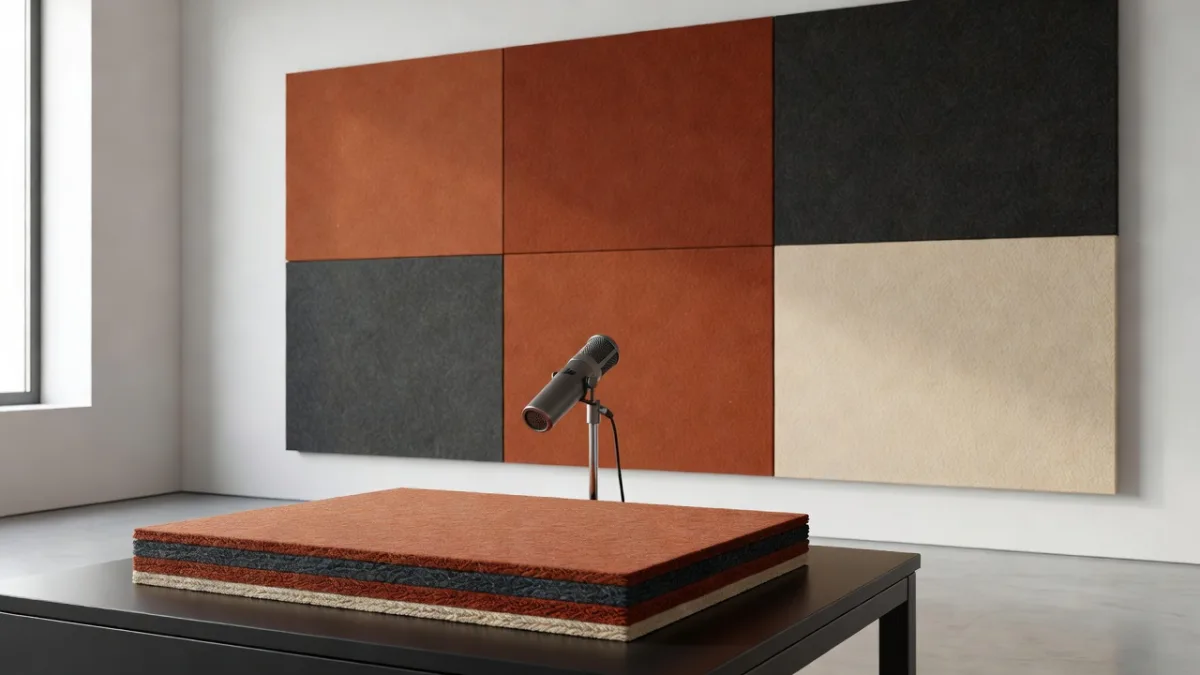
The Sabine alpha (αs) gives the raw value measured per frequency band, as a curve. The weighted alpha (αw) and the NRC compress this curve into a single figure to compare products quickly against each other.
The NRC (Noise Reduction Coefficient), of American origin, is the arithmetic average of the coefficients measured at 250, 500, 1,000 and 2,000 Hz, rounded to the nearest 0.05. Simple, readable, but blind to the extreme lows and highs. The αw, defined by standard ISO 11654 and more common in Europe, fits a reference curve onto the measured values from 200 to 5,000 Hz. It is therefore more demanding, and often slightly lower than the NRC for the same product. The shape indicators L, M or H sometimes accompany the αw to flag an excess of absorption in the lows, mids or highs.
- αs (Sabine): the raw data, frequency by frequency, the only one that shows the material’s real behaviour
- NRC: an average over 4 frequencies, the North American standard, handy for a quick comparison
- αw: the weighted European index over the whole useful spectrum, the basis for classes A to E
- Practical rule: two products with the same αw can have very different curves, so always look at the full curve
Our take as a manufacturer: a single index remains a summary, not a truth. We detail how to read these indices together on our page dedicated to the NRC absorption coefficient of our panels, with laboratory reports to back it up.
What do the acoustic absorption classes A to E mean?
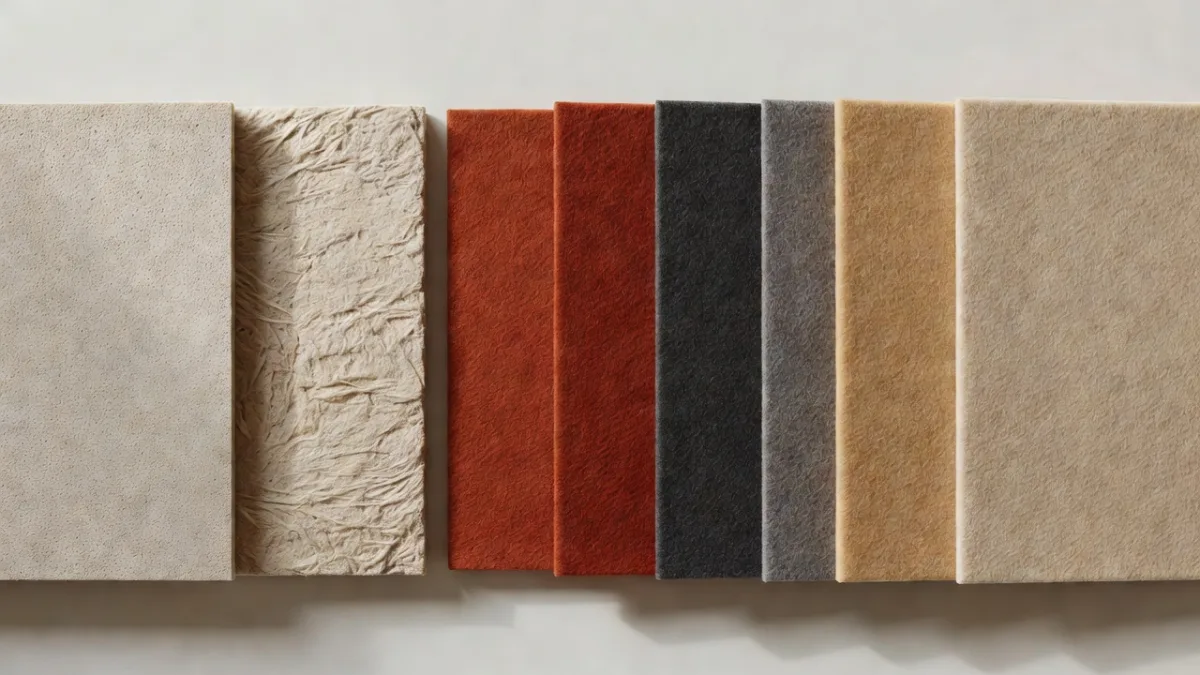
Standard ISO 11654 ranks absorbent materials from A to E according to their αw coefficient. Class A gathers the highest-performing absorbers, with an αw of 0.90 or more, while class E tops out at 0.25.
This classification has one merit: it speaks to specifiers. A brief for a school or a meeting room often requires “class A or B absorber” without detailing the frequencies. In concrete terms, here is the reading grid.
| Class | αw coefficient | Absorption level | Typical examples |
|---|---|---|---|
| Class A | 0.90 to 1.00 | Highly absorbent | 50 mm rock wool, suspended baffles |
| Class B | 0.80 to 0.85 | Highly absorbent | PET felt panel with air gap, thick melamine foam |
| Class C | 0.60 to 0.75 | Absorbent | Standard suspended-ceiling tiles, 12 mm glued PET felt |
| Class D | 0.30 to 0.55 | Moderately absorbent | Thick carpet, heavy pleated curtains |
| Class E | 0.15 to 0.25 | Weakly absorbent | Wood on battens, thin carpet |
| Unclassified | 0.00 to 0.10 | Reflective | Concrete, glass, tiling, painted plaster |
Remember one thing: below class C, a material is not enough to correct a truly reverberant room. Curtains and carpet help, but they do not replace real acoustic treatment.
What is the sound absorption coefficient of the main materials?
Raw concrete absorbs about 2 % of the sound energy while 50 mm rock wool absorbs more than 90 % in the mids and highs. The table below compiles the measured absorption coefficients of common building materials, by frequency.
These values are orders of magnitude drawn from the acoustic literature and laboratory reports. They vary with thickness, density and installation method: the same PET felt easily gains 0.2 to 0.3 point of αw when suspended with an air gap instead of being glued. The recycled PET felt we use at ACOUSTELIO plays in the same league as mineral wools on the frequencies of the human voice, without irritating fibres or a visible technical frame.
| Material | 125 Hz | 500 Hz | 1 000 Hz | 2 000 Hz | Indicative αw |
|---|---|---|---|---|---|
| Raw smooth concrete | 0.01 | 0.02 | 0.02 | 0.02 | 0.05 |
| Single glass (glazing) | 0.30 | 0.10 | 0.07 | 0.05 | 0.10 |
| Painted plasterboard | 0.29 | 0.05 | 0.04 | 0.07 | 0.10 |
| Wood parquet on joists | 0.20 | 0.10 | 0.07 | 0.06 | 0.15 |
| Thick carpet on underlay | 0.05 | 0.25 | 0.40 | 0.55 | 0.30 |
| Heavy pleated curtains | 0.15 | 0.55 | 0.70 | 0.65 | 0.50 |
| 12 mm PET felt glued to the wall | 0.05 | 0.30 | 0.75 | 0.90 | 0.55 |
| PET felt suspended with air gap | 0.20 | 0.75 | 0.95 | 0.90 | 0.85 |
| 50 mm melamine foam | 0.10 | 0.65 | 0.90 | 0.95 | 0.80 |
| 50 mm rock wool | 0.20 | 0.90 | 0.95 | 0.90 | 0.90 |
| 100 mm glass wool | 0.45 | 0.95 | 1.00 | 1.00 | 1.00 |
Reading the table vertically tells a clear story: hard, smooth materials do almost nothing, textiles do half the work, and only porous materials that are thick or installed with an air gap reach classes A and B. No common material absorbs the low frequencies well at a small thickness, that is a physical limit, not a manufacturing flaw.
How do you use these coefficients to correct a noisy room?
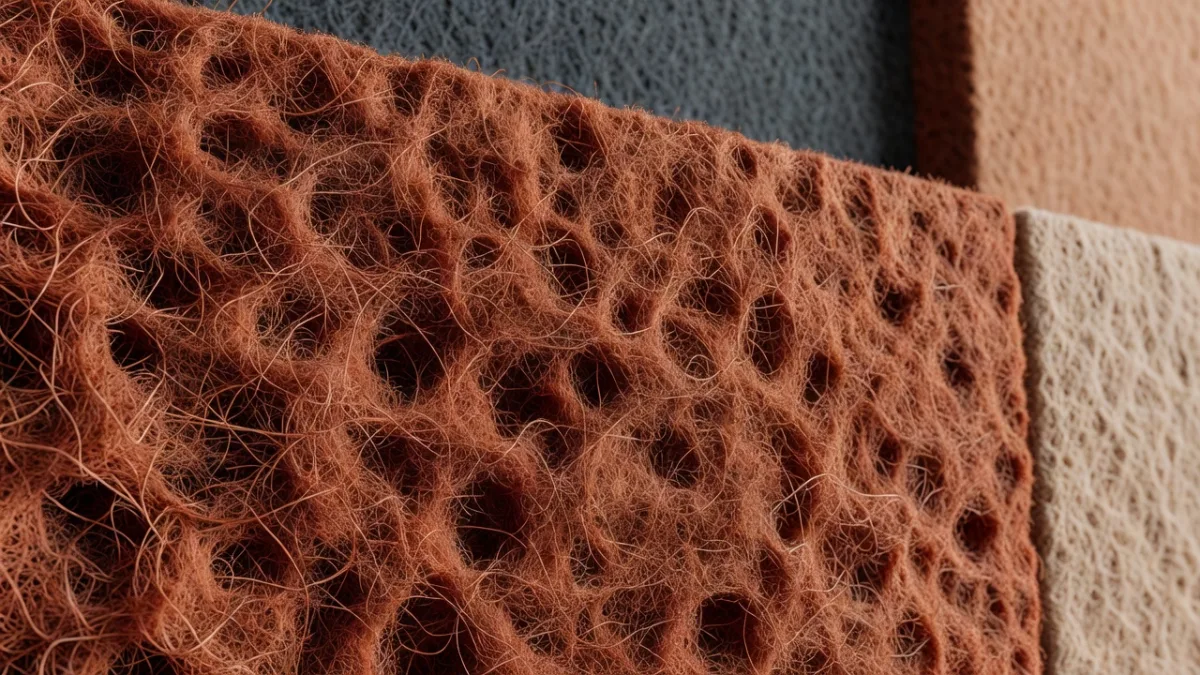
To correct a room, you multiply the surface of each material by its absorption coefficient, then add it all up: you get the equivalent absorption area A, in m². The Sabine formula (T = 0.16 × V / A) derives the room’s reverberation time from it.
Take a 100 m² restaurant floor under a 3 m ceiling, all concrete, glass and tiling. Volume: 300 m³. Absorption area: barely 8 m². The result, a reverberation time around 2 seconds, unliveable from 30 covers onward. Add 25 m² of wall panels and baffles at αw 0.85: the absorption area climbs to 29 m² and reverberation falls below 0.9 second. The din deflates, because every m² of panel works at 85 % where the bare wall worked at 2 %.
- Field rule: treating 15 to 30 % of the wall and ceiling surface is enough in most cases
- Walls: our printed wall panels install with adhesive or clips, at ear height for preference
- Ceiling: ceiling baffles and rafts benefit from the air gap, so they absorb on both faces
- Distribution: better to spread the absorbers across several walls than to concentrate everything on a single wall
At ACOUSTELIO, our projects show an average 50 % reduction in reverberation with this 15 to 30 % rule. And in 2026, the French reference for offices remains standard NF S31-080, which targets less than 0.5 second of reverberation in a high-performance open space.
What are the limits of the sound absorption coefficient?
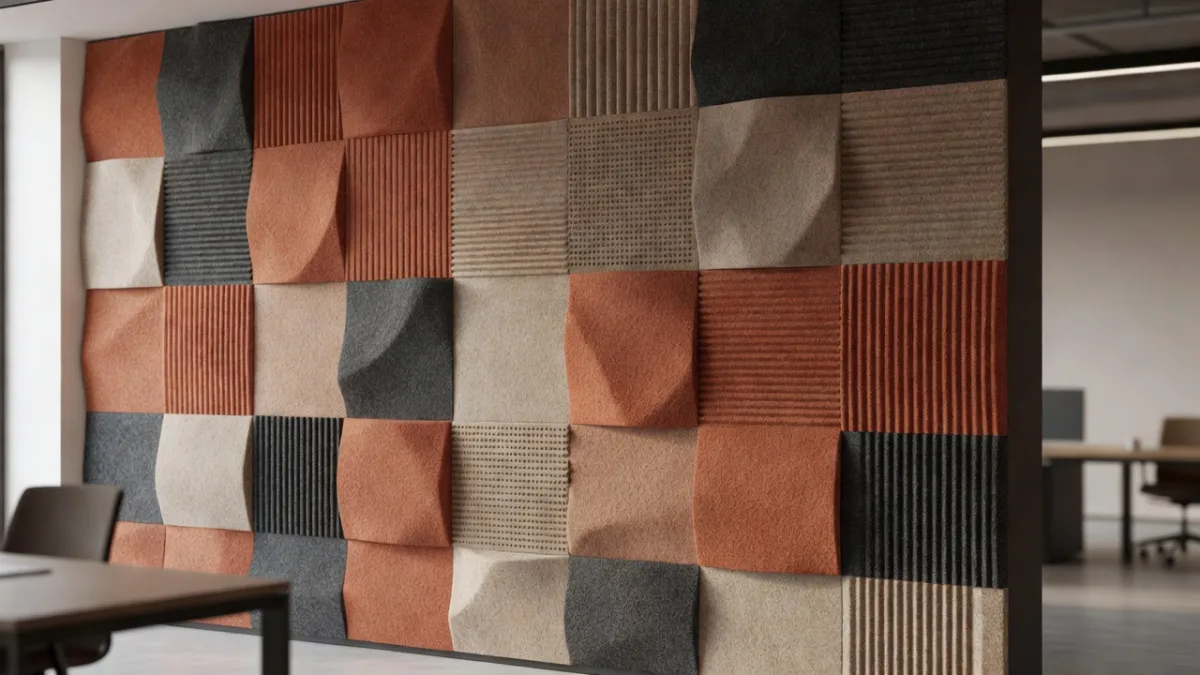
The sound absorption coefficient remains a laboratory measurement, obtained under standardised conditions that never exactly reproduce your space. Three precautions are needed before comparing technical sheets.
First, the installation method changes everything. The same panel can move from class C glued to the wall to class A suspended from the ceiling, and some manufacturers display the most flattering value without stating the mounting. Next, values above 1 exist on the reports: it is not magic, but an edge effect of the sample (the diffraction on the edges artificially increases the absorbing surface). In practice, it is capped at 1.00. Finally, neither the NRC nor the αw describes the low frequencies. A meeting room with a problem of deep male voices can stay tiring despite “class A” panels chosen on the single overall index alone.
- Installation conditions: demand the value matching your real mounting, wall or suspended
- Values > 1: a standardised measurement artefact, to be read as “near-total absorption”
- Low frequencies: poorly covered by single indices, check the curve below 250 Hz if your problem is deep, in the literal sense
- Ageing: paint, dust or fouling reduce porosity, and so absorption, over the years
At ACOUSTELIO, our projects show that the real question is almost never “what is the best coefficient?” but “what surface, in what place, for what use?”. Good sizing with a material at 0,85 always beats a few scattered panels at 1.00.
Frequently asked questions about the sound absorption coefficient
What is the difference between sound absorption and soundproofing?
Sound absorption reduces reverberation inside a room, whereas soundproofing blocks the transmission of sound between two spaces. An absorbent PET felt panel makes your restaurant less noisy for your customers, but it will not stop noise from passing to the neighbour: that is the job of heavy masses, linings and mass-spring-mass systems. The two notions use different indices, α and classes A to E for absorption, the Rw index in decibels for soundproofing. Much disappointment comes from this confusion, kept alive by certain foam sellers. At ACOUSTELIO, we do acoustic treatment, and we say so clearly.
Why do some absorption coefficients exceed 1?
A coefficient above 1 comes from an edge effect during the ISO 354 measurement, not from absorbing more than 100 % of the energy, which would be physically impossible. The 10 to 12 m² sample placed in the reverberation room also absorbs through its edges, and the diffraction of the waves on its borders increases the effective capture surface. The calculation then relates the absorbed energy to the frontal surface alone, hence values of 1.05 or 1.10 on some laboratory reports. Convention has us round them to 1.00 in project calculations. If a technical sheet displays 1.15 as a sales argument, be careful: it is an artefact, not a feat.
What absorption coefficient should you aim for in a restaurant or open space?
For a restaurant or an open space, aim for class A or B materials, so an αw of at least 0.80, on 15 to 30 % of the wall and ceiling surface. An average material would force you to cover almost every wall for the same result, which costs more and constrains the decor. In a restaurant, priority goes to the ceiling (baffles or rafts) and the walls near the tables. In an open space, standard NF S31-080 recommends a reverberation time below 0.5 second, which requires a widely treated ceiling and absorbent screens between workstations. On our projects, this approach reduces reverberation by 50 % on average.
What does a panel’s NRC of 0,85 actually mean?
An NRC of 0,85 means the panel absorbs on average 85 % of the sound energy it receives across the frequencies 250, 500, 1,000 and 2,000 Hz, those of the human voice. In other words, only 15 % of the sound hitting the panel goes back into the room. It is the value measured in the laboratory for ACOUSTELIO panels, and it places PET felt on a par with classic professional absorbers. Be careful all the same: the NRC says nothing about the bass below 250 Hz or the highs beyond 2,000 Hz. For an office or hospitality use, this spectrum covers the bulk of the problem, because the din of conversations sits exactly on these frequencies.
What surface of acoustic panels should you install in a room?
The rule observed in the field: treating 15 to 30 % of the combined surface of the walls and ceiling is enough in the vast majority of cases. For a 50 m² floor with a 2.70 m height, that represents around 20 to 40 m² of panels depending on the severity of the problem and the materials in place. The precise calculation goes through the Sabine formula: volume of the room, inventory of the existing surfaces with their coefficients, then adding panels until the target reverberation time is reached. That is exactly the sizing we carry out free of charge with every ACOUSTELIO quote, delivered within 48 h with the recommended surface and the advised layout.
Does PET felt absorb as well as rock wool?
On the frequencies of speech, yes: a well-sized PET felt panel reaches an NRC of 0,85, against about 0.90 for a 50 mm rock wool laid bare. Mineral wool keeps a slight edge in the bass at equal thickness, thanks to its fibrous density. But the raw comparison forgets the real use: rock wool requires a frame, a protective veil and a finish, whereas PET felt is both the absorber and the finish, printable in high definition, with no airborne fibres, light and rated B-s1,d0 for fire. For public-access premises, this combination of performance, aesthetics and compliance explains why PET has taken over in recent years.
You now know the full mechanics of the sound absorption coefficient: what it measures, how to read it and which surfaces to treat. What remains is moving from the chart to your room. Send us your space’s dimensions and a few photos: we calculate the surface to treat and you receive a custom quote within 48 h, proof approved before production and DDP delivery in 10 to 15 working days.